
Learning Hub
Glossary
18/8 Stainless Steel
18/8 stainless steel is a common industry term that describes the chemical composition of austenitic stainless steel rather than a specific standardized grade. The designation refers to a composition containing approximately 18% chromium and 8% nickel, which provide good corrosion resistance.
Although 18/8 is not a formal grade defined by ASTM material specifications, it is widely understood and treated across the fastener industry as a grade designation. In practice, fasteners sold as 18/8 stainless steel are most often manufactured from Grade 304 stainless steel or a closely related alloy that falls within the same composition range.
304 Stainless Steel
Grade 304 stainless steel is an austenitic stainless steel and the most commonly used stainless steel alloy. It is specified under ASTM material specifications and contains approximately 18% chromium and 8% nickel, which provide good corrosion resistance and strength.
304 stainless steel performs well in indoor and many outdoor environments with exposure to moisture and mild chemicals but does not contain molybdenum, making it less resistant to chlorides and saltwater than Grade 316 stainless steel.
In fastener applications, 304 stainless steel is widely used for general-purpose assemblies where moderate corrosion resistance is required.
316 Stainless Steel
Grade 316 stainless steel is an austenitic stainless steel specified under ASTM material specifications and known for its superior corrosion resistance compared to Grade 304 stainless steel. Like other austenitic steels, it contains chromium and nickel, but it also includes approximately 2–3% molybdenum, which significantly improves resistance to pitting, crevice corrosion, and chloride exposure.
The typical composition of 316 stainless steel includes about 16–18% chromium, 10–14% nickel, and 2–3% molybdenum. This alloy is often referred to as “marine grade stainless steel” due to its durability in saltwater, chemical, and harsh outdoor environments.
In fastener applications, 316 stainless steel is commonly used in marine, coastal, chemical, and outdoor structural settings where maximum corrosion resistance is required.
A2 Stainless Steel
Class A2 stainless steel is a metric fastener designation defined under ISO standards and commonly associated with austenitic stainless steel similar to Grade 304. It contains chromium and nickel and offers good corrosion resistance in many indoor and outdoor environments.
Class A2 stainless steel fasteners perform well in applications exposed to moisture and mild chemicals but do not contain molybdenum, making them less resistant to chlorides and saltwater than Class A4 stainless steel. They are widely used for general-purpose fastener applications where moderate corrosion resistance is required.
A4 Stainless Steel
Class A4 stainless steel is a metric fastener designation defined under ISO material specifications and is typically associated with austenitic stainless steel similar to Grade 316. In addition to chromium and nickel, it contains molybdenum, which provides enhanced resistance to corrosion, particularly in chloride-rich environments.
A4 stainless steel fasteners are often referred to as marine-grade fasteners due to their durability in saltwater, chemical, and harsh outdoor environments. In fastener applications, A4 stainless steel is commonly used in marine, coastal, chemical, and outdoor structural settings where high corrosion resistance is required.
Alloy Steel
Alloy steel is a type of steel that has been intentionally mixed with one or more alloying elements—such as chromium, nickel, molybdenum, vanadium, manganese, or tungsten—to improve its mechanical and physical properties beyond those of plain carbon steel. These added elements enhance characteristics like strength, hardness, toughness, wear resistance, and corrosion resistance, depending on the specific combination and percentage used.
At its core, all steel is primarily iron (Fe) with a small amount of carbon (C)—usually less than 2%. In carbon steel, carbon is the main hardening element, but in alloy steels, other elements are added (typically between 1% and 5%, though sometimes higher) to achieve specialized performance.
Different alloying elements serve specific purposes:
- Chromium (Cr): Improves hardness, corrosion resistance, and wear resistance.
- Nickel (Ni): Increases toughness and impact resistance.
- Molybdenum (Mo): Enhances strength at high temperatures and resists softening.
- Vanadium (V): Refines grain structure and increases toughness and fatigue strength.
- Manganese (Mn): Boosts strength and hardness while aiding deoxidation.
- Tungsten (W): Increases hot hardness and high-temperature strength.
Alloy steels are broadly classified into two groups:
- Low-alloy steels, with total alloying content below about 5%, used for general engineering and structural applications.
- High-alloy steels, with more than 5% total alloying elements, designed for highly specialized uses such as tool steels, heat-resistant steels, and stainless steels.
Common uses of alloy steels include gears, axles, crankshafts, fasteners, tools, high-strength structural components, and pressure vessels. Their ability to combine strength, toughness, and resistance to fatigue and corrosion makes them essential in automotive, aerospace, oil and gas, and heavy machinery industries.
American Iron and Steel Institute (AISI)
The American Iron and Steel Institute (AISI) is a trade association that represents the North American steel industry. Established in 1908, it was created to promote the interests of steel producers, support research and development, and provide a unified voice on issues that affect the industry.
One of AISI’s key roles is industry representation, where it advocates on behalf of steelmakers in critical areas such as trade policy, environmental regulation, energy policy, infrastructure, and workforce development. It also plays a major part in standards development, having historically created and published technical standards and specifications for steel products, including structural steel design guides that are widely used by engineers and architects.
In addition, AISI invests heavily in research and innovation, funding and coordinating work in areas such as new steel grades, sustainability, recycling, advanced manufacturing, and energy efficiency. Beyond this, the organization is engaged in public outreach, promoting the benefits of steel—including its strength, recyclability, and sustainability—to governments, industries, and the public at large.
In fastener, materials, and industrial supply chains, “AISI” is also commonly used as shorthand for the AISI steel designation/numbering convention, especially for stainless steels (for example, AISI 304 and AISI 316). Those AISI numbers are widely used in catalogs and specs to communicate a stainless family/composition, even though standards and product requirements are often ultimately controlled by specifications like ASTM/ASME/SAE/ISO depending on the application.

Austenitic Stainless Steel
Austenitic stainless steel is a category of stainless steel characterized by its face-centered cubic (FCC) crystal structure, known as the austenitic phase. This structure is stable at both high and low temperatures and gives the alloy its defining properties—excellent corrosion resistance, high ductility, good weldability, and nonmagnetic behavior (in most conditions). Austenitic stainless steels are the most widely used type of stainless steel, accounting for roughly two-thirds of all stainless steel production.
The primary alloying elements in austenitic stainless steel are chromium (Cr) and nickel (Ni), though manganese (Mn) and nitrogen (N) can also be added to enhance strength and stability. Chromium, typically at levels of 16–26%, provides a passive oxide layer that protects the surface from oxidation and corrosion, while nickel (usually 6–22%) stabilizes the austenitic structure and improves toughness and formability.
This class of stainless steel is notable for its excellent resistance to corrosion and oxidation, even in aggressive environments such as marine, chemical, and food processing applications. It also maintains its strength and toughness at both cryogenic and elevated temperatures, making it suitable for a wide range of industrial uses—from fasteners, pressure vessels, and heat exchangers to kitchen equipment, architectural panels, and piping systems.
Austenitic stainless steels are grouped into several grades, with the most common being Type 304 (18% chromium, 8% nickel) and Type 316 (which adds about 2% molybdenum for improved resistance to chlorides and acids). While these steels are generally nonmagnetic, cold working can induce slight magnetism due to strain-induced transformation of some austenite into martensite.
Carbon Steel
Carbon steel is an iron–carbon alloy in which carbon is the primary hardening element, typically ranging from about 0.05% to 1.0% carbon and up to roughly 2.1% by definition, with only small amounts of other elements present—about ≤1.65% manganese, ≤0.60% silicon, and ≤0.60% copper. When alloying elements exceed those limits the steel is classified as an alloy steel rather than plain carbon steel. Increasing carbon content raises strength and hardness but reduces ductility, toughness, and weldability. As carbon rises, the microstructure shifts from mostly ferrite/pearlite at low carbon to finer pearlite and, when heat treated, martensite at higher carbon levels.
Within this family, low-carbon (mild) steels at about 0.05–0.30% carbon are easily formed and welded but cannot be through-hardened by quenching; they are often strengthened by cold work or given a hard surface by case hardening. Common examples include AISI 1008, 1018, and 1020, used for sheet, plate, brackets, and low-strength fasteners such as A307/Grade 2-type bolts. Medium-carbon steels at roughly 0.30–0.60% carbon respond well to quench-and-temper heat treatment for higher strength while retaining moderate weldability; AISI 1045 is typical, used for shafts, gears, and many higher-strength fasteners (for example, many Grade 5-type bolts are medium-carbon and quenched and tempered). High-carbon steels around 0.60–1.0% carbon (up to about 1.2% in some specifications) can be made very hard and wear-resistant after heat treatment but have lower toughness and weldability; examples include 1060, 1080, and 1095, used for springs, cutting edges, and wear parts.
Heat treatment is central to tuning properties. Annealing or normalizing is used to soften material and refine grain. Quenching and tempering of medium- and high-carbon grades produce a martensitic structure that is then tempered to balance strength and toughness. Low-carbon grades generally are not through-hardened; when a hard surface is needed they are case-hardened (e.g., carburized or nitrided) so the core remains tough while the surface gains wear resistance.
Because plain carbon steels rust readily, they are commonly protected with finishes such as paint, oil, phosphate, electro-zinc, zinc-flake, and hot-dip galvanizing. Care is required when plating high-strength fasteners (approximately ≥1000 MPa tensile strength) to avoid hydrogen embrittlement.
In fastener terms, A307/SAE Grade 2 hardware is typically low-carbon steel and low strength; SAE Grade 5 fasteners are typically medium-carbon steel that has been quenched and tempered for higher strength; and SAE Grade 8 fasteners are usually alloy steel rather than plain carbon steel, even though they are also quenched and tempered. In short, carbon steel is the workhorse of steels—cost-effective, versatile, and highly tunable via carbon content and heat treatment—chosen when strength and formability at low cost are priorities, with surface protection applied wherever corrosion resistance is required.
Damascus Steel
Damascus steel is a legendary type of steel that was historically used to make blades, swords, and knives, most famously from around the 3rd to the 17th century in the Middle East and surrounding regions. Its name comes from either the city of Damascus in Syria, a major trade hub for these blades, or from the Arabic word damas (meaning "watered"), which describes the flowing, wave-like surface patterns seen on the steel.
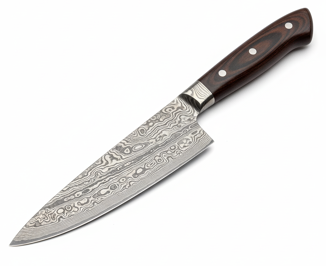
The steel is famous for its distinctive banded or wavy patterns that look like running water or wood grain. These patterns were not just decorative; they resulted from the way the metal was forged. True Damascus steel was produced using wootz steel imported from India and Sri Lanka, which contained trace impurities of vanadium and other elements. Blacksmiths forged and folded this steel in a way that preserved its unique crystalline microstructure, giving the blades a combination of extreme hardness and toughness—hard enough to hold a sharp edge, but flexible enough to resist shattering. These properties made Damascus steel weapons highly prized, with legends claiming they could slice through other swords or even cut a hair falling on the blade.
By the 18th century, the original process for making true Damascus steel was lost, largely because the supply of wootz ingots from India dried up and the exact methods were closely guarded secrets never fully documented. Modern bladesmiths today recreate “Damascus” steel through pattern welding, which involves forge-welding layers of different steels together and manipulating them to form the same kind of flowing patterns. While this modern Damascus often equals or exceeds the performance of the historical material thanks to advances in metallurgy, it is not identical to the ancient wootz-based steel.
Duplex Stainless Steel
Duplex stainless steel is a type of stainless steel that combines the properties of both austenitic and ferritic stainless steels within a single microstructure. Its name comes from this “dual-phase” composition — roughly 50% austenite and 50% ferrite — which gives it an exceptional balance of strength, toughness, and corrosion resistance. This hybrid structure provides advantages that neither phase can achieve alone, making duplex stainless steels highly valued in demanding industrial environments.
Chemically, duplex stainless steels typically contain 19–28% chromium, 3–10% nickel, and 0.05–0.5% nitrogen, with possible additions of molybdenum, copper, and tungsten to enhance corrosion resistance. The nitrogen and molybdenum are especially important for improving resistance to pitting, crevice corrosion, and chloride-induced stress corrosion cracking, which are major weaknesses of austenitic and ferritic grades when used alone.
Mechanically, duplex stainless steels are about twice as strong as common austenitic grades like 304 or 316, while maintaining good ductility and impact toughness. They have excellent resistance to chloride stress corrosion cracking, a property inherited from their ferritic phase, and superior general and localized corrosion resistance due to their high chromium and molybdenum content. Their reduced nickel content also makes them more cost-stable, as they are less affected by fluctuations in nickel prices.
Common grades include 2205 (UNS S32205/S31803), the most widely used standard duplex stainless steel, and 2507 (UNS S32750), a “super duplex” grade with higher alloy content and even greater corrosion resistance. Duplex stainless steels are widely used in chemical processing, oil and gas production, desalination plants, pulp and paper manufacturing, marine environments, and structural applications where strength and corrosion resistance are critical.
In summary, duplex stainless steels offer a unique combination of high strength, corrosion resistance, and cost efficiency, bridging the gap between austenitic and ferritic grades. Their dual-phase structure gives them the ability to withstand harsh chloride environments, high mechanical loads, and thermal stresses, making them one of the most versatile materials used in modern industrial design.
Ferritic Stainless Steel
Ferritic stainless steel is a type of stainless steel primarily composed of iron and chromium, with a body-centered cubic (BCC) crystal structure known as the ferritic phase. Unlike austenitic stainless steels, ferritic grades contain little to no nickel, which makes them more affordable but also less ductile. They are magnetic, have moderate corrosion resistance, and exhibit excellent resistance to stress corrosion cracking.
The chromium content in ferritic stainless steels typically ranges from 10.5% to 30%, which provides a protective oxide layer that resists oxidation and rust. However, since they lack significant amounts of nickel and other stabilizing elements, they are less resistant to highly corrosive or acidic environments compared to austenitic stainless steels. They also have lower toughness, especially at low temperatures, and are not hardenable by heat treatment, though they can be strengthened through cold working.
Ferritic stainless steels are known for their good thermal conductivity, resistance to scaling at high temperatures, and minimal thermal expansion, which makes them especially useful in automotive exhaust systems, heat exchangers, furnace components, and architectural trim. They are also favored in applications where magnetic properties are desirable or where cost reduction is important, since the absence of nickel significantly lowers material expense.
Common ferritic stainless steel grades include Type 409, used widely in automotive exhaust systems, Type 430, common in kitchen appliances and architectural panels, and Type 446, which offers excellent resistance to oxidation and scaling in high-temperature environments.
Free-Cutting Steel
Free-cutting steel, also known as free-machining steel, is a specially formulated type of carbon or alloy steel designed to enhance machinability—that is, to make cutting, drilling, turning, or milling operations faster and smoother with minimal tool wear. These steels contain additives such as sulfur, lead, phosphorus, or selenium that help the metal break into small chips during machining, reduce friction, and prevent built-up edge formation on cutting tools.
In standard steels, the material tends to produce long, continuous chips that tangle around tools, generate excess heat, and cause premature tool wear. Free-cutting steels overcome these problems by creating short, easily broken chips, which improves machining speed, surface finish, and tool life. The tradeoff, however, is that these steels often exhibit slightly reduced toughness, ductility, and weldability due to the presence of non-metallic inclusions from the additives.
The most common example is free-cutting mild steel (such as AISI 12L14), which contains small amounts of lead (Pb) and sulfur (S). During machining, the lead acts as a lubricant, allowing tools to slide smoothly through the material, while sulfur forms manganese sulfide (MnS) inclusions that help chips break apart cleanly. Other variants use selenium or tellurium for similar effects, especially when lead is avoided for environmental or health reasons.
Chemically, a typical free-cutting carbon steel might have a composition such as:
- 0.10–0.45% carbon (depending on strength requirements)
- 0.15–0.35% sulfur
- 0.85–1.00% manganese
- 0.15–0.35% lead (if leaded type)
Free-cutting steels are widely used in high-volume production environments, especially in automatic lathes, CNC machines, and screw machines, where speed and consistency are critical. They’re common in parts like fittings, bushings, fasteners, pins, shafts, and precision machined components that require high dimensional accuracy but not extreme mechanical strength.
AKA: Free-Machining Steel
Hot Rolled Pickled and Oiled Steel (HRPO)
Hot Rolled Pickled and Oiled steel, often abbreviated HRPO, is hot-rolled steel that has gone through an additional finishing step after rolling. The steel is first produced as ordinary hot-rolled sheet or coil, which typically leaves an oxide scale layer on the surface. It is then pickled, meaning the surface scale and iron oxides are chemically removed, commonly with hydrochloric acid, and then oiled with a light protective film because the newly cleaned surface is more susceptible to rusting.
In practical terms, HRPO steel is chosen when a manufacturer wants the strength, economy, and formability of hot-rolled steel but with a cleaner, more uniform surface than standard black hot-rolled material. Removing the scale makes the steel easier to process in operations such as forming, bending, welding, cutting, and painting, and it gives a better starting surface for subsequent fabrication. The oil is not a permanent finish or corrosion-proof coating; it is a temporary rust-preventive film intended to protect the clean surface during storage, handling, and shipment.
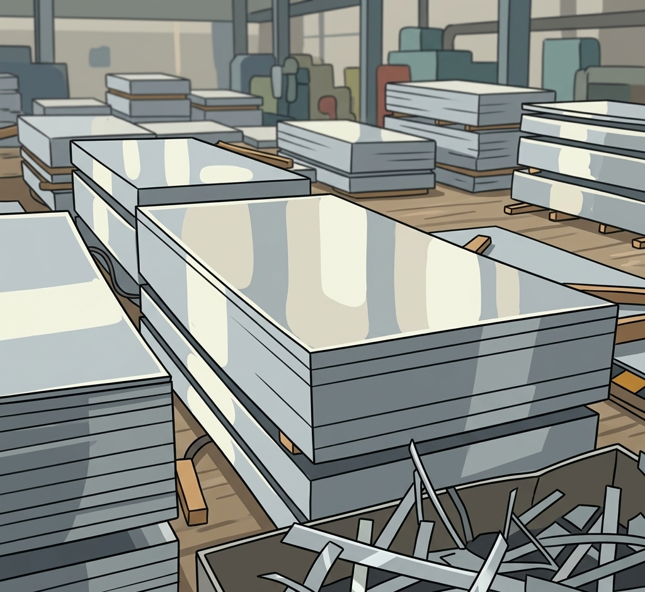
Compared with plain hot-rolled steel, HRPO has a neater appearance and a surface that is generally more suitable when scale would interfere with fabrication or finish quality. Compared with cold-rolled steel, however, HRPO still remains fundamentally a hot-rolled product, so it usually does not have the same level of tight thickness tolerance, smooth finish, or dimensional precision associated with cold-rolled material. It occupies a middle ground: cleaner and more fabrication-friendly than as-rolled hot-rolled steel, but less refined and usually less costly than cold-rolled sheet.
HRPO steel is widely used for fabricated parts such as automotive chassis and suspension components, machine frames, structural and non-structural formed parts, agricultural equipment, trailers, and general industrial components where appearance must be better than scaled hot-rolled steel but where full cold-rolled surface quality is not necessary.
HSLA Steel
HSLA steel, short for high-strength low-alloy steel, is a type of steel designed to provide higher strength, better toughness, and improved performance compared with ordinary carbon steel, while still using relatively small amounts of alloying elements. The “high-strength” part refers to its improved mechanical properties, and the “low-alloy” part means the steel is not heavily alloyed like stainless steel or many tool steels.
HSLA steels are usually based on low-carbon or medium-low-carbon steel with small additions of elements such as vanadium, niobium, titanium, molybdenum, chromium, nickel, copper, manganese, or silicon. These elements are added in controlled amounts to refine the grain structure, increase strength, improve toughness, and sometimes enhance corrosion resistance or weldability. In many HSLA grades, the alloying additions are very small, but they have a large effect on the final performance of the steel.
HSLA steel is often strengthened through grain refinement, precipitation strengthening, and controlled rolling or heat treatment. Grain refinement means the steel’s internal crystal structure is made finer, which generally improves both strength and toughness. Precipitation strengthening occurs when tiny particles form within the steel and help resist deformation. These strengthening methods allow HSLA steel to achieve useful strength without requiring the higher carbon levels that can make steel harder to weld or more brittle.
In fastener and industrial applications, HSLA steel may be used where a part needs better strength-to-weight performance, toughness, or durability than mild steel can provide. It can be found in structural components, brackets, plates, formed parts, automotive parts, heavy equipment components, construction hardware, frames, supports, and some specialty fastener-related parts. It is especially useful when the design calls for strength without excessive thickness or weight.
HSLA steel is not one single grade. It is a broad category covering many grades and specifications, each with different chemistry and mechanical properties. One HSLA steel may be optimized for forming, another for weldability, another for impact toughness, and another for atmospheric corrosion resistance. Because of that, HSLA steel should always be selected by the specific grade, specification, yield strength, tensile strength, toughness requirement, and service environment.
Compared with plain carbon steel, HSLA steel usually offers higher yield strength, better toughness, and better performance in demanding applications. Compared with heavily alloyed steels, it is often more economical and easier to fabricate. Its main value is that it provides a practical balance of strength, weight, weldability, formability, and cost for structural and industrial parts.
Killed Steel
Killed steel is a type of fully deoxidized steel in which oxygen is almost completely removed from the molten metal before it solidifies. This process prevents gas evolution during solidification, ensuring a uniform composition and eliminating gas porosity or blowholes in the finished product. The term “killed” comes from the idea that the steel has been “quieted” — it doesn’t bubble or effervesce while cooling in the mold, unlike rimmed or semi-killed steels.
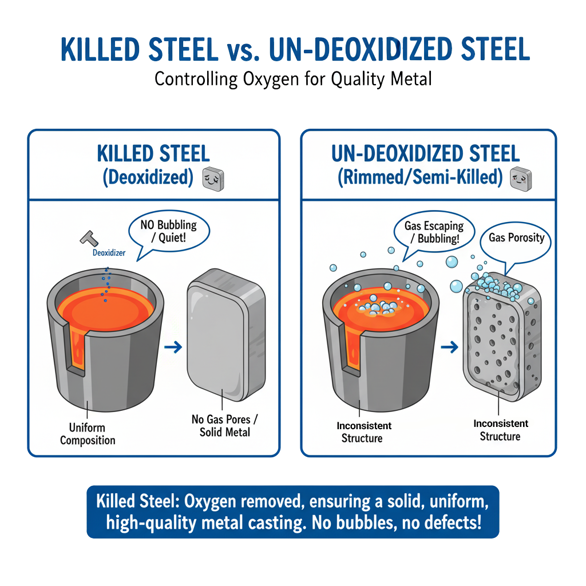
The deoxidation process is typically achieved by adding strong deoxidizing agents such as aluminum, silicon, or manganese to the molten steel. These elements combine with dissolved oxygen to form stable oxides, which float to the top and are removed as slag. As a result, the molten steel solidifies quietly and uniformly throughout the ingot or casting.
Killed steels are characterized by their high uniformity, consistent composition, and dense structure. They are particularly suited for applications that require deep drawing, heat treatment, or high structural integrity, since the absence of gas pockets improves machinability, weldability, and toughness.
Common uses include pressure vessels, structural shapes, plates, and alloy steels for tools and automotive components. Most alloy steels and high-quality carbon steels are killed steels because their performance depends on precise control of chemical composition and microstructure.
AKA: Deoxidized Steel
MagnaCut Steel
MagnaCut steel, more properly CPM MagnaCut, is a powder-metallurgy stainless tool steel developed specifically for knife blades and other cutting applications where a strong balance of corrosion resistance, toughness, hardness, and edge retention is required. It was engineered to deliver the benefits users often want from premium blade steels without forcing as much of the usual compromise between stain resistance and wear performance. In practical terms, MagnaCut is known for being able to achieve high hardness while still maintaining strong toughness and excellent resistance to rust and staining.
Metallurgically, MagnaCut is designed so that more chromium remains available in solution for corrosion resistance rather than being tied up as large chromium carbides, while vanadium and niobium contribute to wear resistance and edge stability. Because it is produced through powder metallurgy, the carbide structure is finer and more evenly distributed than in many conventional steels, which helps support a combination of strength, sharpenability, and cutting performance. MagnaCut is most commonly associated with premium knives rather than standard industrial fastener or structural applications, so it is generally discussed as a specialty blade steel rather than a general-purpose engineering alloy grade.
Martensitic Stainless Steel
Martensitic stainless steel is a category of stainless steel known for its high strength, hardness, and moderate corrosion resistance, achieved through heat treatment that transforms its crystal structure into martensite. It is characterized by a body-centered tetragonal (BCT) crystal structure, which forms when steel containing sufficient carbon is rapidly cooled or quenched from a high temperature. This gives martensitic stainless steels their distinctive ability to be hardened and tempered, much like carbon steels.
The composition of martensitic stainless steels typically includes 11.5% to 18% chromium and 0.1% to 1.2% carbon, with small amounts of other elements such as molybdenum, nickel, or vanadium to improve strength, corrosion resistance, and toughness. The chromium content provides the protective oxide layer that resists rust and oxidation, while the carbon allows for the formation of martensite during quenching, leading to significant hardness and wear resistance.
Unlike austenitic or ferritic stainless steels, martensitic grades are magnetic and can be heat treated to a wide range of hardness levels. However, this comes at a tradeoff: their corrosion resistance is generally lower, especially in environments involving chlorides or acids. They also tend to have reduced ductility and weldability compared to other stainless steel families.
Common martensitic grades include Type 410 (general-purpose, used for cutlery, valves, and turbine blades), Type 420 (high-carbon, used for surgical instruments and knives), and Type 440C (very high carbon, used for bearings, precision tools, and high-wear components). These steels are often used where mechanical strength, edge retention, and wear resistance are more critical than corrosion resistance.
Nitronic 60 Stainless Steel
Nitronic 60 stainless steel is a nitrogen-strengthened austenitic stainless steel engineered specifically for galling and wear resistance while retaining strong corrosion resistance. It is commonly designated as UNS S21800 and is sometimes referred to as an “anti-galling stainless.”
Compositionally, Nitronic 60 is built on an austenitic (non-magnetic in the annealed condition) structure similar to 300-series stainless steels, but it is modified with elevated nitrogen, silicon, and manganese, along with chromium and nickel. This chemistry is what gives it a unique combination of properties that standard grades like 304 or 316 struggle to achieve simultaneously. The chromium provides corrosion resistance through formation of a stable chromium oxide film, while nitrogen strengthens the material and contributes to improved wear performance.
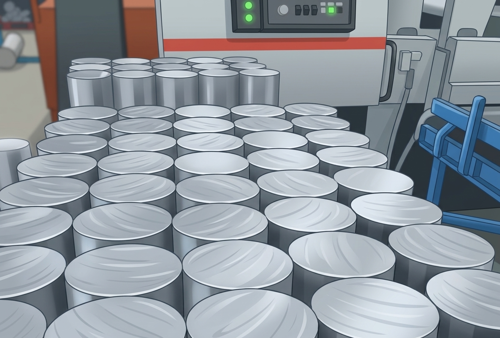
The defining characteristic of Nitronic 60 is its exceptional resistance to galling and metal-to-metal seizure. Galling is a form of adhesive wear that occurs when two similar metals (especially stainless steels) slide against each other under load, causing material transfer, tearing, and eventual locking of threads or surfaces. Nitronic 60 resists this by forming a more stable surface interaction under pressure, reducing the tendency for cold welding at contact points. In practical terms, this makes it highly valuable for fasteners, nuts, bolts, studs, valve components, shafts, and sliding surfaces where stainless-on-stainless contact would otherwise be problematic.
From a mechanical standpoint, Nitronic 60 provides higher strength than typical 300-series stainless in the annealed condition, without requiring heat treatment to achieve its baseline properties. It also maintains good toughness and ductility across a range of temperatures. While it is not precipitation-hardened like some high-strength stainless alloys, it offers a strong balance of strength, toughness, and wear resistance.
Corrosion resistance of Nitronic 60 is comparable to Type 304 in many environments, and in some cases approaches Type 316, though it is not typically selected primarily for extreme corrosion resistance like highly alloyed or duplex grades. Its performance is generally strong in industrial, mildly corrosive, and moderately aggressive environments, including exposure to water, many chemicals, and atmospheric conditions.
In fastener and industrial applications, Nitronic 60 is used where engineers need to avoid galling without relying on coatings, lubricants, or dissimilar material pairings. It is commonly found in valves, marine hardware, pump components, chemical processing equipment, food processing machinery, and heavy industrial assemblies where repeated assembly/disassembly or sliding contact occurs.
In practical terms: Nitronic 60 is a stainless steel designed to solve one of the biggest problems with stainless fasteners—galling—while still delivering solid corrosion resistance and mechanical performance.
Precipitation Hardening Stainless Steel
Precipitation hardening stainless steel, often abbreviated as PH stainless steel, is a class of stainless steel that achieves its exceptional high strength, hardness, and corrosion resistance through a specialized heat treatment process known as precipitation hardening (or age hardening). This process involves the controlled formation of very fine particles (precipitates) within the metal’s microstructure, which strengthen the material without significantly reducing its toughness or corrosion resistance.
Chemically, PH stainless steels contain chromium and nickel as their main alloying elements, similar to austenitic grades, but they also include copper, aluminum, titanium, or niobium to enable the precipitation-hardening effect. The chromium provides corrosion resistance, while the nickel stabilizes the austenitic or martensitic structure, and the additional elements form the fine precipitates that dramatically increase strength during heat treatment.
The hardening process occurs in three main stages: solution treatment, quenching, and aging. During solution treatment, the alloying elements are dissolved at high temperature. Quenching rapidly cools the material to lock these elements in a supersaturated solid solution. Finally, during aging, the metal is reheated to a moderate temperature, allowing controlled precipitation of intermetallic compounds that impede dislocation motion — the mechanism that gives the steel its high strength.
Depending on their metallurgical structure, PH stainless steels can be martensitic, semi-austenitic, or austenitic. The most common grade is 17-4 PH (UNS S17400), which contains roughly 17% chromium and 4% nickel, along with copper and niobium for hardening. It offers excellent strength, moderate corrosion resistance (similar to 304), and can be hardened to yield strengths exceeding 1,000 MPa (145 ksi). Other notable grades include 15-5 PH, 17-7 PH, and 13-8 Mo, each designed for specific combinations of toughness, hardness, and corrosion resistance.
Precipitation hardening stainless steels are used extensively in aerospace, nuclear, and petrochemical industries, as well as for valves, shafts, turbine components, fasteners, and high-performance mechanical parts that must maintain strength at both elevated and sub-zero temperatures.
In summary, precipitation hardening stainless steels combine the corrosion resistance of austenitic grades with the strength of martensitic steels, made possible through precise heat treatment. Their ability to achieve very high mechanical performance while maintaining corrosion resistance makes them ideal for critical applications where strength, durability, and reliability are equally important.
Sheet Steel
Sheet steel is steel that has been processed into a thin, flat form and supplied as sheet or coil for fabrication into other products and components. It is part of the broader family of flat-rolled steel products, meaning the steel has been passed through rollers to reduce its thickness and create a broad, flat section with relatively uniform dimensions. In practical terms, sheet steel is the steel used when a manufacturer needs a material that can be cut, punched, bent, stamped, roll formed, welded, or otherwise fabricated into panels, enclosures, brackets, ductwork, appliance parts, automotive components, and many other industrial products.
In hardware and fabrication language, sheet steel is distinguished from plate mainly by thickness, although the exact cutoff can vary somewhat by specification, market, or manufacturer. A common rule of thumb is that material below about 1/4 inch, or about 6 mm, is considered sheet, while thicker flat material is often treated as plate. In the United States, sheet steel thickness is also often identified by gauge rather than only by decimal inch or millimeter thickness, and federal law still publishes a standard gauge table for sheet and plate iron and steel.
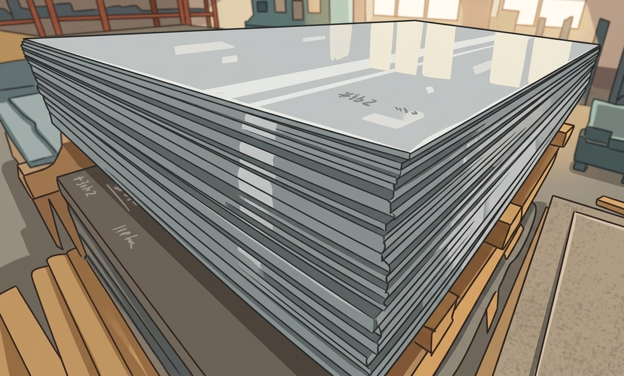
Sheet steel may be produced in hot-rolled, cold-rolled, galvanized, coated, stainless, or other forms depending on the intended application and required performance. Hot-rolled sheet is generally associated with broader tolerances and lower-cost structural or formed applications, while cold-rolled sheet is commonly chosen where improved surface finish, closer dimensional control, or better forming consistency is needed. Coated sheet, such as galvanized steel sheet, is used when corrosion resistance is important.
From an industrial standpoint, sheet steel is valued because it combines strength, formability, availability, and manufacturing efficiency. It can be processed in large volumes and converted into finished parts quickly, which is why it is widely used across automotive, construction, HVAC, appliance, agricultural, electrical equipment, packaging, and general manufacturing markets.
Spring Steel
Spring steel is a high-strength steel designed to flex, bend, twist, or deflect under load and then return to its original shape without taking a permanent set. It is used where a part needs to store and release mechanical energy, maintain pressure, absorb shock, or provide repeated elastic movement.
The key property of spring steel is a high yield strength. Yield strength is the stress level where permanent deformation begins. In a spring application, the material must operate below that point so it can flex elastically and recover. A normal mild steel part may bend and stay bent, but properly processed spring steel can deflect many times and still spring back.
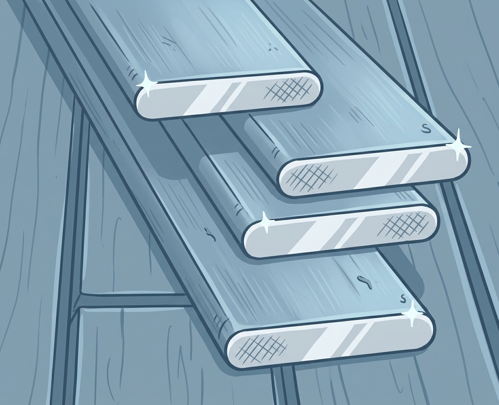
Spring steel is not one single alloy. It is a family of steels that are selected and processed for elastic performance. Common spring steels include high-carbon steel, music wire, oil-tempered wire, chrome-silicon steel, chrome-vanadium steel, and some stainless spring steels. Carbon is important because it allows the steel to be hardened and strengthened through heat treatment. Alloying elements such as chromium, silicon, vanadium, manganese, and nickel may be added to improve strength, toughness, fatigue resistance, hardenability, or temperature performance.
Spring steel can be strengthened by cold working, heat treatment, or both. In many cases, the steel is hardened and tempered to achieve the right balance of strength and toughness. Hardening increases strength, but can make the steel brittle. Tempering reduces brittleness and adjusts the final mechanical properties so the steel can flex repeatedly without cracking too easily. That balance is the whole trick: spring steel must be strong enough to resist permanent bending, but tough enough to survive repeated loading.
In industrial and fastener-related applications, spring steel is used for spring washers, lock washers, retaining rings, snap rings, clips, clamps, Belleville washers, wave washers, hose clamps, cotter pins, spring pins, wire forms, and tensioning components. These parts are not just holding pieces together; they are actively applying force, maintaining contact pressure, absorbing movement, or resisting loosening.
A major design concern with spring steel is fatigue. A spring part may fail not because it was overloaded once, but because it was flexed thousands or millions of times. Surface condition, edge quality, heat treatment, corrosion, scratches, forming radius, stress concentration, and operating environment all matter. A tiny notch or pit can become the starting point for a fatigue crack.
Spring steel is also commonly supplied in different conditions, such as annealed, hard-drawn, oil-tempered, blue-tempered, or spring-temper strip. Softer annealed material is easier to form, while spring-temper material already has high elastic strength but may be harder to bend without cracking. For stamped or formed spring parts, manufacturers often choose between forming first and heat treating later, or forming material that is already in spring temper.
Stainless Steel
Stainless steel is a corrosion-resistant alloy of iron that contains a minimum of 10.5% chromium (Cr) by mass, along with varying amounts of carbon, nickel, molybdenum, and other elements. The presence of chromium is what gives stainless steel its defining property — the ability to form a thin, invisible layer of chromium oxide on its surface when exposed to oxygen. This layer, known as the passive film, protects the metal beneath from rust and oxidation, and it self-heals if scratched or damaged.
Stainless steel is both strong and durable, with excellent resistance to corrosion, heat, and chemical attack, which makes it one of the most versatile materials in modern engineering, manufacturing, and architecture. Its composition can be modified to enhance certain properties — for example, adding nickel improves ductility and toughness, while molybdenum increases resistance to acids and chlorides (such as in seawater or salt-rich environments).
There are several major categories of stainless steel, each with distinct characteristics:
- Austenitic stainless steels (e.g., 304, 316): The most common type, containing high levels of chromium and nickel. They are non-magnetic, highly formable, and extremely corrosion-resistant. Grade 304 is widely used in kitchen equipment and architecture, while 316 includes molybdenum for added marine and chemical resistance.
- Ferritic stainless steels: Contain chromium but little or no nickel. They are magnetic, less ductile, and typically used in automotive exhaust systems and appliances.
- Martensitic stainless steels: Have higher carbon content, allowing them to be hardened by heat treatment. They are used for cutting tools, blades, and fasteners.
- Duplex stainless steels: Combine austenitic and ferritic structures for greater strength and stress corrosion resistance, often used in chemical plants and pipelines.
- Precipitation-hardening stainless steels: Can be heat-treated to very high strengths, used in aerospace and high-performance applications.
Stainless steel’s appeal lies not only in its performance but also in its aesthetic and hygienic qualities. Its smooth, reflective surface resists staining and bacterial buildup, making it ideal for food processing, medical instruments, architecture, and consumer products.
Zinc-Plated Steel
Zinc-plated steel is carbon or alloy steel that has been coated with a thin layer of zinc to provide corrosion resistance and enhanced durability. The zinc acts as a protective barrier between the steel and the surrounding environment, preventing moisture and oxygen from reaching the steel surface — two key factors that cause rust and oxidation.
The coating process, called electroplating (or electro-galvanizing), involves immersing the steel part in a zinc salt solution and passing an electric current through it. This deposits a thin, even layer of zinc—usually between 5 to 25 microns thick—onto the steel surface. The resulting finish is typically bright silver, bluish, or yellowish depending on the post-treatment (such as clear, blue, or yellow chromate passivation).
Zinc-plated steel offers two types of corrosion protection:
- Barrier protection, where the zinc layer physically seals the steel from air and moisture.
- Sacrificial protection, where zinc, being more reactive than iron, corrodes first when the surface is damaged or scratched—effectively protecting the underlying steel from rust.
This makes zinc-plated steel a cost-effective choice for fasteners, brackets, bolts, nuts, washers, and hardware used in automotive, construction, machinery, and general manufacturing applications. However, while it resists corrosion better than bare steel, zinc plating is not as durable as hot-dip galvanizing, which provides a much thicker zinc layer and better long-term outdoor protection.