
Learning Hub
Glossary
Pitting Corrosion
Pitting corrosion is a localized and highly destructive form of electrochemical corrosion that produces small, deep holes or “pits” on a metal surface. Unlike uniform corrosion—which affects a surface evenly—pitting attacks specific microscopic areas, often penetrating deeply while leaving much of the surrounding surface relatively intact. This makes it especially dangerous and difficult to detect, since severe structural damage can occur beneath an otherwise smooth surface.
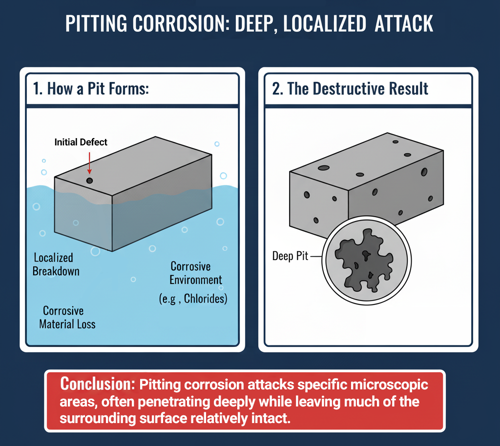
Pitting corrosion typically begins when a protective oxide film (the passive layer) that normally shields metals such as stainless steel, aluminum, titanium, or nickel alloys is locally damaged or weakened. This can happen due to chloride ions (from saltwater or perspiration), mechanical scratches, chemical impurities, or stagnant fluid conditions. Once the film is breached, a tiny anodic site forms where metal dissolution begins:
Anodic reaction:
Fe → Fe²⁺ + 2e⁻
The nearby intact surface acts as a cathode, where a reduction reaction consumes the released electrons:
Cathodic reaction:
O₂ + 2H₂O + 4e⁻ → 4OH⁻
Inside the pit, metal ions hydrolyze in the presence of water, creating acidic conditions (low pH) that further accelerate dissolution. Meanwhile, chloride ions migrate into the pit, maintaining electrical neutrality and promoting even more localized attack. The chemistry inside the pit becomes self-sustaining, causing it to deepen rapidly while the rest of the surface remains passive.
This autocatalytic process can lead to narrow, deep cavities that compromise the structural integrity of thin components like tubes, tanks, or fasteners. Because pits can penetrate metal walls without significant overall mass loss, pitting corrosion is among the most insidious and dangerous forms of corrosion, often leading to sudden leakage or failure with little visible warning.
Common causes include:
- Chloride-containing environments, such as seawater or road salts.
- Poor oxygenation, which prevents passive film repair.
- Deposits or crevices that trap corrosive agents.
- Improper alloy selection or surface contamination during fabrication.
Prevention and control of pitting corrosion rely on:
- Using more resistant alloys (e.g., 316 stainless steel instead of 304, due to its molybdenum content).
- Maintaining clean, oxygenated surfaces so the passive film can regenerate.
- Applying protective coatings or cathodic protection.
- Avoiding chloride-rich environments when possible or using corrosion inhibitors.