
Learning Hub
Glossary
Elastic Deformation
Elastic deformation is the temporary change in shape or size of a material that occurs when an external force or stress is applied, but the material returns to its original shape once the force is removed. It happens within the material’s elastic limit, meaning the internal atomic bonds are stretched or compressed but not permanently rearranged. The relationship between stress and strain in this region follows Hooke’s Law, which states that the deformation is directly proportional to the applied load.
In simpler terms, when a force is applied to a bolt, spring, or metal rod, it may elongate or compress slightly, but once the load is removed, it returns to its initial length and form. This behavior occurs because the atomic structure of the material only experiences reversible displacements—the bonds between atoms act like tiny springs that stretch and recover.
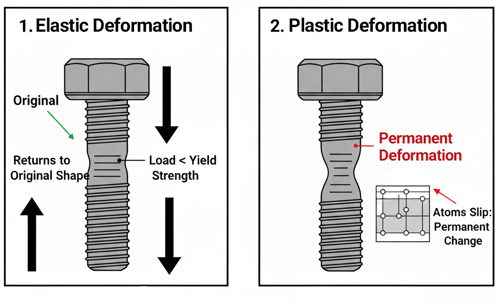
Elastic deformation is a critical concept in engineering and materials science because it defines the safe working range of a material. Designers and engineers ensure that fasteners, beams, and machine components operate below their elastic limit to prevent permanent deformation or failure. When the stress exceeds this limit, the material enters the plastic deformation stage, where changes become irreversible.
In summary, elastic deformation is a reversible, proportional response to stress, allowing materials to absorb energy and return to their original form once the load is released. It represents the phase before permanent, plastic deformation begins.
Elastic Limit
The elastic limit is the maximum stress a material can withstand and still return to its original shape once the load is removed. Below this point, deformation is fully elastic—atoms in the material’s crystal lattice are displaced slightly but return to their original positions when the stress is released. If the stress goes beyond the elastic limit, the material enters plastic deformation, where the changes in shape are permanent and the material will not fully recover its original dimensions.
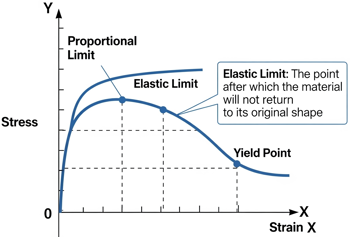
The elastic limit is closely related to, but not always identical to, the yield strength, which marks the onset of measurable permanent deformation. It is a critical property in the design of fasteners, springs, and structural components, because keeping stresses within the elastic range ensures a part can repeatedly bear loads without lasting damage. Exceeding the elastic limit can cause permanent distortion or failure, especially in applications where tight tolerances, fatigue resistance, or safety are essential.
Elastic Stop Nut
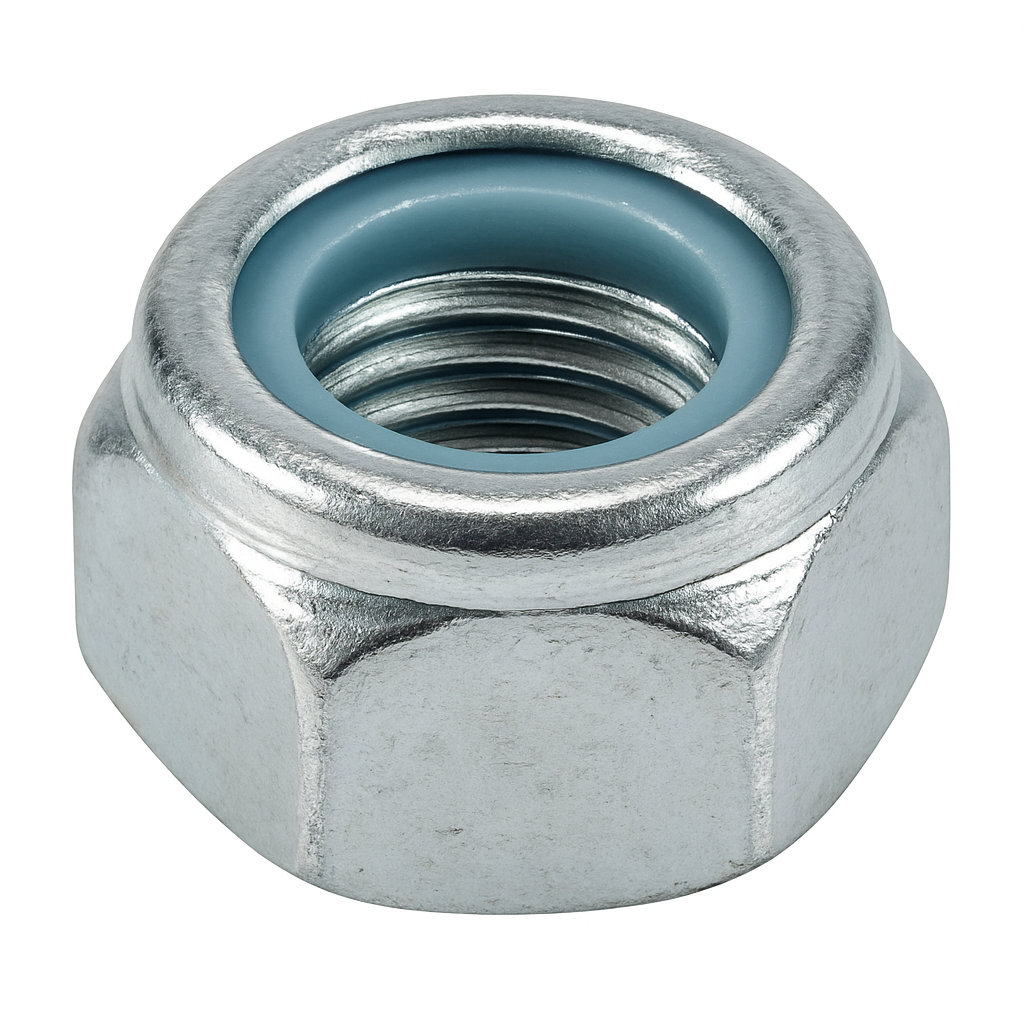
An elastic stop nut (often called a nyloc nut or nylon insert locknut) is a type of locknut that incorporates a non-metallic insert, usually made of nylon, at the top of the nut. When the nut is tightened onto a bolt or threaded stud, the threads of the bolt cut into the nylon insert, creating friction and resistance that prevents the nut from loosening due to vibration or dynamic loads.
Unlike ordinary nuts that may back off under vibration, the elastic insert keeps constant pressure on the threads. This locking feature does not damage the bolt threads and allows the nut to be reused several times, though the locking ability decreases after repeated installations.
Elastic stop nuts are widely used in aerospace, automotive, machinery, and industrial applications where vibration resistance is critical. They are especially common in assemblies that experience continuous motion or dynamic stress, such as engines, airframes, and equipment frames.
Superelasticity
Superelasticity (also called pseudoelasticity) is a material behavior where a metal can undergo very large, reversible strains and then return to its original shape upon unloading, without permanent deformation. Unlike ordinary elasticity (where reversible strain is small and proportional to stress), superelasticity comes from a stress-induced phase transformation rather than simple stretching of atomic bonds.
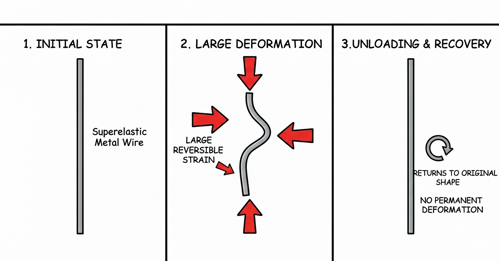
It is most strongly associated with shape memory alloys, especially nickel-titanium (NiTi / Nitinol). Under load at a temperature where the alloy is in the austenite phase, the material transforms to martensite as stress increases, allowing substantial strain at nearly constant stress (a characteristic plateau). When the load is removed, the martensite transforms back to austenite and the strain is recovered, producing a distinct hysteresis loop on the stress–strain curve.
In industrial hardware contexts, superelastic NiTi is used when you want parts that can flex repeatedly without taking a set, maintain contact force over movement, or tolerate deformation during installation—examples include certain clips, springs, retaining components, and specialty fastener-like devices. Its practical limits depend on alloy composition, temperature, and design; outside the superelastic temperature window or if overstressed, the material can still permanently deform or fatigue like other metals.
Viscoelasticity
Viscoelasticity is a material property that describes how a substance exhibits both viscous and elastic behavior when subjected to deformation.
A viscous material (like honey or oil) resists flow and dissipates energy as heat, meaning it deforms continuously under stress and doesn’t return to its original shape once the stress is removed. An elastic material (like rubber) deforms under stress but stores that energy and returns to its original form once the stress is gone.
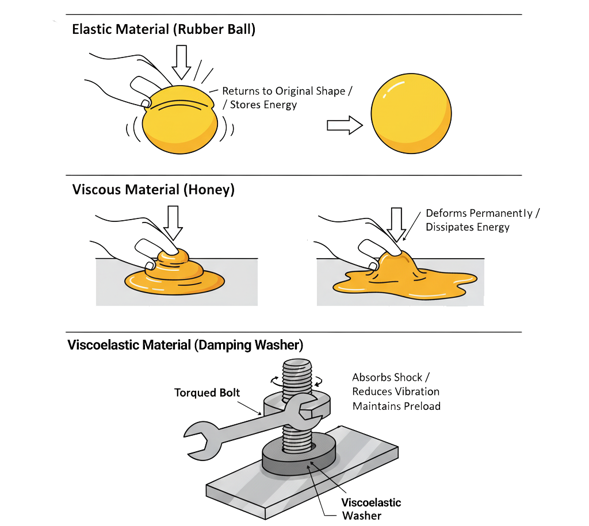
A viscoelastic material combines these two behaviors. When a force is applied, it both deforms elastically (storing energy) and flows or relaxes over time (dissipating energy). When the force is removed, it gradually returns toward its original shape but may not recover instantly or completely.
This property is common in materials such as rubber, polymers, biological tissues, and damping materials, which are often used in fasteners and vibration-control applications. In fasteners, viscoelastic components—like damping washers or polymer seals—help absorb shocks, reduce vibration, and maintain preload stability by controlling how stress and strain are distributed over time.