
Learning Hub
Glossary
Elastic Deformation
Elastic deformation is the temporary change in shape or size of a material that occurs when an external force or stress is applied, but the material returns to its original shape once the force is removed. It happens within the material’s elastic limit, meaning the internal atomic bonds are stretched or compressed but not permanently rearranged. The relationship between stress and strain in this region follows Hooke’s Law, which states that the deformation is directly proportional to the applied load.
In simpler terms, when a force is applied to a bolt, spring, or metal rod, it may elongate or compress slightly, but once the load is removed, it returns to its initial length and form. This behavior occurs because the atomic structure of the material only experiences reversible displacements—the bonds between atoms act like tiny springs that stretch and recover.
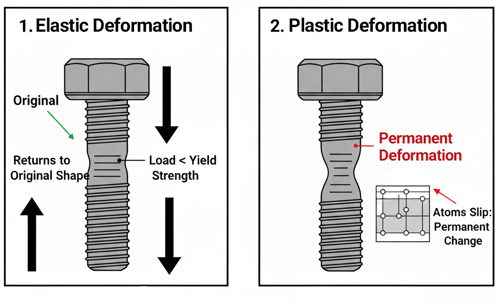
Elastic deformation is a critical concept in engineering and materials science because it defines the safe working range of a material. Designers and engineers ensure that fasteners, beams, and machine components operate below their elastic limit to prevent permanent deformation or failure. When the stress exceeds this limit, the material enters the plastic deformation stage, where changes become irreversible.
In summary, elastic deformation is a reversible, proportional response to stress, allowing materials to absorb energy and return to their original form once the load is released. It represents the phase before permanent, plastic deformation begins.
Plastic Deformation
Plastic deformation is the permanent change in shape or size of a material that occurs when it is subjected to a stress beyond its elastic limit or yield strength. In this state, the material no longer returns to its original form after the load is removed, unlike during elastic deformation where the shape fully recovers. Plastic deformation happens when the applied stress causes atoms within the material’s crystal structure to move or slip past each other, resulting in a lasting rearrangement of the internal structure.
In metals, plastic deformation often begins gradually once the yield strength is exceeded and continues until fracture. During this process, the metal stretches, compresses, or bends without breaking, which is why it’s a key property in manufacturing processes such as forging, rolling, bending, and drawing. The ability of a material to undergo plastic deformation before breaking is called ductility.
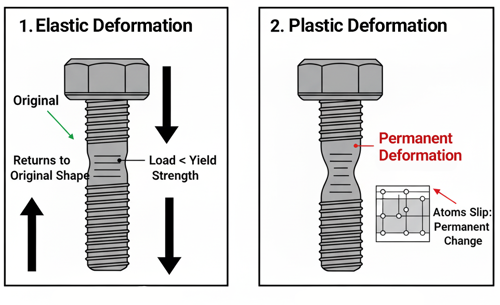
For example, when a bolt is tightened past its yield strength, it begins to stretch permanently — its diameter may slightly reduce, and the threads might elongate. If the load continues to increase, the bolt eventually “necks” and fractures. This behavior demonstrates the material’s transition from elastic to plastic deformation, showing how stress can permanently alter its geometry.
In summary, plastic deformation represents the irreversible flow of a material under stress, where it maintains its new shape even after the load is removed. It’s a crucial concept in understanding how metals and other materials behave under real-world mechanical forces and why design limits are based on avoiding excessive plastic strain that can lead to failure.
Torsional Deformation
Torsional deformation is the twisting or rotational displacement that occurs in a structural member—such as a shaft, rod, or beam—when it is subjected to a torque or twisting moment about its longitudinal axis. Unlike bending, which produces curvature, torsion produces an angular twist along the length of the member. This deformation arises because the applied torque generates shear stresses inside the material, causing each cross-section to rotate relative to its neighboring sections.
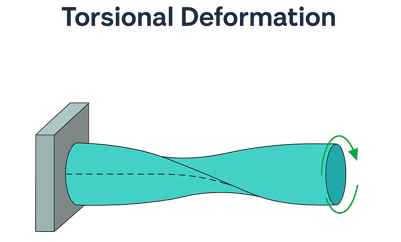
The extent of torsional deformation depends on several factors: the magnitude of the applied torque, the length of the shaft, the material’s rigidity, and the geometry of the cross-section. For a uniform circular shaft, the angle of twist is determined by the relationship θ = (T × L) / (G × J), where T is the torque, L is the length of the shaft, G is the shear modulus of the material, and J is the polar moment of inertia of the cross-section. This formula highlights that stiffer materials with higher shear modulus and shapes with larger polar moment of inertia (such as thick or hollow tubes) resist torsional deformation more effectively.
In practice, torsional deformation is important in mechanical and structural design because excessive twisting can cause misalignment, vibration, fatigue, or even failure. For example, in drive shafts, fasteners, and transmission systems, engineers must carefully account for torsional deformation to ensure efficiency, durability, and safety. It is often controlled by selecting proper materials, optimizing geometry, or limiting the applied torque to safe operating ranges.