
Learning Hub
Glossary
Test Force
Test force is the controlled amount of force applied to a part, material, fastener, or assembly during a test to measure performance, verify strength, confirm compliance, or check whether the part can withstand a specified load without unacceptable damage or failure.
In fastener applications, test force is often used during proof load testing, tensile testing, shear testing, hardness testing, pull-out testing, torque-tension testing, wedge tensile testing, and assembly validation. The force may be applied in tension, compression, shear, or another loading direction depending on what the test is trying to evaluate.
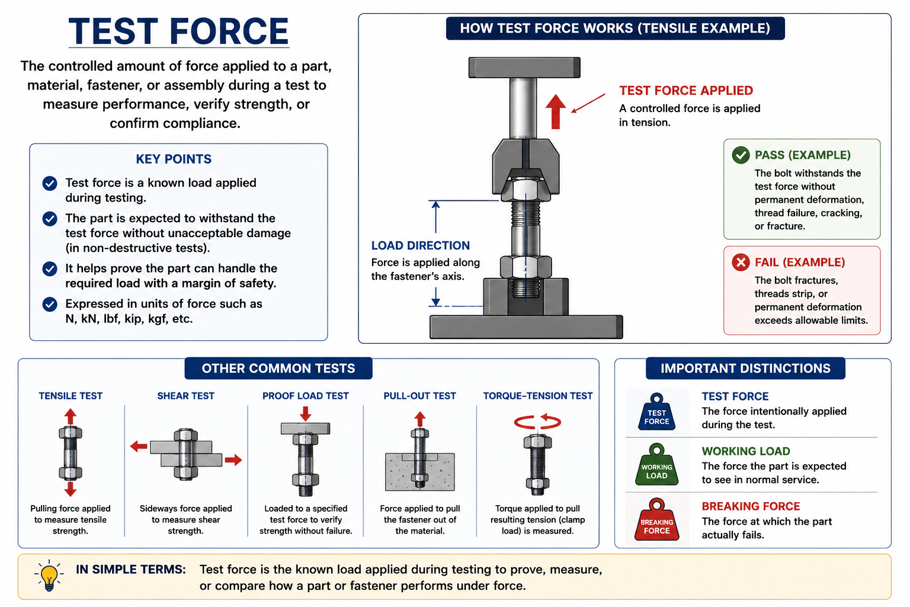
For example, in a proof load test, a bolt or nut may be loaded to a specified test force to confirm that it can withstand that force without permanent deformation, thread failure, cracking, or fracture. The part is not supposed to break during this kind of test. Instead, the test force acts like a controlled “show me you can handle this” load.
Test force is different from breaking force or ultimate load. Test force is the force intentionally applied during the test. Breaking force is the force at which the part actually fails. A test force may be set below the expected failure point so the part can be verified without destroying it, or it may be increased until failure if the test is destructive.
Test force is also different from working load. Working load is the force a part is expected to see in service. Test force is applied under controlled test conditions and is often higher than the normal working load to provide a margin of confidence.
Test force may be expressed in newtons, kilonewtons, pounds-force, kips, kilograms-force, or other force units, depending on the standard, industry, and test equipment being used. In simple terms, test force is the known load applied during testing to prove, measure, or compare how a part performs under force.