
Learning Hub
Glossary
Pound-Force
Pound-force, abbreviated lbf, is a unit of force used mainly in the United States customary system. It represents the amount of force required to accelerate a one-pound mass under standard Earth gravity. One pound-force is equal to approximately 4.448 newtons.
Pound-force should not be confused with pound-mass, which describes how much matter an object contains. Pound-force describes a push, pull, load, or tension acting on that mass. In everyday use, the word “pound” is often used for both weight and force, but engineering calculations distinguish between lb for mass and lbf for force.
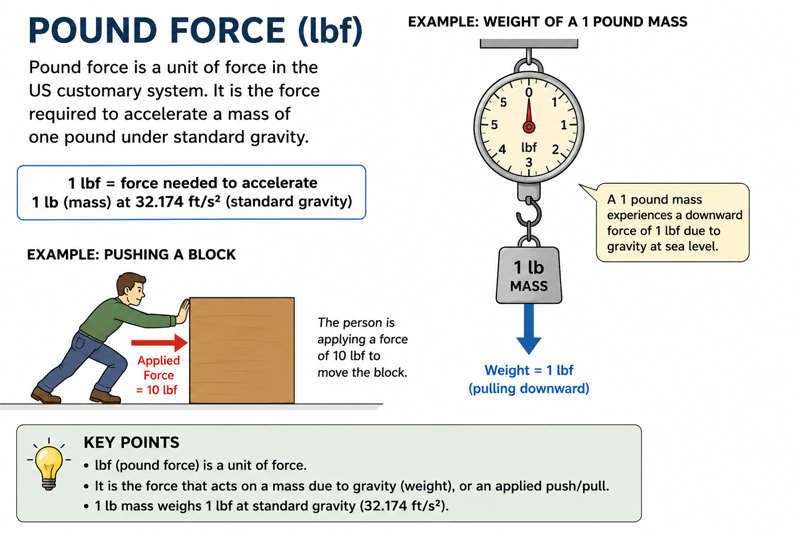
For example, an object with a mass of one pound exerts a downward force of approximately one pound-force due to gravity at Earth’s surface. An object with a mass of 100 pounds therefore weighs approximately 100 pound-force under normal conditions.
In fastener applications, pound-force is commonly used to express preload, clamp force, tensile load, shear load, and test force. A bolted joint described as having a clamp load of 5,000 lbf means the fastener is pulling the joined parts together with a force of 5,000 pound-force.
Pound-force is also used in units such as pound-force per square inch, or psi, which measures stress or pressure, and inch-pounds or foot-pounds, which measure torque. In practical terms, pound-force tells you how strongly something is being pushed, pulled, stretched, or clamped.