
Learning Hub
Glossary
Torque-Tension Testing
Torque-tension testing is a mechanical test used to measure the relationship between the torque applied to a threaded fastener and the amount of tensile load, or preload, created in the fastener. During the test, a bolt, screw, or nut is tightened in a controlled test fixture while instruments simultaneously record the applied torque, the resulting clamp force, and sometimes the torque consumed under the fastener head and within the threads. The goal is to determine how efficiently tightening torque is converted into useful clamping force.
Most of the torque applied during tightening does not directly stretch the bolt. A large portion is lost to friction between the male and female threads and beneath the rotating nut or bolt head. Only a relatively small portion produces the axial tension that holds the joint together. Because friction can vary greatly with lubrication, coatings, surface finish, material, thread condition, and tightening speed, two visually identical fasteners tightened to the same torque can produce significantly different clamp loads.
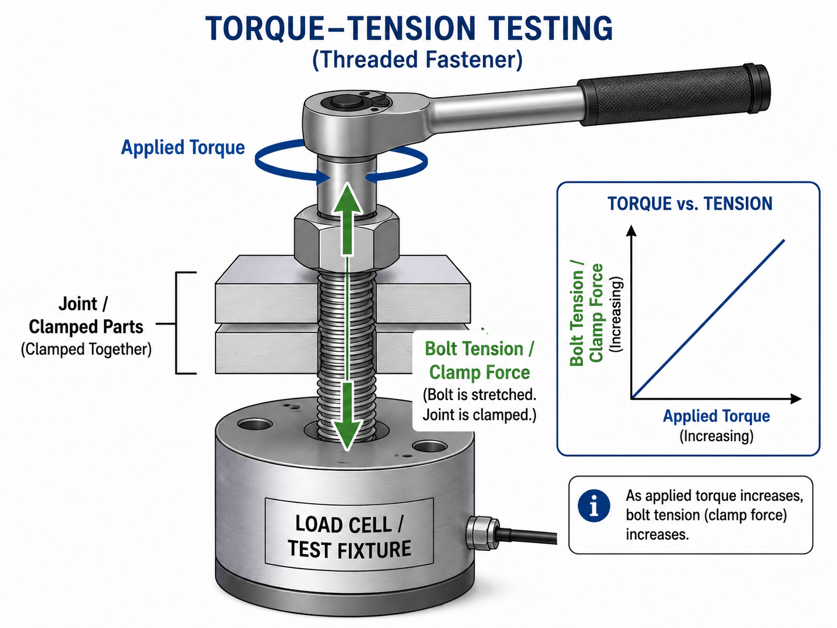
A torque-tension test is typically performed using a specialized load cell and torque-measuring system. The fastener is installed in the test fixture and tightened to a specified torque, clamp load, rotation angle, or failure point. The equipment records data throughout the tightening cycle and produces a torque-versus-tension curve. From this information, engineers can calculate values such as the coefficient of friction, nut factor, tightening efficiency, prevailing torque, breakaway torque, and the consistency of the fastener’s clamping performance.
A commonly used simplified relationship is: T = KDF
where T is tightening torque, K is the nut factor, D is the nominal fastener diameter, and F is the resulting preload. The nut factor is not a fixed material property; it is an empirical value influenced heavily by friction and the complete fastening system.
Torque-tension testing is especially important when evaluating lubricants, plating, zinc-flake coatings, waxes, locking features, prevailing-torque nuts, and other surface treatments. It helps verify that a fastener can reach the required clamp load without being undertightened, overtightened, stripped, or broken. The test can also identify excessive friction, unstable friction, coating damage, galling, or large variations between production lots.
In practical terms, torque-tension testing answers the question: When this fastener is tightened to a certain torque, how much actual clamping force will it produce, and how consistently will it produce it?