
Learning Hub
Glossary
Wedge Tensile Testing
Wedge tensile testing is a fastener test used to evaluate the tensile strength and head-to-shank integrity of a bolt or screw while it is being pulled at a slight angle. Instead of pulling the fastener perfectly straight, the test uses a wedge-shaped washer or fixture under the head so the fastener is forced to carry tensile load while also experiencing bending stress near the head.
The purpose is to prove that the fastener can withstand a specified tensile load without failing prematurely at a weak transition area, especially where the head joins the shank. That area is important because it often contains geometry changes, fillets, forging flow lines, and possible stress concentrations. A bolt might pass a straight tensile test but still reveal weakness when loaded through a wedge because the angled setup places extra demand on the head-to-body junction.
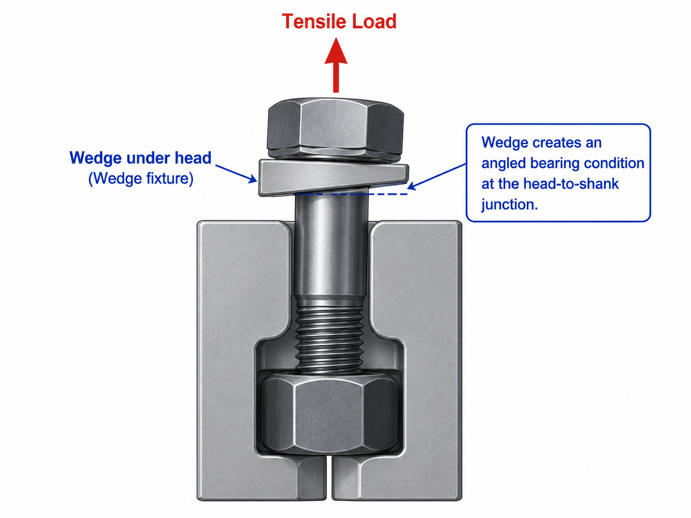
In a typical wedge tensile test, the fastener is installed through a hardened wedge fixture and threaded into a test nut or gripping fixture. A tensile testing machine then pulls the fastener along its axis until it reaches the required proof or tensile load, or until it fractures. The wedge under the head creates a controlled angular bearing condition, making the test more severe than a simple straight pull.
For externally threaded fasteners, wedge tensile testing is commonly used to confirm that the bolt or screw meets strength requirements and that the head does not pop off, crack, separate, or fail below the required load. If failure occurs, the location and mode of failure matter. A fracture through the threaded section may be acceptable in some test conditions, while failure at the head-to-shank junction may indicate a problem with material, heat treatment, forging quality, under-head radius, or overall fastener design.
Wedge tensile testing is especially relevant for hex bolts, structural bolts, cap screws, and other headed fasteners used in load-bearing applications. It helps verify that the fastener is not only strong in pure tension, but also robust when real-world loading is slightly misaligned. In the land of fasteners, loads are not always polite enough to pull perfectly straight.
In simple terms, wedge tensile testing is a controlled pull test with the fastener head tilted on a wedge. It asks: Can this bolt survive tensile loading even when the head is forced into a more demanding, angled condition?