
Learning Hub
Glossary
Brinell Hardness Test
Brinell Hardness is a method of measuring how resistant a material is to indentation, giving an indication of its hardness. In the Brinell hardness test (BHN), a hard steel or tungsten carbide ball is pressed into the surface of a material under a specific load. The diameter of the indentation left behind is measured, and the Brinell Hardness Number (BHN) is calculated by dividing the load by the surface area of the indentation.
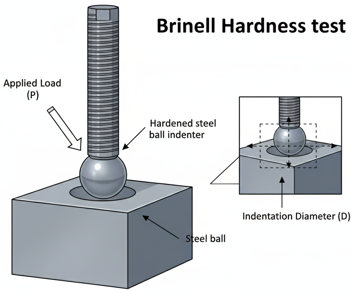
Brinell hardness testing is commonly used for metals and alloys, especially when testing large, coarse-grained materials like castings and forgings. Because it produces a relatively large indentation, it averages out hardness over a bigger area, making it especially useful for non-uniform materials.
Hardness Level
The measure of a material’s resistance to deformation, scratching, or indentation. In fasteners, hardness level indicates how durable the surface is and how well it can resist wear and damage over time. It’s usually shown as a number based on standardized tests like the Rockwell, Brinell, or Vickers scales.
Knoop Hardness Test
The Knoop hardness test is a microhardness testing method used to measure the hardness of very small, thin, or delicate materials—such as metal coatings, thin films, ceramics, and microstructures—where traditional hardness tests (like Rockwell or Brinell) would be too aggressive or imprecise. It was developed by Frederick Knoop and his colleagues at the National Bureau of Standards in 1939.
Unlike macroscopic hardness tests that use larger loads and indenters, the Knoop test uses a very light load (typically between 10 and 1000 grams-force) and an elongated diamond-shaped indenter. The indenter is rhombohedral, with one diagonal much longer than the other (about a 7:1 ratio). This unique shape allows for shallow indentations, making it ideal for testing thin coatings or brittle materials without causing cracking or substrate influence.
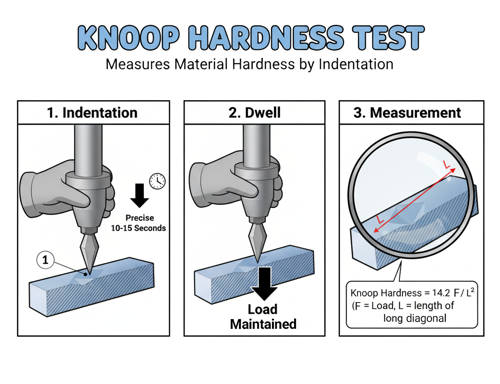
Here’s how the test works:
A highly polished sample surface is prepared, and the diamond indenter is pressed into it under a precise load for a set time (often around 10–15 seconds). After the load is removed, the length of the long diagonal (L) of the indentation is measured under a microscope. Because the indentation is so shallow, the area of contact can be accurately calculated using that diagonal measurement.
The Knoop hardness number (HK) is then determined by the formula:
HK = 14.229 × (F / L²)
where:
- HK = Knoop hardness number
- F = applied load (in kilograms-force)
- L = length of the long diagonal (in millimeters)
The constant 14.229 is derived from the geometry of the indenter.
The resulting value is expressed in kgf/mm² and gives a precise indication of the material’s resistance to localized deformation.
Because the Knoop test causes minimal surface damage and offers extremely fine resolution, it’s commonly used in metallurgy, thin-film coatings, microelectronics, ceramics, and glass. It’s particularly useful for measuring hardness gradients in surface treatments, case-hardened steels, and individual microstructures or phases within a metal or alloy.
Material Hardness
A material property describing resistance to surface deformation such as scratching, denting, or indentation. It is the underlying property that standardized tests quantify, while the resulting measurement or acceptable range is the hardness level.
Mohs Hardness Scale
The Mohs Hardness Scale is a comparative scale that measures the relative hardness of minerals and other materials based on their ability to resist scratching. It was developed in 1812 by German mineralogist Friedrich Mohs and is still widely used today as a quick, practical way to rank material hardness. The scale ranges from 1 to 10, with 1 being the softest and 10 the hardest. Each mineral on the scale can scratch any material ranked lower than itself, but not those higher.
At the soft end, talc is ranked at 1, meaning it can be easily scratched by any other mineral. At the hardest end, diamond is ranked at 10, representing the maximum hardness in natural materials. Other familiar examples include gypsum (2), calcite (3), fluorite (4), apatite (5), feldspar (6), quartz (7), topaz (8), and corundum (9, which includes sapphires and rubies).
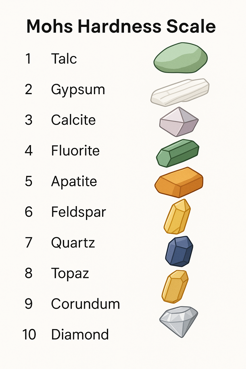
The Mohs Scale is not linear but ordinal, meaning the difference in hardness between successive numbers is not equal. For example, diamond (10) is much harder compared to corundum (9) than corundum is compared to topaz (8). Despite this, the scale is practical for fieldwork and industry because it gives a fast and simple way to test hardness using scratch comparisons.
In the context of fasteners and industrial applications, the Mohs Hardness Scale is relevant for understanding wear resistance, abrasion resistance, and material compatibility. For example, coatings, cutting tools, and surface treatments are often selected based on hardness relative to the materials they will interact with. While engineers often use more precise hardness measures such as Rockwell, Vickers, or Brinell hardness tests, the Mohs scale remains a useful reference for comparing material durability in general terms.
Rockwell Hardness Scale
The Rockwell Hardness Scale is one of the most widely used systems for measuring the hardness of metals, alloys, and other materials. Unlike the Mohs scale, which relies on scratch resistance, the Rockwell method determines hardness by measuring how deeply a steel or tungsten carbide indenter penetrates the surface of a material under a specific load. This makes it more precise, standardized, and applicable to a broad range of engineering materials.
The testing process begins by pressing an indenter—either a cone-shaped diamond, known as a Brale indenter, or a hardened steel ball—into the surface of the sample. First, a minor load is applied to seat the indenter and establish a reference point. A larger major load is then applied and held for a set time before being released. The depth of penetration relative to the initial position is measured, and the result is expressed as a Rockwell Hardness Number (HR). In this system, a shallower indentation indicates a harder material.
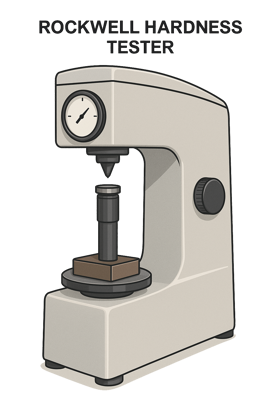
There are multiple Rockwell scales, each tailored to different materials and hardness ranges, and identified by a letter suffix after the HR value. For example, the Rockwell C scale (HRC) uses a diamond cone indenter and is typically applied to hardened steels, cutting tools, and high-strength fasteners. The Rockwell B scale (HRB) uses a steel ball indenter and is more suitable for softer metals such as copper, aluminum, and softer steels. Other variations—such as HRA, HRD, HRE, and HRF—are used for specific materials and testing conditions. As an example, a hardened steel bolt might fall in the range of HRC 35–45, while a softer structural steel may measure HRB 70–90.
The purpose and function of the Rockwell test is to provide a quick, reliable, and reproducible measure of a material’s resistance to indentation and deformation. This measurement correlates directly to the strength, wear resistance, and durability of the material being tested, making it highly valuable for both quality control and engineering design.
The Rockwell method offers several advantages. It is fast and easy to perform, requires minimal sample preparation, and is considered non-destructive for large parts since it only leaves a small indentation. It applies to a wide variety of metals and alloys and gives direct numerical results without the need for conversions.
There are also limitations. The test works best on flat or smoothly curved surfaces and is not suitable for rough or irregular geometries. It requires precise test conditions and proper calibration to ensure accuracy. It is less effective for very thin materials, coatings, or small parts where indentation depth may compromise the sample.
In applications, the Rockwell Hardness Scale is frequently used in fasteners and other industrial components to verify that they meet strength and wear resistance requirements. Automotive bolts, aerospace fasteners, and cutting tools are commonly measured on the Rockwell C scale, ensuring consistent quality and reliability in critical assemblies.
Vickers Hardness Test
Vickers Hardness (HV) is a measure of a material’s hardness determined using the Vickers hardness test. In this test, a diamond-shaped pyramid indenter is pressed into the material’s surface under a specific load. The size of the indentation left behind is measured under a microscope, and the hardness value (HV) is calculated based on the applied force divided by the surface area of the indentation.
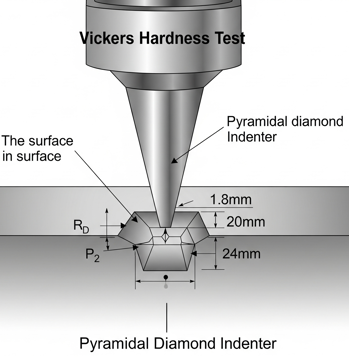
This method is widely used because it can test very hard or very thin materials, and it works on metals, ceramics, and coatings. Vickers Hardness is expressed in units of HV (e.g., 450 HV), where higher numbers indicate harder materials. It’s commonly applied in metallurgy, fastener testing, aerospace, and quality control to evaluate wear resistance, strength, and material performance.