
Learning Hub
Glossary
Kilogram-Force
Kilogram-force, abbreviated kgf, is a unit of force equal to the force exerted by standard Earth gravity on a mass of one kilogram. One kilogram-force is equal to exactly 9.80665 newtons, which is also approximately 2.205 pound-force.
Kilogram-force should not be confused with the kilogram, abbreviated kg, which is a unit of mass. A kilogram describes the amount of matter in an object, while kilogram-force describes a push, pull, load, tension, or weight acting on that mass. Under standard gravity, a mass of one kilogram has a weight of approximately one kilogram-force.
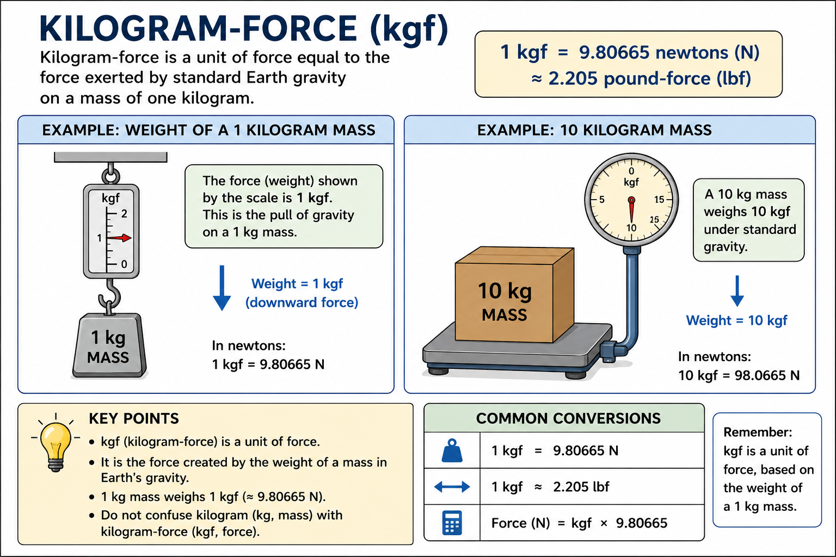
For example, an object with a mass of 10 kilograms exerts a downward force of approximately 10 kgf when it is resting near Earth’s surface. In newtons, that force is approximately 98.07 N. The relationship can be written as force in newtons equals kilogram-force multiplied by 9.80665.
In fastener and mechanical applications, kilogram-force may be used to describe clamp load, tensile load, pull-out force, test force, or the capacity of equipment. A fastener producing a clamp load of 1,000 kgf is pulling the joined parts together with a force of approximately 9,807 newtons.
Kilogram-force is not part of the modern International System of Units, which uses the newton as the standard unit of force. However, kgf is still encountered on older drawings, test equipment, pressure gauges, technical specifications, and machinery. In practical terms, kilogram-force tells you how strongly something is being pushed, pulled, lifted, stretched, or clamped, using the weight of a one-kilogram mass under standard gravity as the reference.