
Learning Hub
Glossary
Pull-Out Testing
Pull-out testing is a mechanical test used to measure how much force is required to pull a fastener, anchor, insert, stud, bolt, screw, rivet, or embedded component out of the material it is installed in. The test applies a controlled tensile force along the fastener’s axis until the part either reaches a required test load or fails.
In fastener and anchor applications, pull-out testing helps answer a very practical question: will the fastener stay in the material when it is pulled on? This is especially important for anchors in concrete or masonry, threaded inserts in plastic or metal, screws in wood, rivet nuts in sheet metal, adhesive anchors, weld studs, expansion anchors, and other fastening systems where the strength of the connection depends heavily on the base material.
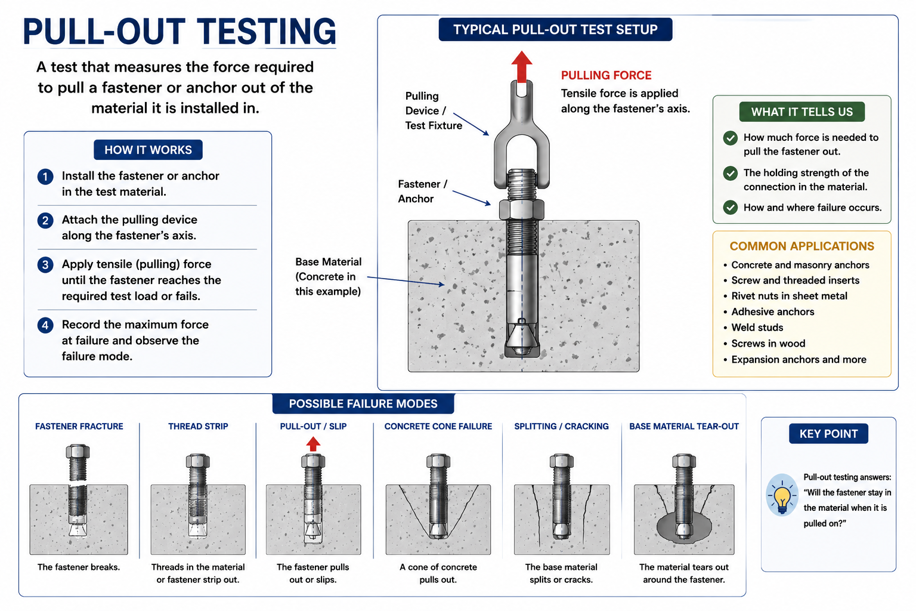
During a pull-out test, the fastener is installed into the test material using the specified method. A test fixture or pulling device is then attached to the fastener, and force is applied gradually. The test equipment records the load required to move, loosen, strip, break, or completely remove the fastener from the material.
Failure can happen several different ways. The fastener itself may fracture, the threads may strip, the insert may pull free, the anchor may slip, the surrounding concrete or wood may crack, or the base material may tear out around the fastener. Those failure modes are important because they show whether the weak point is the fastener, the installation method, the mating threads, the adhesive, or the material being fastened into.
Pull-out testing is different from tensile testing. In a tensile test, the goal is often to measure the strength of the fastener or material itself by pulling it apart. In a pull-out test, the focus is the holding strength of the installed connection. It is not just asking, “How strong is the fastener?” It is asking, “How well does this fastener stay put in this material?”