
Learning Hub
Glossary
Double Shear
Double shear is a loading condition that occurs when a fastener such as a bolt, pin, or rivet is subjected to shear forces acting in two parallel planes. This means the load is distributed across two cross-sectional areas instead of one, allowing the fastener to resist higher loads than it would in single shear. Essentially, the fastener experiences two simultaneous shearing actions, which makes the connection stronger and more efficient.
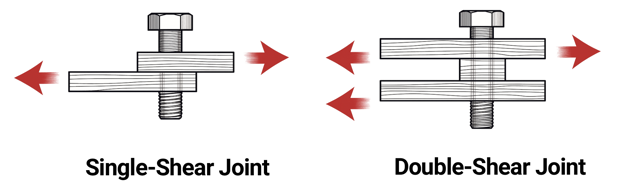
In a single-shear joint, the bolt or pin is only sheared in one location, with the entire load acting on a single cross-section. In a double-shear joint, however, the load passes through two connected members, so the fastener is sheared in two places. Because the load is divided between two shear planes, each carries only half the total force, effectively doubling the joint’s shear capacity when the load is evenly distributed.
A simple example can be seen in bolted plate assemblies. If two plates are joined by a single bolt, that bolt is in single shear. If a third plate is added between them and the bolt passes through all three, the bolt is in double shear. This configuration provides greater strength and stability because it reduces the stress on each shear plane. In practical terms, double shear allows a joint to support more load without increasing the size of the fastener, making it a preferred design in many structural and mechanical applications.
Shear Load
Shear load is a sideways force applied across a material, fastener, or joint that tries to make one part slide past another. In a fastened assembly, shear load acts perpendicular to the fastener’s axis, rather than pulling along the length of the bolt or screw.
A simple example is a bolt passing through two overlapping plates. If one plate is pushed to the left and the other is pushed to the right, the bolt is loaded in shear. The force is trying to cut across the bolt’s shank at the joint line, almost like scissors trying to slice through the fastener.
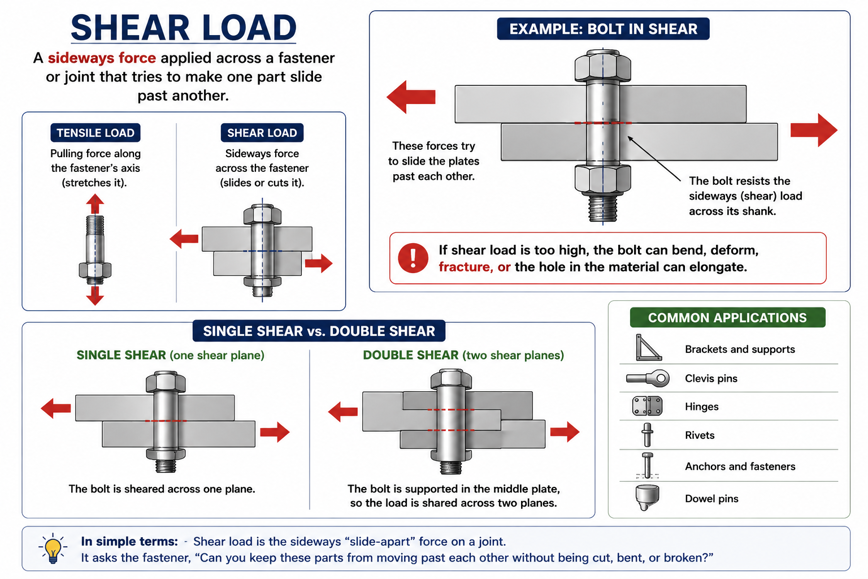
Shear load is different from tensile load. Tensile load pulls a fastener lengthwise and tries to stretch it. Shear load pushes sideways across the fastener and tries to slide or cut it. In many real assemblies, a fastener may experience both tension and shear at the same time, but the terms describe different directions of force.
In fastener applications, shear load is important for bolts, pins, rivets, screws, anchors, dowel pins, clevis pins, and structural connectors. Parts exposed to sliding, side loading, vibration, impact, or bracket-style loading often need to be checked for shear. If the shear load is too high, the fastener may bend, deform, fracture, tear through the material, or cause the hole in the joined part to elongate.
Shear load can occur in single shear or double shear. In single shear, the fastener is being sheared across one plane, such as two plates joined together. In double shear, the fastener is supported in a way that creates two shear planes, such as a clevis joint with a center plate captured between two outer plates. Double shear usually allows the load to be shared across two sections of the fastener instead of one.
In simple terms, shear load is the sideways “slide-apart” force on a joint. It asks the fastener, “Can you keep these parts from moving past each other without being cut, bent, or broken?”
Shear Nut
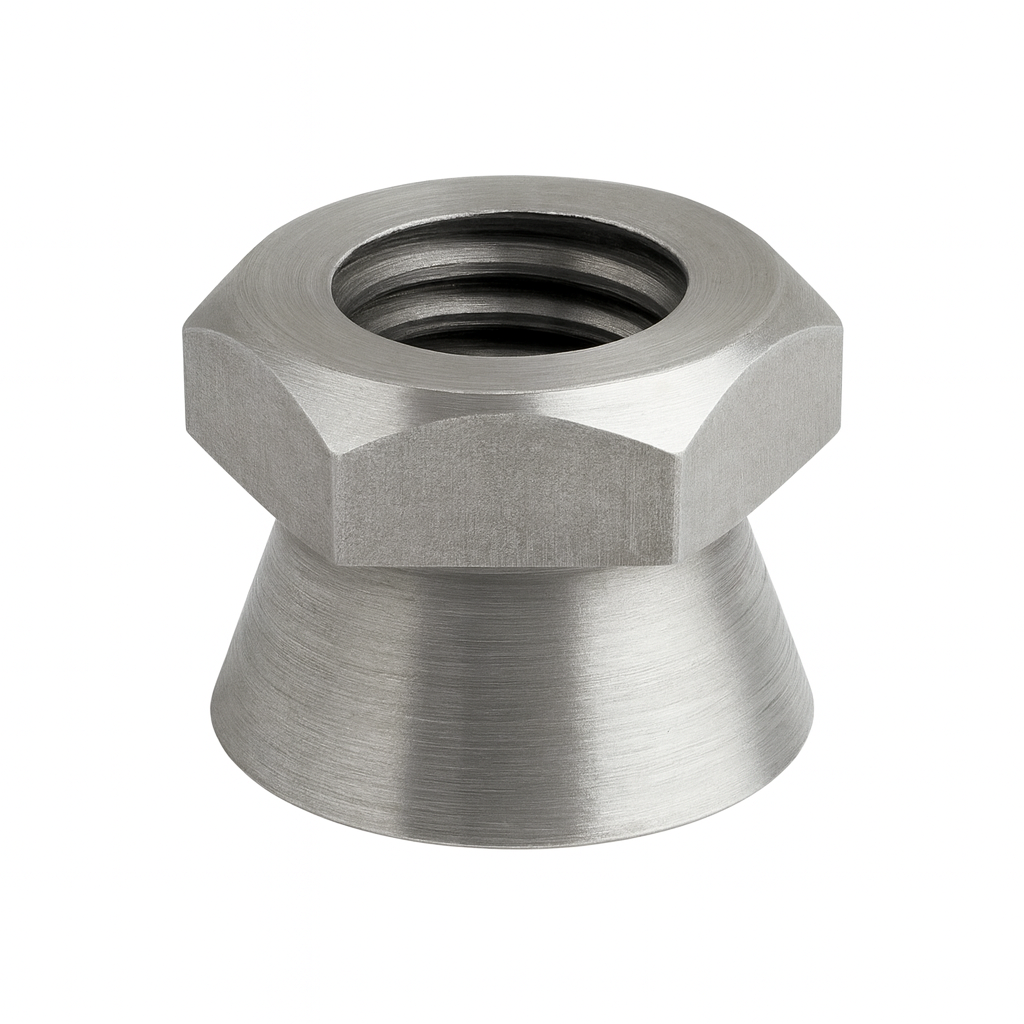
A shear nut is a type of security fastener designed to prevent tampering or unauthorized removal. It consists of a hexagonal upper section used for tightening and a smooth, conical lower section. During installation, the hex portion breaks off (shears) once a specified torque is reached, leaving behind only the tamper-resistant cone.
Because the remaining section has no grip points for standard tools, shear nuts are extremely difficult to remove without specialized equipment. They are commonly used in security-sensitive applications such as fencing, street signs, utility installations, and other public infrastructure where theft or vandalism is a concern.
Shear Screw
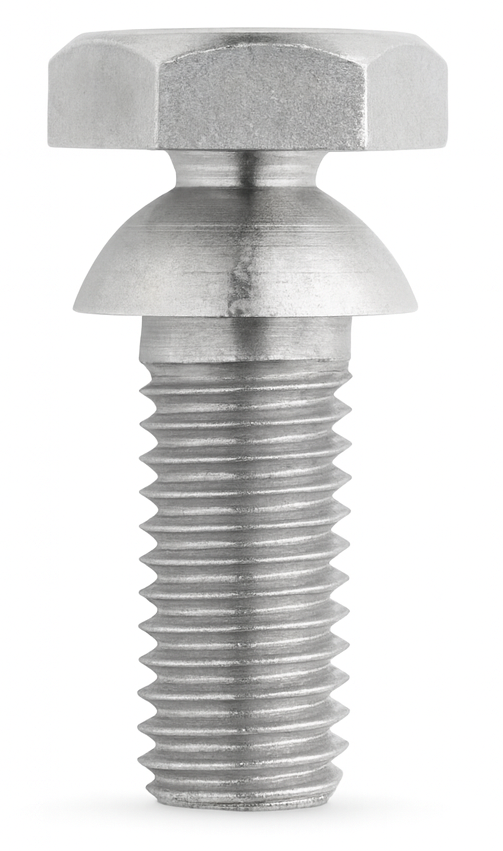
A shear screw is a tamper-resistant fastener specifically designed so that its drive head intentionally breaks off, or “shears,” when tightened to a predetermined torque. Once this happens, the drive portion separates from the body of the screw, leaving behind a smooth, often conical or headless surface. Because there is no usable drive left, the fastener cannot be engaged with standard tools, making it extremely difficult to remove.
The main purpose of a shear screw is to create a permanent and secure fastening in situations where tampering or unauthorized removal must be prevented. By eliminating the head after installation, the screw ensures that it cannot be loosened without specialized methods such as drilling or destructive extraction, which adds a strong layer of security.
Shear screws are widely used in applications that demand high security and reliability. They are commonly found in access panels, electrical enclosures, and public fixtures, where tampering could compromise safety or operations. They are also used as theft-prevention fasteners in items such as meter housings, street furniture, and alarm systems. Additionally, they serve an important role in safety-critical assemblies where loosening could lead to hazards or failures.
While they share similarities with break-off screws, the defining characteristic of a shear screw is that the head shears away at a calibrated torque, leaving behind a permanent, tamper-proof fixing that is non-removable under normal conditions. This ensures that once installed, the fastener provides long-term security and reliability.
Shear Strength
Shear strength is the maximum amount of force a material or fastener can withstand when two opposing forces try to slide one part of it across another, essentially trying to “cut” or “shear” it. Instead of pulling the fastener apart (tension) or crushing it (compression), shear acts sideways, across the fastener’s cross-section.
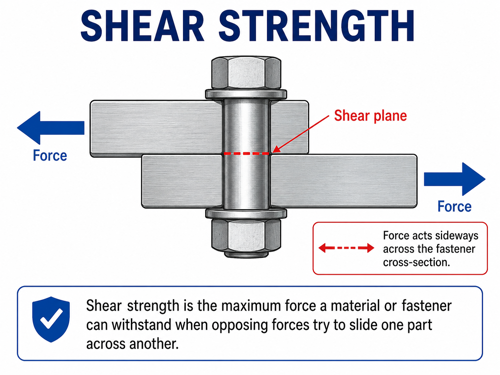
In fasteners, shear strength is a critical measure of how a bolt, pin, rivet, or screw will perform when loads push across it rather than pull on it. A bolt holding two plates together in double-shear, a clevis pin in machinery, a wheel stud supporting a rotating hub, or a rivet in sheet metal all experience shear loads. Typically, shear strength for steel fasteners is roughly 60% of their tensile strength, though the exact value depends on material, grade, heat treatment, and manufacturing method.
Understanding shear strength is essential in industrial design, construction, and fastener selection because a fastener may meet tensile requirements but still fail if exposed to high lateral forces. In applications with vibration, shock loading, joints that shift, rotating equipment, or structural members that bear sideways loads, choosing a fastener with the correct shear capability is just as important as selecting the right tensile strength or hardness.