
Learning Hub
Glossary
Plating (Industrial)
Industrial plating is a surface-finishing process in which a thin layer of metal is deposited onto another material, usually a metal part, to improve its performance, appearance, or durability. The plated layer may be added for corrosion resistance, wear resistance, electrical conductivity, solderability, hardness, lubricity, dimensional buildup, or decorative appearance.
In many industrial applications, plating is done by electroplating. In electroplating, the part is placed in a chemical bath containing dissolved metal ions, and an electric current is used to deposit the plating metal onto the part’s surface. For example, zinc, nickel, chromium, copper, tin, cadmium, silver, or gold can be deposited onto steel or other base materials. The part being plated is usually connected as the cathode, and the plating metal builds up on its surface in a controlled layer.
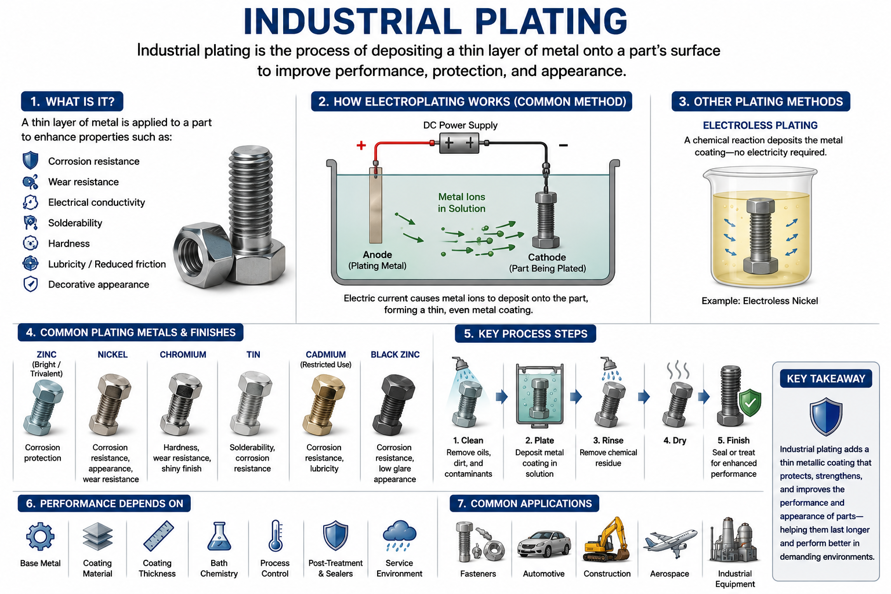
Industrial plating can also include related processes such as electroless plating, where the metal coating is deposited through a chemical reaction instead of electrical current. Electroless nickel plating is a common example. It can coat complex shapes more uniformly than many electroplating processes because it does not depend on current flow in the same way.
For fasteners, industrial plating is especially important because bolts, screws, nuts, washers, and threaded parts often need added corrosion protection or controlled friction. Zinc plating is commonly used to protect steel from rust by providing both a barrier and sacrificial protection. Nickel plating may be used for appearance, wear resistance, and corrosion resistance. Tin plating may help with solderability. Cadmium plating, while highly controlled and restricted due to environmental and health concerns, has historically been used in aerospace and marine applications because of its corrosion resistance and lubricity.
The performance of a plated part depends on the base metal, plating material, coating thickness, surface preparation, cleaning quality, bath chemistry, current density, post-treatments, sealers, and the environment where the part will be used. Poor plating control can lead to problems such as uneven coating thickness, poor adhesion, hydrogen embrittlement risk in high-strength steel, reduced thread fit, dull appearance, porosity, cracking, peeling, or inconsistent torque-tension behavior.
Industrial plating should not be confused with painting or powder coating. Paint and powder coating apply an organic film over the surface, while plating deposits a metallic layer. It is also different from hot-dip galvanizing, where steel is dipped into molten zinc, and mechanical galvanizing, where zinc particles are impact-bonded to the surface.