
Learning Hub
Glossary
Electroless Nickel Plating
Electroless nickel plating (ENP) is a chemical plating process that deposits a uniform layer of nickel-phosphorus or nickel-boron alloy onto a substrate without the use of an external electrical current. Unlike traditional electroplating, which relies on electric current to drive metal deposition, electroless nickel plating uses an autocatalytic chemical reaction—meaning the metal itself helps catalyze its own deposition.
The process begins by immersing the part in a nickel salt solution (usually nickel sulfate or nickel chloride) along with a reducing agent, most commonly sodium hypophosphite. The reducing agent chemically reduces nickel ions (Ni²⁺) to metallic nickel (Ni⁰), which deposits evenly on the surface. Once the first layer of nickel forms, it becomes catalytic, allowing the reaction to continue and build up the coating uniformly.
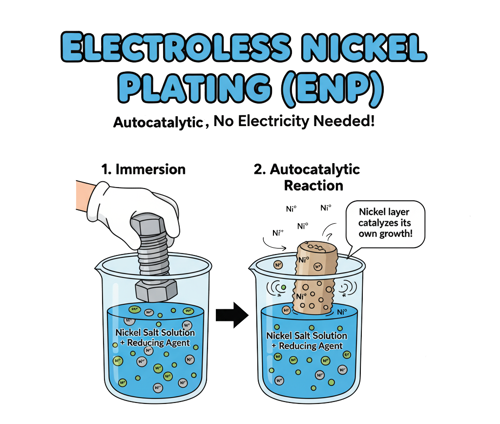
This method offers a major advantage: the coating thickness is completely uniform, even on complex geometries, recesses, threads, and internal surfaces—areas that are often unevenly coated during electroplating. This makes ENP ideal for precision parts, valves, pumps, fasteners, and molds where tight tolerances and smooth finishes are required.
Electroless nickel coatings can be tailored to specific applications based on their phosphorus content:
- Low-phosphorus (2–5%) coatings are hard, wear-resistant, and conductive.
- Medium-phosphorus (6–9%) coatings provide a balance of hardness and corrosion resistance.
- High-phosphorus (10–13%) coatings offer excellent corrosion and chemical resistance, making them ideal for marine or chemical environments.
After plating, the coating can be heat-treated to increase hardness—up to 1,000 HV (about 70 Rockwell C)—comparable to hardened steel. It also improves adhesion and wear resistance.
Electroless nickel plating is widely used across aerospace, automotive, oil and gas, electronics, and tooling industries. Common applications include gear components, hydraulic pistons, molds, connectors, and shafts. Its combination of hardness, smoothness, lubricity, and corrosion protection makes it one of the most versatile surface treatments available.