Learning Hub
Glossary
Gold (Au)
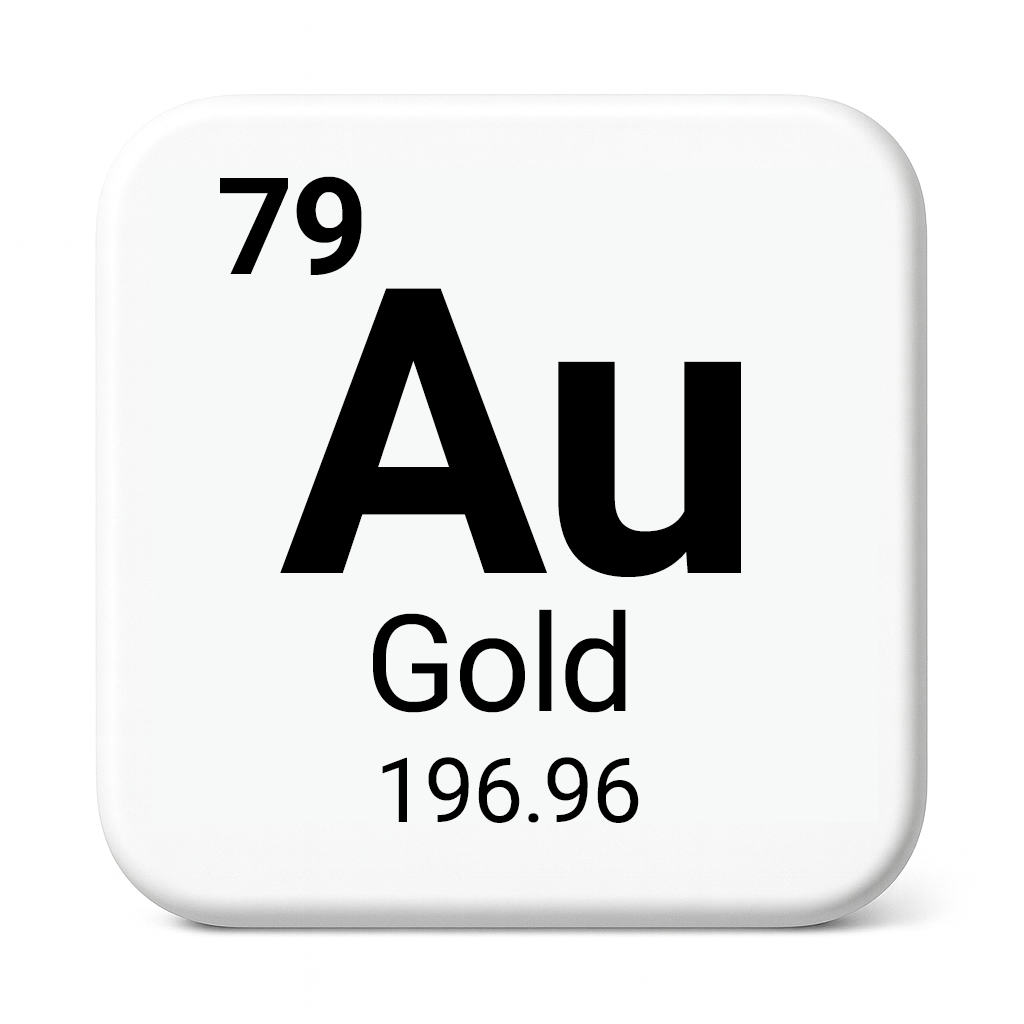
Gold is a dense, soft, yellow metallic element with the chemical symbol Au and atomic number 79. It is one of the best-known precious metals because of its distinctive color, high value, resistance to corrosion, and long history of use in coins, jewelry, decoration, electronics, and financial reserves.
Gold is classified as a noble metal, meaning it resists oxidation and many forms of chemical attack much better than most metals. Unlike iron, gold does not rust. Unlike copper or silver, it does not readily tarnish under normal atmospheric conditions. This stability is one reason ancient gold artifacts can survive for thousands of years with very little surface deterioration.
Pure gold is very malleable and ductile, meaning it can be hammered into extremely thin sheets or drawn into fine wire without breaking. However, pure gold is also relatively soft, so it is often alloyed with other metals such as copper, silver, nickel, palladium, or zinc to improve hardness, strength, color, and wear resistance. The purity of gold is often measured in karats. Pure gold is 24 karat, while 18 karat gold contains 18 parts gold and 6 parts other metals.
Gold is an excellent electrical conductor and is highly resistant to surface oxidation, which makes it useful in electrical contacts, connectors, circuit boards, aerospace components, and high-reliability electronics. Even a very thin gold coating can help maintain low electrical resistance because the surface does not easily corrode or form insulating oxides.
In industrial and fastener-related applications, gold may be used as a thin plating where excellent corrosion resistance, electrical conductivity, or reliable contact performance is needed. It is not typically chosen for structural strength because it is too soft and expensive compared with engineering metals such as steel, stainless steel, titanium, or nickel alloys.
Gold occurs naturally in the Earth’s crust, sometimes as native metal and sometimes associated with quartz veins, sulfide minerals, or placer deposits. It can be recovered through mining, crushing, gravity separation, flotation, leaching, refining, and electrochemical processes. Because gold is chemically stable and valuable even in small quantities, it is also widely recycled from jewelry, electronics, and industrial scrap.