
Learning Hub
Glossary
Corrosion Resistance
Corrosion resistance is a material’s ability to withstand chemical or electrochemical attack from its environment without breaking down, rusting, pitting, staining, weakening, or losing function. In simple terms, it describes how well a material can resist deterioration when exposed to moisture, oxygen, salts, acids, chemicals, heat, or other corrosive conditions.
Corrosion resistance can come from the material itself or from a protective surface finish. Stainless steel, for example, resists corrosion because chromium in the steel forms a very thin, stable oxide layer on the surface. This passive film helps protect the metal underneath from further attack. Aluminum works in a similar way by forming a protective aluminum oxide layer. Other metals, such as plain carbon steel, have relatively poor corrosion resistance unless they are protected by plating, galvanizing, paint, oil, phosphate, black oxide, zinc flake, or another coating system.
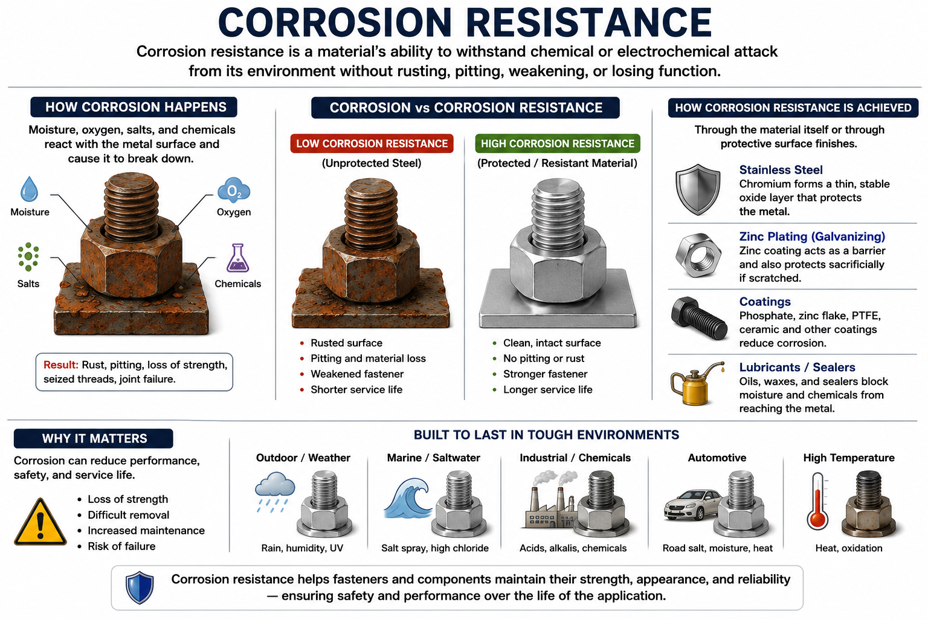
In fastener applications, corrosion resistance is important because bolts, screws, nuts, washers, and threaded components are often exposed to water, humidity, road salt, chemicals, outdoor weather, or industrial environments. If corrosion attacks a fastener, it can reduce thread engagement, weaken the part, make removal difficult, damage the joint, or eventually cause failure.
Corrosion resistance is not the same as corrosion protection, although the two are closely related. Corrosion resistance describes how well a material or finished part can naturally or functionally withstand corrosion. Corrosion protection refers to the methods used to improve that performance, such as coatings, platings, sealers, oils, sacrificial zinc layers, or better joint design.
The level of corrosion resistance depends on many factors, including the base metal, coating type, coating thickness, surface preparation, exposure environment, temperature, moisture, salt concentration, contact with dissimilar metals, and whether the surface is scratched or damaged. A finish that performs well indoors may fail quickly in a marine, salt-spray, chemical, or high-temperature environment.