
Learning Hub
Glossary
ANSI (American National Standards Institute)
ANSI stands for the American National Standards Institute, a private, non-profit organization that oversees the development of voluntary consensus standards for products, services, processes, systems, and personnel in the United States. Its primary purpose is to coordinate, accredit, and unify standards developed by other organizations to ensure consistency and reliability across industries. ANSI also serves as the official U.S. representative to international standard-setting bodies, including the International Organization for Standardization (ISO) and the International Electrotechnical Commission (IEC), helping align U.S. practices with global requirements. By promoting uniform standards, ANSI ensures that products and services are safe, reliable, and compatible.
One of ANSI’s most important contributions is its role in accreditation. While ANSI itself does not write standards, it accredits the procedures of standards-developing organizations (SDOs) to ensure they follow requirements for openness, balance, consensus, and due process. This creates a fair and transparent system for developing industry-wide standards. ANSI’s influence extends across many industries, including construction, manufacturing, energy, safety equipment, and information technology.
ANSI’s work has a significant impact on both domestic and global trade. It plays a key role in harmonizing U.S. standards with international ones, helping reduce trade barriers and ensuring American products can compete in worldwide markets. For example, consistent standards guarantee that a product designed in the U.S. meets compatibility and safety expectations overseas.
In the fastener industry, ANSI standards are especially important. They define specifications for bolt, screw, and nut sizes, materials, strength grades, and testing methods. These standards ensure that fasteners manufactured in different locations are interchangeable and reliable. For example, a bolt produced in one state will fit properly with a nut made in another, thanks to the consistency provided by ANSI standards.

Differential Expansion
Differential expansion is the difference in how much two materials or components expand or contract with temperature change. It happens because materials have different coefficients of thermal expansion and because parts in an assembly may heat or cool at different rates, so they don’t all change size by the same amount at the same time.
In bolted industrial joints, differential expansion matters because it can change clamp load and sealing stress. If the flanges, gasket, and bolts expand by different amounts as temperature rises (or cools), the joint can see preload increase or decrease, sometimes unevenly around the bolt circle. Over repeated thermal cycles, that shifting load can contribute to gasket relaxation/leakage, bolt loosening or yielding, joint distortion, and fatigue—especially in equipment like heat exchangers, piping flanges, and pressure vessels where temperature swings are routine.
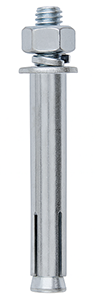
Double Expansion Shield Anchor
A Double Expansion Shield Anchor is a mechanical anchor used to securely fasten objects into brittle base materials like concrete, brick, or block, where expansion anchors might otherwise crack the material.
Expansion Bolt
An expansion bolt is a type of fastener used to secure heavy loads to materials like concrete, brick, or stone by expanding within a drilled hole to create a tight, friction-based anchor. Unlike ordinary screws or bolts that rely on threads for grip, expansion bolts use mechanical expansion to hold firm against the walls of the base material, making them ideal for structural and load-bearing applications.
The basic design of an expansion bolt includes a bolt or threaded stud, an expansion sleeve or shell, and a cone-shaped plug or wedge. When the bolt is tightened, it pulls the cone into the sleeve, forcing the sleeve to expand outward and press tightly against the sides of the hole. This frictional force locks the bolt securely in place. Some versions expand mechanically when torqued, while others rely on hammering or chemical adhesives (like epoxy) for additional strength.
Expansion bolts come in several varieties depending on the application:
- Wedge anchors – common for structural applications like mounting machinery, handrails, or heavy equipment to concrete.
- Sleeve anchors – versatile and used in softer masonry materials.
- Drop-in anchors – designed to sit flush with the surface, often used for overhead or suspended installations.
- Shield anchors – provide excellent holding power in brick or stone walls.
Because of their strength and reliability, expansion bolts are widely used in construction, infrastructure, and industrial equipment mounting, ensuring stable, vibration-resistant connections that can withstand shear and tension forces.
Expansion Nut
An expansion nut is a blind fastening device or threaded insert that secures itself by expanding as it is tightened. Instead of relying on tapped threads in the base material, it is installed into a predrilled hole and then deforms, flares, or swells behind the surface to create a secure female-threaded attachment point. This makes it useful in thin materials, hollow sections, brittle materials, or applications where standard threads cannot be cut directly into the parent material.
In practical use, the term expansion nut can refer to more than one product style. Some types use a rubber body with a metal insert that compresses and expands behind the panel when a screw is tightened, helping provide threaded retention along with some vibration resistance and sealing. Other types are made of metal with slotted sections that collapse and spread on the blind side of the material, forming a backing shape that holds the nut in place and helps distribute load.
An expansion nut is best understood as a threaded blind insert that anchors itself by expanding within or behind a hole during installation. It is commonly used when only one side of the workpiece is accessible and when the assembly needs a reusable threaded connection in material that is too thin, soft, or fragile to tap conventionally.
AKA: Well Nut, Rubber Nut, Snap-In Nut

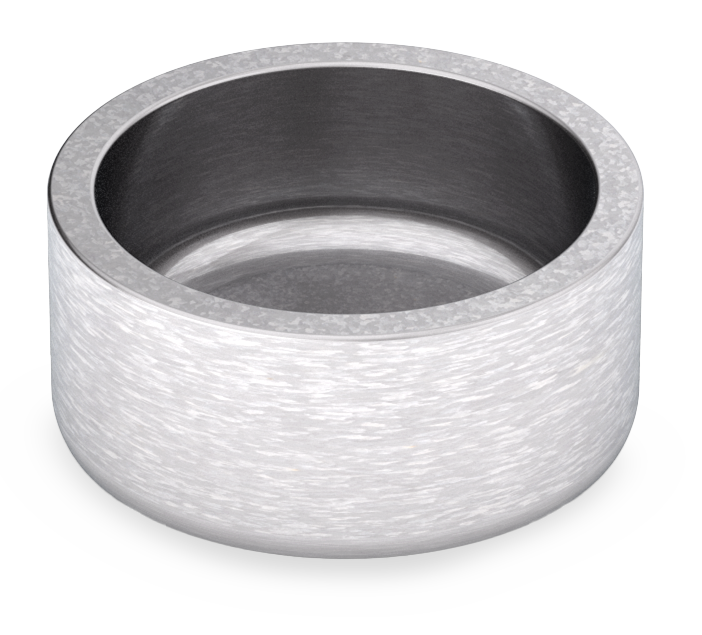
KMC Expansion Plug
An industrial expansion plug is a mechanical device used to seal, block, or test openings in pipes, tubes, or bores by expanding to create a tight and secure fit. These plugs are widely used in plumbing, automotive, aerospace, and industrial applications to prevent fluid or gas leakage, maintain pressure, or temporarily seal off sections for maintenance.
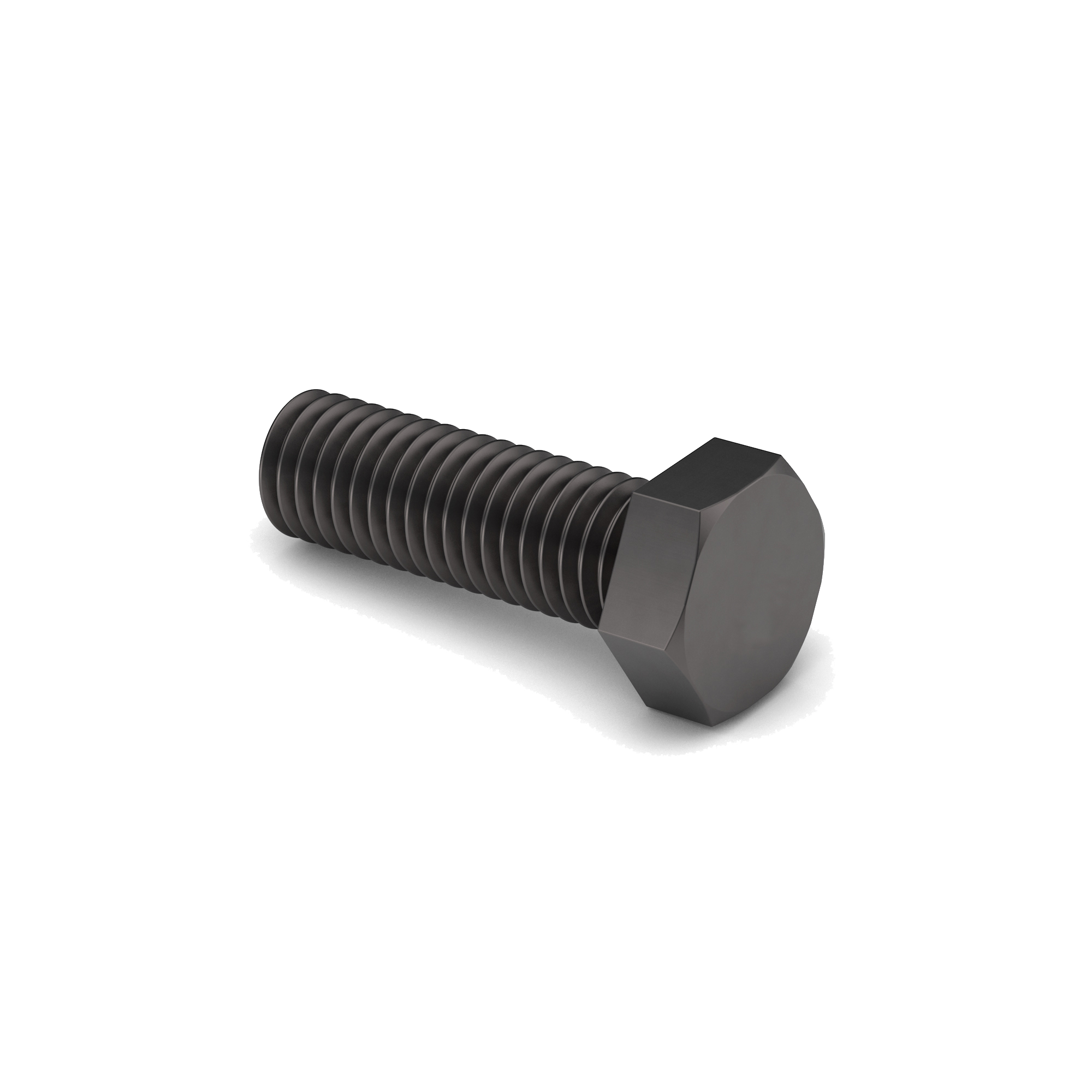
Metric Hex Head Cap Screw (ANSI)
A Metric Hex Head Cap Screw (ANSI) is a type of threaded fastener with a hexagonal (six-sided) head, used for securing materials or components. It is manufactured to metric dimensions and follows specifications set by the American National Standards Institute (ANSI). These screws are widely used in machinery, construction, automotive, and many other applications.
Thermal Expansion
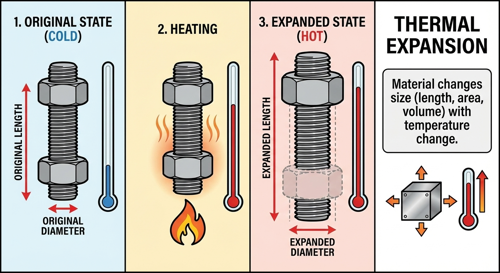
Thermal expansion, in the context of engineering and fasteners, is the tendency of any material to change its size—specifically its length, area, or volume—in direct response to a change in temperature. When a component is heated, its constituent atoms vibrate more energetically and move further apart, resulting in physical expansion. Conversely, cooling the component causes the atoms to slow down and move closer together, leading to contraction. This fundamental property is measured by the Coefficient of Thermal Expansion (α), a value unique to each material. The amount a component's length changes is proportional to its original length, the temperature change, and this coefficient.
Calculating Thermal Expansion
The change in length (ΔL) of a component due to a change in temperature (ΔT) can be calculated using a linear expansion formula.
Change in Length=Coefficient of Thermal Expansion×Original Length×Change in Temperature
Impact on Fastened Joints
Understanding thermal expansion is critical in fastener design, particularly when a joint involves multiple materials. This phenomenon, known as Differential Thermal Expansion, occurs when the fastener (e.g., a steel bolt) and the materials it clamps (e.g., aluminum flanges) have different coefficients of thermal expansion (α). If the bolt expands or contracts at a different rate than the clamped material, it can create two significant problems. The first is a loss of clamp load, where the joint loosens because the component expands more than the bolt, a common failure point. The second is the generation of excessive stress, where a highly expansive bolt can over-tighten and crush the clamped components. Engineers mitigate these risks by carefully selecting materials with closely matched α values or by incorporating elastic elements like compression washers to absorb the inevitable dimensional changes.