
Learning Hub
Glossary
Sealing Stress
Sealing stress is the compressive contact stress applied to a gasket (or sealing surface) in a joint—essentially the pressure squeezing the gasket between the mating faces—that is necessary to create and maintain a leak-tight seal. It is created primarily by bolt preload (clamp load) and is distributed over the gasket’s effective contact area, so it’s often thought of as “how hard the joint is pressing on the gasket” at assembly and in service.
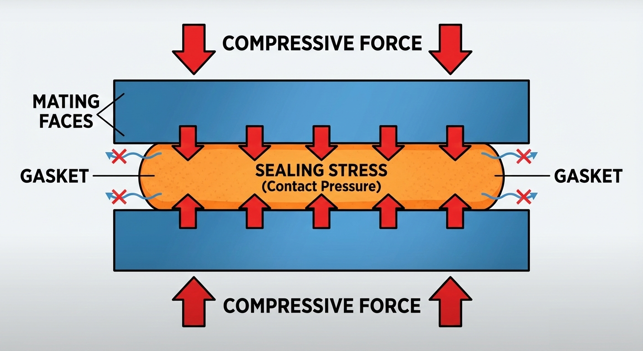
Sealing stress has two practical requirements: there must be enough stress to seat the gasket initially (so it conforms to flange surface roughness, waviness, and minor imperfections), and there must be enough retained stress over time to resist internal pressure, thermal cycling, vibration, and relaxation mechanisms that try to open leak paths. If sealing stress is too low or non-uniform, the gasket may not fully conform, micro-channels can remain, and leakage can occur; if sealing stress is too high, the gasket can be over-compressed, damaged, extruded, or crushed, which can also lead to leakage or shortened service life.
In real joints, sealing stress is not perfectly uniform around the gasket because it’s influenced by bolt spacing, flange stiffness, gasket type, surface finish, alignment, and tightening method. It can also change after tightening due to gasket seating/relaxation, embedment, creep (cold flow), and differential thermal expansion, which is why controlled tightening sequences, multiple passes, and sometimes retorque practices are used to achieve and maintain the target sealing stress window for the specific gasket and service conditions.
AKA: Gasket Seating Stress