
Learning Hub
Glossary
Torque-to-Yield Bolt (TTY)
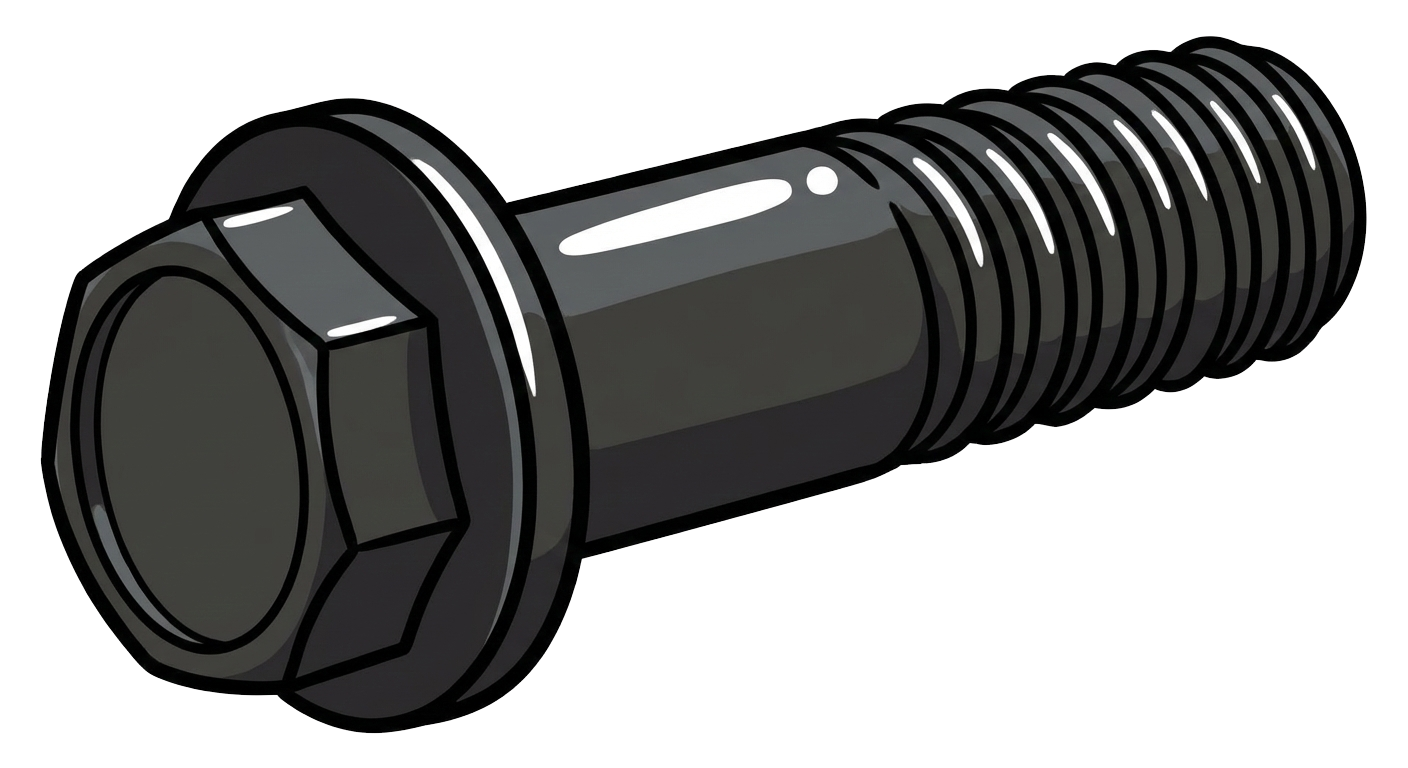
A Torque-to-Yield (TTY) bolt is a fastener designed to be tightened beyond its elastic limit into the plastic range, meaning it permanently stretches slightly during installation. Instead of relying on torque alone, these bolts are tightened in two steps: first to a specified torque value, then by a set angle of rotation. This method ensures a highly accurate and uniform clamping force, making TTY bolts especially useful in critical applications such as engine cylinder heads, main bearings, and connecting rods, where consistent pressure is vital to prevent leaks or failures.
Because they are stretched past their yield point, TTY bolts cannot be safely reused—once removed, they must be replaced. While more costly and requiring precise torque-angle tools, their ability to deliver consistent load distribution makes them a preferred choice in demanding environments where reliability is essential.
AKA: Stretch Bolt
Yield Point
The exact moment when a fastener begins to deform permanently under stress. This is when the material starts to stretch and won’t return to its original shape once the load is removed. Unlike yield strength, which is a specific stress value, the yield point refers to the actual onset of this permanent deformation.
Yield Strength
Yield strength is the amount of stress a material can withstand before it begins to deform permanently. Up to this point, the material behaves elastically—meaning it will return to its original shape when the load is removed. Once the yield strength is exceeded, however, the material enters the plastic deformation range, where it begins to stretch or bend in a way that cannot be reversed, even if the load is taken off.
In the context of fasteners such as bolts or screws, yield strength represents the maximum tensile stress that can be applied without causing permanent elongation. It is a critical design limit because a fastener that yields may lose its ability to maintain proper clamping force, leading to joint failure or loosening over time. Yield strength is typically measured in megapascals (MPa) or pounds per square inch (psi), and is determined through a tensile test where a specimen is pulled until it begins to yield.
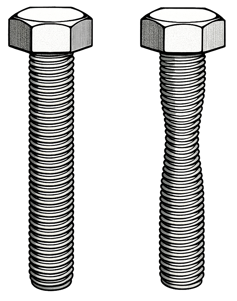
On a stress–strain curve, the yield point marks the transition between the elastic and plastic regions. Before this point, the relationship between stress and strain is linear and predictable (following Hooke’s Law). Once yield strength is reached, the material starts to deform more rapidly with little additional stress, signaling the onset of permanent distortion.
For most steel fasteners, the yield strength is usually about 80–90% of the ultimate tensile strength (UTS). For example, a bolt with a tensile strength of 800 MPa might have a yield strength of around 640–720 MPa. Engineers use this value to ensure that fasteners are tightened to produce sufficient clamping force without exceeding their elastic limit.
In summary, yield strength defines the boundary between reversible and irreversible deformation. It ensures that fasteners, structural components, and machine parts can operate safely under load while maintaining their original form and function. It is one of the most important mechanical properties used in engineering design and material selection.