
Learning Hub
Glossary
Gasket Leakage
Gasket leakage is the unintended escape of a fluid (gas or liquid) through a gasketed joint because the gasket–flange interface does not maintain a continuous, sufficiently compressed sealing barrier. Leakage occurs when the contact stress on the gasket is too low, non-uniform, or becomes compromised, allowing a leak path to form through surface imperfections, gasket porosity, micro-channels, or along the gasket edges.
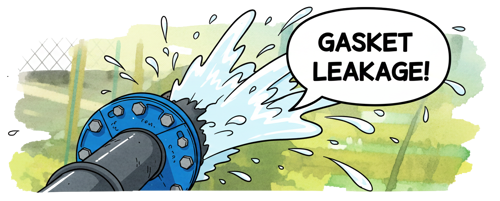
Leakage is commonly caused by insufficient bolt preload, uneven tightening, or loss of clamp load over time due to gasket seating/relaxation, embedment, creep (cold flow), or vibration. It can also be driven by thermal cycling, which repeatedly changes relative expansion between bolts, flanges, and the gasket, altering gasket stress and potentially “working” the joint until sealing stress drops below what’s required. Additional contributors include incorrect gasket selection for the service (pressure, temperature, chemical compatibility), damaged or warped flange faces, improper surface finish, misalignment, and bolt or nut issues (yielding, galling, wrong lubrication, or excessive friction variability that prevents achieving target preload).
Gasket leakage is often described by where it occurs: internal leakage (past a partition in heat exchangers), external leakage (to atmosphere), or blowout (a sudden gasket failure from excessive pressure or loss of restraint). Preventing it typically centers on achieving and retaining the correct gasket stress using proper gasket type, flange finish, bolt material, tightening method (multi-pass patterns, controlled torque, tensioning), and, when required, post-assembly retorque practices such as a relaxation pass.