
Learning Hub
Glossary
Piping Flanges
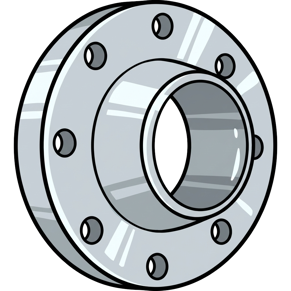
Piping flanges are mechanical connectors used to join sections of pipe, valves, pumps, and other equipment into a pressure-tight system using bolts and a gasketed sealing surface. Think of them as the “bolt-together” joints of a piping system—built so you can assemble, disassemble, inspect, swap components, and maintain without cutting and rewelding pipe every time.
What a flange actually does in the real world
A flange joint is basically three things working together:
1. Two flange faces (the mating surfaces)
2. A gasket between them (the seal)
3. Bolting that clamps the faces together with enough force to compress the gasket and resist internal pressure
In industrial service, flanges show up wherever you need serviceability (valves, strainers, instruments), equipment connections (pump suction/discharge, vessel nozzles, heat exchangers), and code-compliant pressure boundaries.
Why flanges matter (and where problems happen)
Flanges are engineered to handle:
- Pressure & temperature (your “pressure class” / rating)
- Thermal cycling (hot/cold swings can relax bolt load)
- Vibration (pumps, compressors)
- Corrosion/chemistry (material selection is huge)
- Alignment and assembly quality (most leaks are assembly/tolerance/bolt-load issues)
Most flange leaks aren’t “bad flanges”—they’re usually wrong gasket, incorrect bolt torque pattern, poor surface finish, misalignment, dirty faces, or bolting/material mismatch.
Common flange types (how they attach to pipe)
Here are the usual suspects you’ll see on drawings and in plants:
- Weld Neck (WN): Butt-welded to the pipe with a tapered neck. Excellent for high pressure/high temperature and fatigue service (vibration, cycling).
- Slip-On (SO): Pipe slips into the flange and is fillet-welded. Easier to fit up, common in moderate service.
- Socket Weld (SW): Pipe inserts into a socket and is fillet-welded. Common in small-bore (often ≤2") higher-pressure services.
- Threaded: Screws onto threaded pipe. Used where welding is undesirable, generally limited by service conditions and code practices.
- Lap Joint (LJ): Used with a stub end; the flange rotates around it. Great when you need easy alignment or use expensive alloy pipe but cheaper flange material (with correct compatibility).
- Blind (BL): Solid flange used to cap/terminate a line or provide access for future tie-ins.
Flange faces (how they seal)
The face style controls the gasket type and sealing behavior:
- Raised Face (RF): Most common in industrial piping. Uses a gasket on a raised sealing surface.
- Flat Face (FF): Often used with cast iron equipment to avoid overstressing the flange; gasket covers the entire face.
- Ring-Type Joint (RTJ): Uses a metal ring gasket in a machined groove; for high pressure/high temperature and critical service.
Surface finish (the “serrations”/roughness) matters because it affects how the gasket “bites” and seals.
Pressure classes and sizing
Flanges are typically specified by:
- NPS (Nominal Pipe Size, e.g., 4", 6")
- Pressure Class (e.g., Class 150, 300, 600, 900, 1500, 2500)
- Material grade (e.g., carbon steel, stainless, alloy)
- Facing (RF/FF/RTJ)
- Standard (commonly ASME B16.5 for many sizes, and ASME B16.47 for large diameter flanges)
(Those “classes” are not directly “psi”; the allowable pressure depends on material and temperature.)
Where you’ll see them in fastener-land
Flange joints are a big consumer of stud bolts and nuts. A typical setup is:
- Stud bolts + heavy hex nuts (often with washers depending on spec/practice)
- Materials selected for service: e.g., carbon steel for general service; alloy/stainless where required; with attention to galvanic corrosion and temperature.