
Learning Hub
Glossary
Smelting
Smelting is a high-temperature metallurgical process used to extract a metal from its ore or another metal-bearing material. During smelting, the material is heated in a furnace until chemical reactions separate the desired metal from oxygen, sulfur, rock, and other impurities. The resulting metal is usually collected in a molten state.
A smelting charge commonly includes the ore or metal concentrate, a reducing agent, and a flux. The reducing agent, often carbon, coke, carbon monoxide, or another reactive material, removes oxygen from metal oxides. The flux reacts with unwanted minerals and impurities to form slag, a molten waste material that can be separated from the metal.
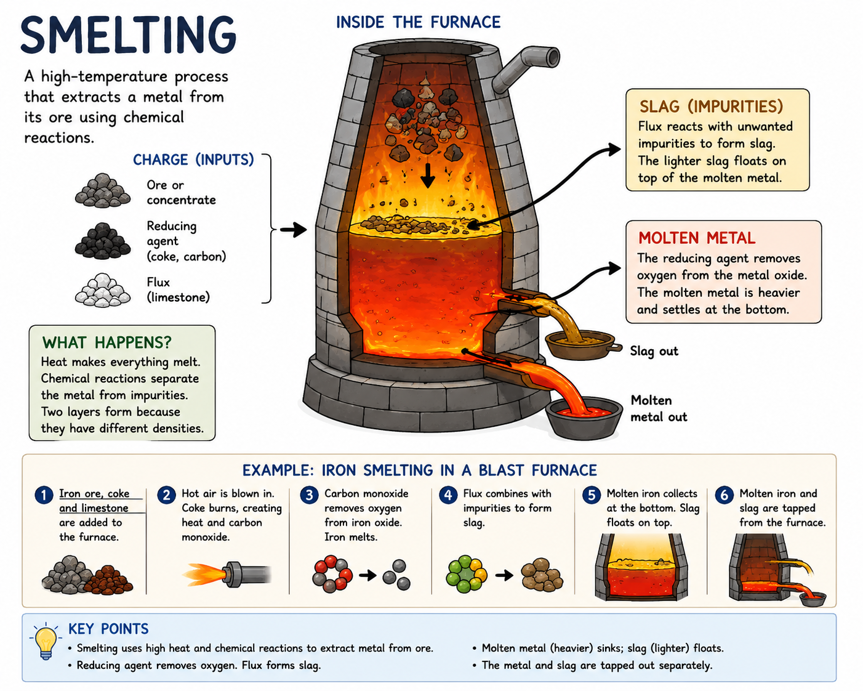
Because molten metal and slag usually have different densities, they form separate layers inside the furnace. The heavier molten metal generally settles toward the bottom, while the lighter slag floats above it. Each layer can then be drained or tapped from the furnace through a separate opening.
For example, in traditional iron smelting, iron ore is heated with coke and limestone in a blast furnace. The coke provides heat and helps remove oxygen from the iron oxide, while the limestone acts as a flux and helps form slag. The furnace produces molten iron that can later be refined into steel.
Smelting is used in the production of metals such as iron, copper, lead, nickel, tin, and zinc, although the equipment and chemical reactions differ depending on the metal. Some smelting processes primarily reduce metal oxides, while others separate metal from sulfide ores or recycled materials.
Smelting is different from simply melting a metal. Melting changes a solid metal into a liquid without necessarily changing its chemical composition. Smelting uses heat together with chemical reactions to extract or separate the metal from other substances. It is also different from roasting and calcination, which heat ores to prepare them for further processing but do not always produce molten metal.
Smelting is one of the main operations within pyrometallurgy. In practical terms, it uses intense heat and controlled chemical reactions to turn metal-bearing material into molten metal and a separate layer of slag.