
Learning Hub
Glossary
Oxides
Oxides are chemical compounds that contain oxygen bonded to another element. The other element may be a metal, a nonmetal, or a metalloid. Common examples include iron oxide, which is rust; aluminum oxide, which forms a protective surface layer on aluminum; silicon dioxide, which is a major component of sand and glass; and calcium oxide, also known as quicklime.
Oxides form when oxygen reacts with another material. This can happen naturally through corrosion, during high-temperature processing, during combustion, or through controlled chemical treatment. For example, when iron reacts with oxygen and moisture, iron oxides form on the surface. When limestone is calcined, calcium carbonate breaks down and produces calcium oxide and carbon dioxide. In steelmaking and smelting, many ores contain metals in oxide form, meaning the metal is chemically combined with oxygen and must be reduced to recover the metal.
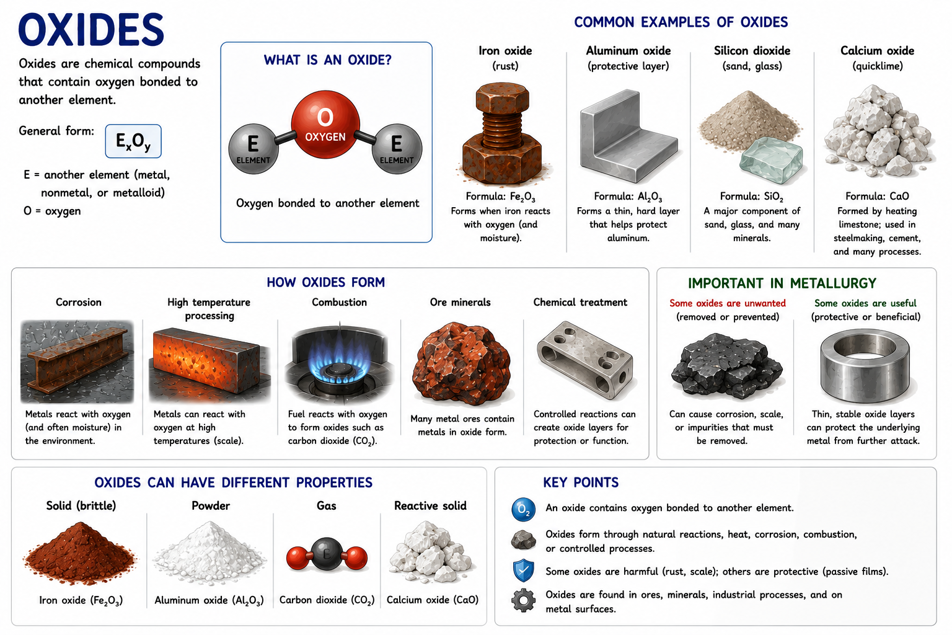
Metal oxides are especially important in metallurgy. Some are unwanted because they represent corrosion, scale, or impurities that must be removed. Others are useful because they form protective layers. Stainless steel, for instance, resists corrosion largely because chromium in the steel forms a very thin, stable chromium oxide film on the surface. Aluminum similarly forms aluminum oxide, which helps protect the underlying metal from further attack.
Oxides can have very different properties depending on the element bonded to the oxygen. Some are brittle solids, some are powders, some are gases, and some are chemically reactive. Carbon dioxide is an oxide of carbon and exists as a gas under normal conditions. Iron oxide is a solid corrosion product. Calcium oxide is a reactive solid used in cement, steelmaking, and chemical processing.
In practical terms, an oxide is what you get when oxygen chemically combines with another element. In fasteners and industrial materials, oxides may appear as rust, heat scale, protective passive films, ore minerals, furnace products, or surface layers created during manufacturing and finishing.