
Learning Hub
Glossary
Pyrometallurgy
Pyrometallurgy is the branch of metallurgy that uses high temperatures to extract, refine, or alter metals and metal-bearing materials. The term comes from words meaning “fire” and “metal,” and it includes processes in which ores, concentrates, scrap, or intermediate products are heated so that chemical reactions can separate the desired metal from unwanted minerals and impurities.
In a typical pyrometallurgical process, the raw material is placed in a furnace and heated until important physical or chemical changes occur. Some components may melt, burn, evaporate, oxidize, or react with added materials. The valuable metal can then be collected as a molten metal phase, while many impurities combine into a separate molten material called slag. Because the metal and slag usually have different densities and chemical compositions, they can often be separated after melting.
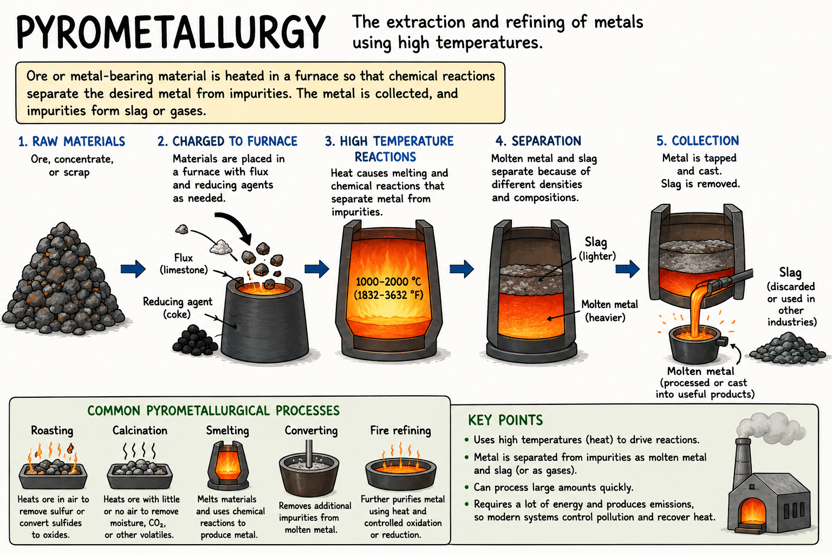
Common pyrometallurgical operations include roasting, calcination, smelting, converting, and fire refining. Roasting heats an ore in the presence of oxygen, often to remove sulfur or convert sulfide minerals into oxides. Calcination heats material with little or no oxygen to remove water, carbon dioxide, or other volatile substances. Smelting melts the material and uses chemical reactions to separate the metal from the ore. Converting removes additional impurities from molten metal, while fire refining uses heat and controlled oxidation or reduction to improve metal purity.
Reducing agents such as carbon, coke, carbon monoxide, or hydrogen may be used to remove oxygen from metal oxides. Fluxes are often added to react with unwanted minerals and form slag. The exact temperature, furnace atmosphere, and chemical additions depend on the metal being processed. Iron, copper, lead, nickel, tin, and several other metals are commonly produced or refined using pyrometallurgical methods.
Pyrometallurgy is valued because it can process large quantities of material quickly and can produce molten metal that is ready for casting or further refining. However, it requires substantial energy and may produce gases, dust, slag, and greenhouse-gas emissions that must be controlled. Modern furnaces therefore use filtration, gas-cleaning equipment, heat recovery, and carefully controlled operating conditions to improve efficiency and reduce environmental impact.
Pyrometallurgy differs from hydrometallurgy, which uses water-based chemical solutions to dissolve and recover metals, and from electrometallurgy, which uses electrical energy to extract or purify metals. In practical terms, pyrometallurgy uses heat-driven reactions to transform metal-bearing material into a usable or more highly refined metal.