Learning Hub
Glossary
Coke
Coke in steelmaking is a hard, porous, carbon-rich material made by heating certain grades of coal to very high temperatures in the absence of oxygen. This process, called coking or carbonization, drives off moisture, gases, tar, and other volatile substances, leaving behind a strong material made mostly of carbon.
Coke is used primarily in a blast furnace, where iron ore is converted into molten iron. It performs several important jobs at the same time. It acts as a fuel that supplies the intense heat needed to melt the iron-bearing material, serves as a reducing agent that helps remove oxygen from iron oxide, and provides a strong physical structure that supports the layers of iron ore and limestone inside the furnace.
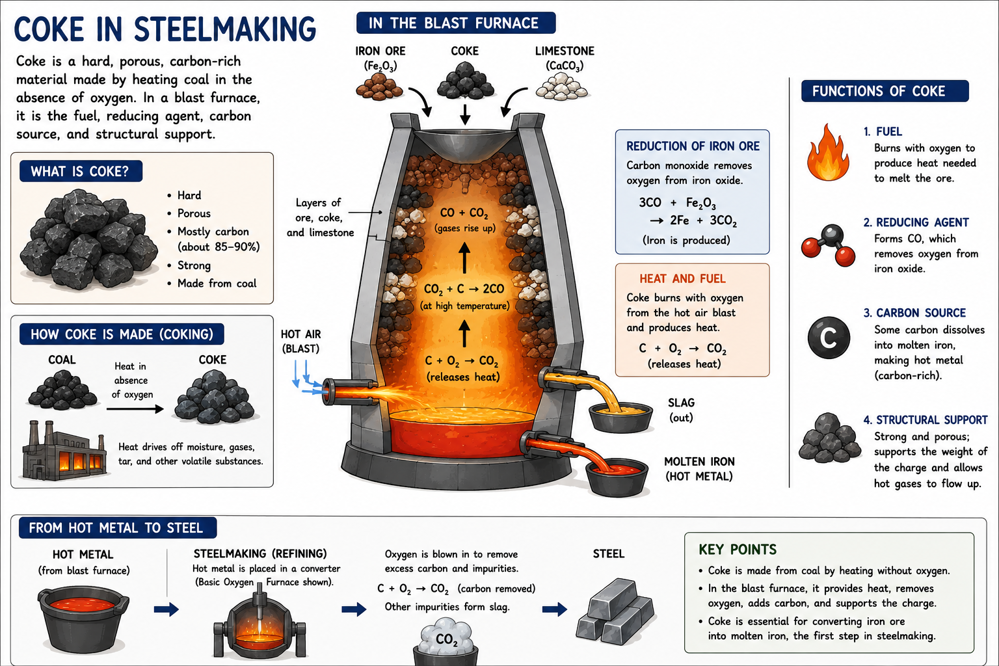
When hot air is blown into the bottom of the blast furnace, carbon in the coke reacts with oxygen and produces heat and carbon dioxide. The carbon dioxide then reacts with additional hot coke to form carbon monoxide. The carbon monoxide rises through the furnace and removes oxygen from the iron oxides in the ore, producing metallic iron. In words, carbon monoxide reacts with iron oxide to form iron and carbon dioxide.
Coke must be strong enough to resist being crushed by the weight of the furnace charge while remaining porous enough to let hot gases flow upward through the material. Ordinary coal would soften, break apart, or release excessive volatile material under blast-furnace conditions, so specially selected coking coal is converted into coke before use.
Some carbon from the coke also dissolves into the molten iron. This produces carbon-rich hot metal, sometimes called pig iron, which is later refined in a basic oxygen furnace or another steelmaking vessel. During refining, excess carbon and other impurities are removed to produce steel with the required composition.
Limestone is commonly charged into the furnace along with coke and iron ore. The limestone forms a flux that combines with unwanted minerals to produce slag, while the coke provides the heat and reducing atmosphere needed for the overall process.
Coke should not be confused with coal itself. Coal is the natural raw material, while coke is the processed, stronger, and more carbon-concentrated product used in the furnace. In practical terms, coke is the blast furnace’s fuel, chemical reducing agent, carbon source, and structural support material.