
Learning Hub
Glossary
Limestone
Limestone is a sedimentary rock composed mainly of the mineral calcite, which is a crystalline form of calcium carbonate. Its chemical composition is commonly written as CaCO₃. Limestone usually forms over long periods from the accumulation of shells, coral fragments, skeletal material, and other calcium-rich remains of marine organisms, although it can also form when calcium carbonate precipitates directly from water.
Limestone varies widely in color, texture, density, and purity. It may be white, gray, tan, yellow, brown, or nearly black depending on the amount of clay, sand, iron compounds, organic material, and other impurities present. Some limestone is fine-grained and nearly uniform, while other varieties contain visible fossils, shell fragments, or rounded particles. Chalk, travertine, coquina, and fossiliferous limestone are examples of different limestone varieties.
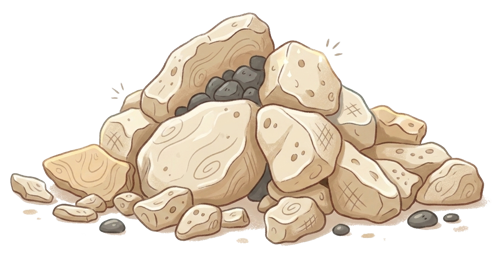
One of limestone’s defining characteristics is that it reacts with acids. When calcium carbonate comes into contact with an acid, it releases carbon dioxide gas and may visibly fizz or bubble. Limestone can also dissolve slowly in naturally acidic groundwater, producing caves, sinkholes, underground channels, and other features associated with karst terrain.
Limestone is widely used as a construction material and as a raw material for producing cement, concrete, lime, glass, and certain types of stone aggregate. Crushed limestone is used for roads, building foundations, drainage systems, agricultural soil treatment, and industrial fillers. Finely ground limestone may be added to soil to reduce acidity and supply calcium.
In metallurgy, limestone is often used as a flux during smelting. When heated, calcium carbonate breaks down into calcium oxide and carbon dioxide. The calcium oxide reacts with silica and other unwanted minerals in the furnace to form slag, allowing those impurities to be separated from the molten metal. This is why limestone is commonly added during the production of iron and steel.
Limestone should not be confused with lime. Limestone is the naturally occurring calcium-carbonate rock, while quicklime is calcium oxide produced by heating limestone, and hydrated lime is calcium hydroxide produced by adding water to quicklime. In practical terms, limestone is a common, calcium-rich rock valued for its usefulness in construction, agriculture, chemical processing, and metal production.