
Learning Hub
Glossary
Hydrometallurgy
Hydrometallurgy is the branch of metallurgy that uses water-based chemical solutions to extract, separate, and purify metals from ores, concentrates, recycled materials, or industrial waste streams. Instead of relying mainly on intense furnace heat, hydrometallurgy uses controlled chemical reactions in liquids to dissolve the valuable metal and separate it from unwanted material.
A typical hydrometallurgical process begins with leaching. In leaching, the metal-bearing material is exposed to an acid, alkaline solution, cyanide solution, ammonia solution, or another chemical reagent that dissolves the desired metal into the liquid. The leftover undissolved rock, gangue, or residue is then separated from the metal-rich solution.
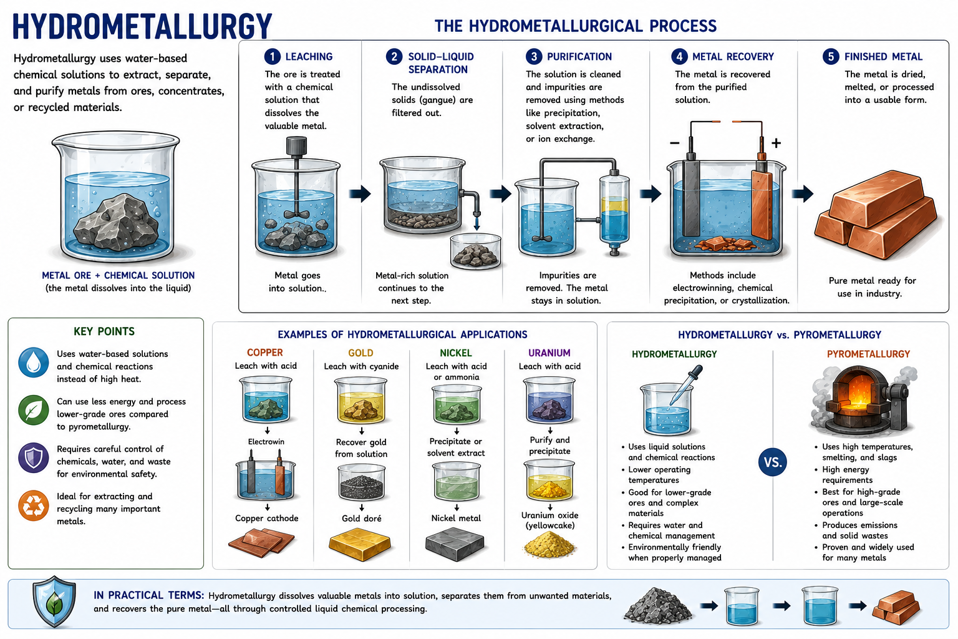
After the metal is dissolved, the solution is purified and concentrated. This may involve filtration, precipitation, solvent extraction, ion exchange, or other chemical separation methods. The goal is to remove unwanted elements and isolate the metal in a useful form. Once purified, the metal is recovered from the solution by methods such as electrowinning, chemical precipitation, or crystallization.
Hydrometallurgy is widely used for metals such as copper, gold, uranium, nickel, cobalt, zinc, aluminum, and rare earth elements. For example, copper can be leached from oxide ores using acid, then recovered from the solution by electrowinning. Gold may be dissolved from ore using a carefully controlled cyanide leaching process, then recovered from the solution.
Hydrometallurgy is often compared with pyrometallurgy. Pyrometallurgy uses high temperatures, furnaces, melting, and slag formation to separate metals. Hydrometallurgy uses liquid chemistry instead. Because it can operate at much lower temperatures, hydrometallurgy may use less energy and can sometimes process lower-grade ores that would be uneconomical to smelt. However, it requires careful control of chemicals, water, waste solutions, and environmental safeguards.