
Learning Hub
Glossary
Electrometallurgy
Electrometallurgy is the branch of metallurgy that uses electrical energy to extract, refine, plate, or otherwise process metals. Instead of relying mainly on furnace heat like pyrometallurgy or liquid chemical leaching like hydrometallurgy, electrometallurgy uses an electric current to drive chemical reactions that move metal ions, separate impurities, or deposit metal onto a surface.
A common electrometallurgical process is electrolysis. In electrolysis, an electric current passes through an electrolyte, which is a liquid or molten material that contains dissolved ions. The current forces certain ions to gain or lose electrons at electrodes. This can cause a metal to form, dissolve, or transfer from one location to another.
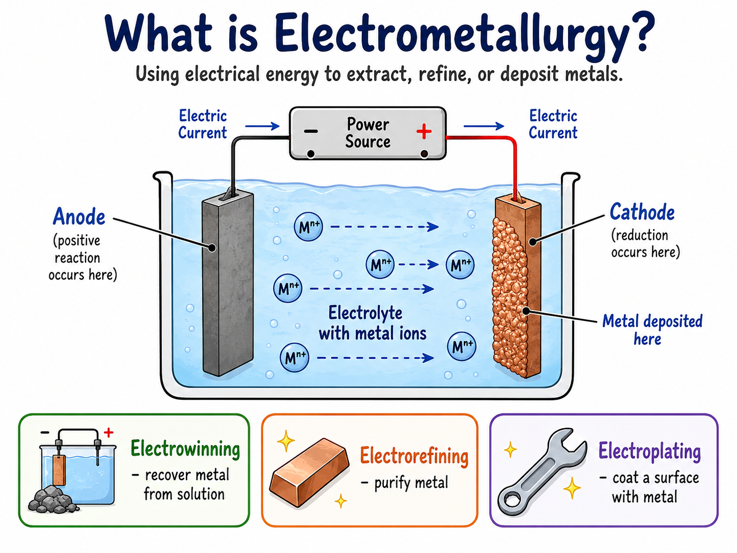
Electrometallurgy is often used in electrowinning, electrorefining, and electroplating. In electrowinning, metal ions are recovered from a solution and deposited as solid metal onto a cathode. This is used for metals such as copper, zinc, nickel, cobalt, and aluminum. In electrorefining, an impure metal is dissolved from an anode and redeposited in a purer form on a cathode. Copper refining is a common example. In electroplating, a thin layer of metal such as zinc, nickel, chromium, copper, tin, or gold is deposited onto a part to improve corrosion resistance, appearance, conductivity, wear resistance, or solderability.
Aluminum production is one of the most important examples of electrometallurgy. Aluminum oxide is dissolved in molten cryolite and reduced using a large electric current. Because aluminum bonds very strongly with oxygen, ordinary carbon reduction methods used for iron are not practical, so electrical energy is needed to separate the aluminum metal.
In fastener and industrial applications, electrometallurgy is especially relevant to plated finishes. Zinc plating, nickel plating, cadmium plating, tin plating, and other electrodeposited coatings rely on controlled electrical current to build a metal coating on the surface of bolts, screws, nuts, washers, and other parts. The process must be carefully controlled because plating thickness, coverage, adhesion, appearance, corrosion resistance, and hydrogen embrittlement risk can all be affected by the chemistry and electrical conditions.
Electrometallurgy is different from simply using electricity to heat something. Its defining feature is that electrical energy directly drives a chemical or electrochemical change. In practical terms, electrometallurgy uses electric current to separate, purify, or deposit metals.