
Learning Hub
Glossary
Aluminum Oxide (Al₂O₃)
Aluminum oxide (chemical formula Al₂O₃) is a white, crystalline oxide of aluminum that occurs naturally as the mineral corundum. It is one of the most important industrial compounds, known for its exceptional hardness, high melting point, chemical stability, and electrical insulation properties.

In its pure crystalline form, aluminum oxide appears as colorless sapphire or red ruby, depending on trace impurities such as chromium or iron. Artificially produced aluminum oxide is typically a fine white powder, widely used in metallurgy, ceramics, abrasives, and electronics.
Aluminum oxide forms naturally when aluminum metal reacts with oxygen. This reaction creates a thin, adherent oxide film that protects aluminum from further corrosion or oxidation—this is why aluminum is so corrosion-resistant. The oxide layer is often thickened intentionally through anodizing, a process that enhances wear and corrosion resistance while allowing for decorative coloring.
In industrial applications, aluminum oxide is produced from bauxite ore through the Bayer process, which extracts and purifies the oxide as calcined alumina. This refined Al₂O₃ serves as the feedstock for aluminum metal production via the Hall–Héroult electrolytic process, where it is dissolved in molten cryolite and reduced to pure aluminum.
Aluminum oxide’s hardness (9 on the Mohs scale) makes it ideal for abrasives, such as sandpaper, grinding wheels, and cutting tools. It’s also an excellent thermal and electrical insulator, used in spark plugs, electronic substrates, resistors, and high-temperature crucibles. In ceramics and refractories, Al₂O₃ provides strength and heat resistance up to temperatures exceeding 2,000°C (3,632°F).
Additionally, aluminum oxide plays a role in chemical and medical fields—it’s used as a catalyst support, chromatography medium, and even as an ingredient in certain dental and orthopedic implants due to its biocompatibility and inertness.
AKA: Alumina
Black Oxide
Black oxide is a chemical conversion coating that creates a thin, dark black surface layer on metal, most commonly steel. Instead of adding a thick layer of another metal like zinc or nickel plating, black oxide changes the outer surface of the base metal through a controlled chemical reaction. On steel, the process forms a black iron oxide layer, usually magnetite, which is chemically known as Fe₃O₄.
Black oxide is valued for its dark appearance, low dimensional change, mild corrosion resistance, reduced light reflection, and ability to hold oil or wax. Because the coating is very thin, it is useful when a part needs a black finish but cannot tolerate much buildup on threads, bearing surfaces, holes, or precision dimensions. This makes it common on fasteners, tools, shafts, gears, machine components, firearms parts, and decorative hardware.
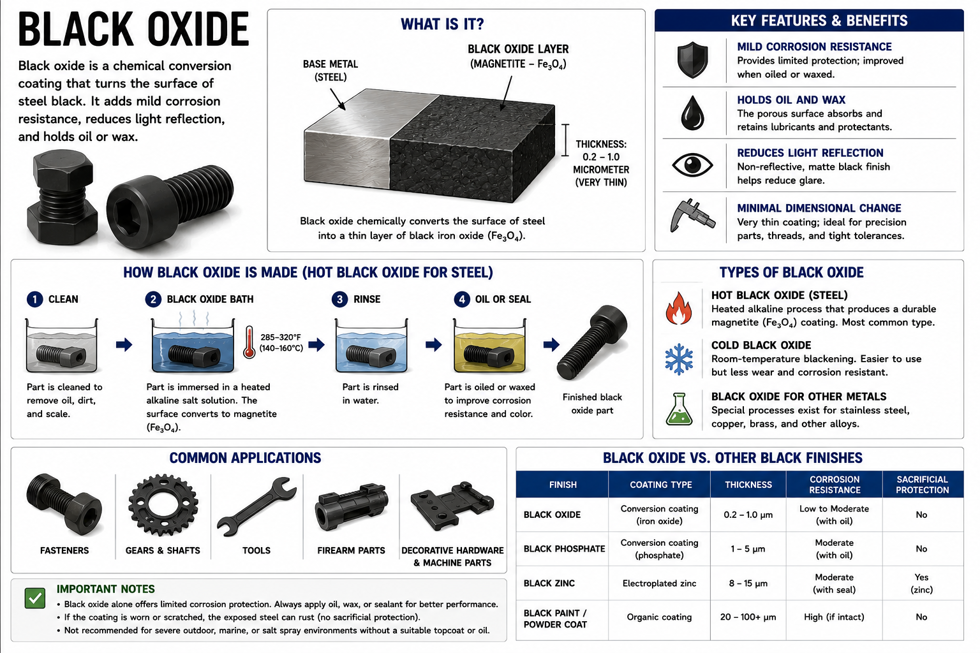
The coating itself does not provide strong corrosion protection by itself. Its corrosion resistance usually comes from the oil, wax, or sealant applied after the black oxide treatment. The black oxide layer is somewhat porous, so it can absorb and hold these protective materials. Without an after-seal, black oxide on steel offers only limited rust protection, especially in wet, salty, or outdoor environments.
There are several types of black oxide processes. Hot black oxide for steel is performed in a heated alkaline salt bath and produces a durable black magnetite finish. Cold black oxide is often used as a room-temperature blackening treatment, but it is usually less wear-resistant and less chemically integrated with the surface than a true hot black oxide. There are also black oxide processes for stainless steel, copper, brass, and other alloys, although the chemistry differs from standard steel black oxide.
In fastener applications, black oxide is often chosen for appearance, minimal dimensional change, mild lubricity when oiled, and reduced glare. However, it is not usually the best choice for severe corrosion environments unless paired with an appropriate oil, wax, or other protective topcoat. It also does not provide sacrificial protection like zinc. If black oxide is scratched or worn away, the exposed steel does not have a more active coating nearby to corrode in its place.
Black oxide should not be confused with black zinc, black phosphate, black paint, or black powder coating. Those finishes may look similar from a distance, but they are different coating systems with different thicknesses, corrosion resistance, friction behavior, and performance characteristics. In practical terms, black oxide is a thin black conversion finish that improves appearance and oil retention while adding only modest corrosion protection unless it is properly sealed.
Chromium Oxide
Chromium oxide refers primarily to chromium(III) oxide, with the chemical formula Cr₂O₃. It’s a dark green, extremely stable compound that forms when chromium reacts with oxygen. This oxide is one of the most important and naturally occurring compounds of chromium—it’s the same protective film that makes stainless steel “stainless.”

Formation and Structure
When chromium in an alloy (like stainless steel or chromoly) is exposed to air, it reacts with oxygen to form a thin, dense, self-healing layer of Cr₂O₃ on the metal’s surface. This layer is only a few atoms thick, but it’s chemically inert and adheres tightly, preventing oxygen and moisture from reaching the metal beneath.
This process is known as passivation, and it’s why stainless steels and chromium-plated parts resist rust and corrosion far better than carbon steel.
Properties
- Chemical formula: Cr₂O₃
- Color: Deep green (also used as a pigment known as chromium green or chrome oxide green)
- Melting point: ~2,435°C (4,415°F)
- Hardness: Very high—used as an abrasive and in polishing compounds
- Chemical stability: Resistant to acids, bases, and oxidation
Industrial and Engineering Uses
Corrosion Protection:
The protective oxide film on chromium-bearing metals shields fasteners, tools, and machinery from rust.
Pigments and Coatings:
Used in paints, ceramics, and glass as a durable green pigment.
Polishing and Abrasives:
Finely ground chromium oxide is used in metal polishing compounds (“green rouge”).
Refractory Applications:
Its heat resistance makes it ideal for furnace linings and ceramics.
In Fasteners and Alloys
In fastener materials like stainless steel, chromium-molybdenum (chromoly) steel, and plated bolts, chromium oxide is what prevents corrosion. If the surface is scratched, the oxide layer re-forms automatically, sealing the exposed metal—making it a key reason why chromium-alloyed steels have such long service lives.
Cobalt Oxide
Cobalt oxide refers to a group of chemical compounds composed of cobalt and oxygen, the most common being cobalt(II) oxide (CoO) and cobalt(III) oxide (Co₂O₃). These oxides are important industrial materials used in ceramics, batteries, catalysts, and pigments because of their unique color, magnetic, and chemical properties.

Cobalt(II) oxide (CoO) is a grayish or olive-green powder that forms when cobalt metal is heated in air at moderate temperatures. It has a cubic crystal structure and is slightly soluble in acids but insoluble in water. CoO is used primarily as a pigment (giving a bluish-green tint), in glass and enamel production, and as a precursor in making other cobalt salts and compounds. It’s also used in lithium-ion batteries as part of the cathode material, contributing to high energy density and stability.
Cobalt(III) oxide (Co₂O₃), on the other hand, is a black crystalline powder that forms when cobalt compounds are oxidized at higher temperatures or in strong oxidizing environments. It contains cobalt in the +3 oxidation state and is less stable than CoO. Co₂O₃ is used mainly as an oxidizing agent, in ceramic glazes, and in certain chemical catalysts, especially for hydrocarbon oxidation and hydrogenation reactions.
Another related compound is cobalt(II,III) oxide (Co₃O₄), which is actually the most stable and technologically important cobalt oxide. It appears as a black powder and contains both +2 and +3 oxidation states of cobalt. Co₃O₄ is widely used in rechargeable batteries, particularly in lithium-ion and sodium-ion cathodes, as well as in supercapacitors, solar cells, and gas sensors. It also functions as a catalyst in environmental and industrial processes such as CO oxidation and water splitting.
Hafnium Oxide (HfO₂)
Hafnium oxide, also called hafnia, is a chemical compound made of hafnium and oxygen. Its chemical formula is HfO₂, meaning each hafnium atom is bonded with two oxygen atoms. It is a hard, white to off-white ceramic material known for its high melting point, chemical stability, electrical insulating ability, and resistance to heat.
Hafnium oxide is especially important because it can act as a very effective electrical insulator while still allowing extremely thin layers to be used. In semiconductor manufacturing, hafnium oxide is used as a high-k dielectric material in advanced computer chips. A high-k dielectric is an insulating material that can store electric charge more effectively than traditional silicon dioxide at very small thicknesses. This helps reduce electrical leakage and allows electronic components to keep shrinking while maintaining performance.
In high-temperature applications, hafnium oxide is valued as a refractory ceramic. It can withstand very high temperatures without melting or breaking down easily, which makes it useful in thermal barrier coatings, furnace materials, advanced ceramics, and aerospace-related materials. Hafnium oxide can also contribute to oxidation resistance when used in certain coatings or ceramic systems.
Hafnium oxide should not be confused with metallic hafnium. Hafnium is the silvery-gray metal element, while hafnium oxide is the ceramic oxide compound that forms when hafnium combines with oxygen. The oxide is much less metallic in behavior; it is hard, electrically insulating, and ceramic-like rather than ductile and conductive.
AKA: Hafnia
Iron Oxide
Iron oxide is a compound formed when iron (Fe) reacts with oxygen (O₂), creating a family of chemical compounds that consist of iron and oxygen in various ratios. These compounds occur naturally as minerals and artificially through corrosion, oxidation, or controlled synthesis, and they are among the most common inorganic materials on Earth.

Chemically, iron oxides are represented by several forms, depending on the oxidation state of iron and the environment in which they form. The three most significant types are:
1. Iron(II) oxide (FeO) — also known as wüstite, this is a black or dark gray compound where iron is in the +2 oxidation state. It typically forms under low-oxygen conditions or as an intermediate product in high-temperature reactions such as steelmaking. FeO is unstable in air and tends to oxidize further.
2. Iron(III) oxide (Fe₂O₃) — commonly called hematite or rust, this is a reddish-brown compound in which iron is in the +3 oxidation state. It is the most stable and widespread form of iron oxide, found both in nature (as hematite ore) and as the end product of corrosion when iron or steel reacts with oxygen and moisture. The reaction can be summarized as:
4Fe + 3O₂ → 2Fe₂O₃
3. Iron(II,III) oxide (Fe₃O₄) — also known as magnetite, this compound contains both Fe²⁺ and Fe³⁺ ions and has a black, magnetic appearance. It forms under moderate oxygen conditions and is used in magnets, pigments, and recording materials. The oxidation process can be written as:
3Fe + 2O₂ → Fe₃O₄
These oxides are not only important in geology and metallurgy but also have widespread industrial and technological uses. For instance, iron oxides serve as pigments (red, yellow, and black iron oxides) in paints, ceramics, and cosmetics; as polishing agents (jeweler’s rouge); and as magnetic materials in electronics and data storage.
In corrosion, iron oxides are often undesirable, forming the flaky, porous “rust” that compromises structural integrity. However, controlled oxidation is sometimes beneficial—such as in passivation layers on stainless steel, where a stable oxide film protects against further corrosion.
Magnesium Oxide (MgO)
Magnesium oxide (MgO) is a white, crystalline, inorganic compound formed by combining magnesium (Mg) and oxygen (O₂). It is a highly stable, non-flammable, and refractory material, meaning it can withstand extremely high temperatures without breaking down. Magnesium oxide occurs naturally as the mineral periclase, but it is most commonly produced synthetically by heating magnesium carbonate (MgCO₃) or magnesium hydroxide (Mg(OH)₂) until they decompose, releasing carbon dioxide or water.

When heated, magnesium reacts with oxygen to form magnesium oxide: 2 Mg + O₂ → 2 MgO
This exothermic reaction produces an intense white flame — a signature of magnesium combustion. The resulting MgO is a fine white powder or solid with a high melting point (~2,852°C or 5,166°F), making it useful in industrial furnaces, crucibles, kilns, and refractory bricks that line high-temperature equipment.
Magnesium oxide has a wide range of uses:
- In metallurgy, it serves as a refractory material and flux, protecting metals from oxidation.
- In construction, MgO boards are used as fire-resistant and mold-resistant alternatives to drywall or cement board.
- In environmental applications, it’s used to neutralize acidic wastewater and flue gases.
- In electrical and thermal insulation, MgO is used inside heating elements (such as in toasters and ovens) due to its high dielectric strength and ability to conduct heat while insulating electrically.
Magnesium oxide also reacts slowly with water to form magnesium hydroxide (Mg(OH)₂), a process known as hydration: MgO + H₂O → Mg(OH)₂
Oxides
Oxides are chemical compounds that contain oxygen bonded to another element. The other element may be a metal, a nonmetal, or a metalloid. Common examples include iron oxide, which is rust; aluminum oxide, which forms a protective surface layer on aluminum; silicon dioxide, which is a major component of sand and glass; and calcium oxide, also known as quicklime.
Oxides form when oxygen reacts with another material. This can happen naturally through corrosion, during high-temperature processing, during combustion, or through controlled chemical treatment. For example, when iron reacts with oxygen and moisture, iron oxides form on the surface. When limestone is calcined, calcium carbonate breaks down and produces calcium oxide and carbon dioxide. In steelmaking and smelting, many ores contain metals in oxide form, meaning the metal is chemically combined with oxygen and must be reduced to recover the metal.
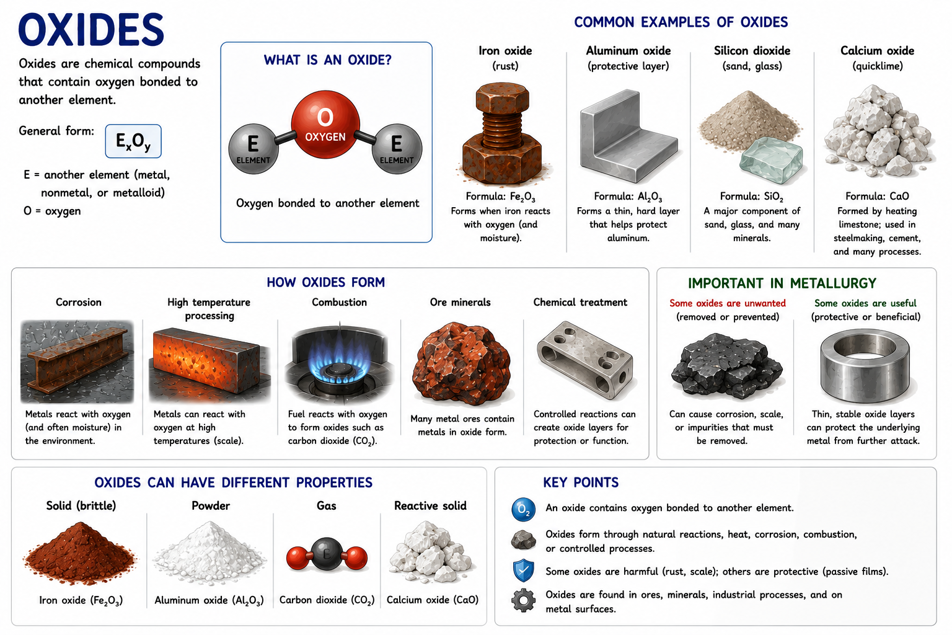
Metal oxides are especially important in metallurgy. Some are unwanted because they represent corrosion, scale, or impurities that must be removed. Others are useful because they form protective layers. Stainless steel, for instance, resists corrosion largely because chromium in the steel forms a very thin, stable chromium oxide film on the surface. Aluminum similarly forms aluminum oxide, which helps protect the underlying metal from further attack.
Oxides can have very different properties depending on the element bonded to the oxygen. Some are brittle solids, some are powders, some are gases, and some are chemically reactive. Carbon dioxide is an oxide of carbon and exists as a gas under normal conditions. Iron oxide is a solid corrosion product. Calcium oxide is a reactive solid used in cement, steelmaking, and chemical processing.
In practical terms, an oxide is what you get when oxygen chemically combines with another element. In fasteners and industrial materials, oxides may appear as rust, heat scale, protective passive films, ore minerals, furnace products, or surface layers created during manufacturing and finishing.
Titanium dioxide (TiO₂)
Titanium dioxide (chemical formula TiO₂) is a white, inorganic compound made from the element titanium and oxygen. It is one of the whitest and brightest substances known, valued for its exceptional opacity, brightness, and UV resistance. Titanium dioxide occurs naturally in minerals such as rutile, anatase, and brookite, and it is extensively refined and processed for industrial use.
The compound’s primary function is as a white pigment and opacifier, meaning it reflects and scatters light extremely efficiently. This makes it indispensable in products like paints, coatings, plastics, papers, ceramics, rubber, inks, fibers, cosmetics, and food. In fact, titanium dioxide is the most widely used white pigment in the world, often labeled as “Titanium White” or Pigment White 6. Its chemical stability and non-reactivity allow it to retain color brilliance and opacity even in harsh environments, and it does not yellow or degrade over time.
Beyond its use as a pigment, titanium dioxide also has important photocatalytic and UV-protective properties. In sunscreens, it acts as a physical UV blocker, reflecting and scattering ultraviolet light to protect skin from sun damage. In photocatalysis, TiO₂ is used in self-cleaning coatings, air purifiers, and antimicrobial surfaces—when exposed to UV light, it generates reactive oxygen species that break down organic pollutants and kill bacteria.
There are two main crystalline forms used industrially: rutile and anatase. Rutile TiO₂ has a higher refractive index and greater stability, making it ideal for paints and coatings that require high opacity and durability. Anatase TiO₂, on the other hand, has superior photocatalytic activity and is preferred for environmental and catalytic applications.
Titanium dioxide is produced from titanium-bearing ores such as ilmenite (FeTiO₃) and rutile (TiO₂) through one of two methods: the sulfate process, which uses sulfuric acid, or the chloride process, which involves titanium tetrachloride (TiCl₄) and is cleaner and more efficient.
Tungsten Oxide
Tungsten oxide (chemical formula WO₃) is a yellow crystalline compound composed of tungsten and oxygen. It is one of the most important oxides of tungsten and serves as a key intermediate in the production of metallic tungsten and tungsten-based materials.

Tungsten oxide is typically produced by heating tungsten metal or tungsten compounds (such as ammonium paratungstate) in the presence of oxygen. It can also form through the controlled oxidation of tungsten at high temperatures. The resulting material is thermally stable, chemically resistant, and exhibits semiconducting properties, making it useful in a wide range of industrial and technological applications.
In metallurgy, tungsten oxide is reduced with hydrogen or carbon to produce pure tungsten metal—a process essential for manufacturing tungsten filaments, carbide tools, and superalloys. Its semiconducting nature also makes it valuable in electrochromic devices (such as smart windows that change color with voltage), gas sensors, catalysts, and photocatalytic coatings for environmental applications.
Depending on the method of synthesis and heating conditions, tungsten oxide can appear in different shades—yellow, blue, or green—each corresponding to slight variations in oxygen content (non-stoichiometric forms like WO₂.₉).
Vanadium Pentoxide (V₂O₅)
Vanadium Pentoxide (V₂O₅) is a bright yellow to rust-orange crystalline compound composed of vanadium and oxygen, and it is one of the most important industrial compounds of vanadium. Chemically, it serves as both an oxidizing agent and a catalyst, making it indispensable in metal production and chemical manufacturing.

In its solid form, vanadium pentoxide consists of layers of vanadium atoms surrounded by oxygen atoms in a distorted octahedral arrangement. It is amphoteric, meaning it can react with both acids and bases, and it exhibits multiple oxidation states, allowing it to easily gain or lose oxygen in chemical reactions. This redox flexibility is what makes V₂O₅ such a powerful catalyst.
The compound’s most important industrial use is as a catalyst in the Contact Process, which produces sulfuric acid—one of the world’s most heavily produced chemicals. In this process, V₂O₅ facilitates the conversion of sulfur dioxide (SO₂) to sulfur trioxide (SO₃) by transferring oxygen atoms efficiently. It’s also used in the manufacture of maleic anhydride, phthalic anhydride, and other organic intermediates.
In metallurgy, vanadium pentoxide is used to produce ferrovanadium alloys, which strengthen steel and improve resistance to heat and wear. When mixed with other metals, it imparts high tensile strength and fatigue resistance—qualities essential for aerospace components, tools, and high-performance steel.
V₂O₅ is also used in ceramics, glass, and pigments, where it acts as a colorant that gives yellow, green, or blue hues depending on oxidation conditions. In electronics and emerging energy technologies, it’s used in vanadium redox flow batteries and solid-state devices because of its ability to reversibly store and release oxygen ions.
However, vanadium pentoxide is toxic in dust or fume form. Inhalation or prolonged exposure can irritate the respiratory tract and cause health issues, so industrial handling requires proper ventilation and protective equipment.