
Learning Hub
Glossary
Precipitation Hardening
Precipitation hardening (also called age hardening) is a heat-treatment method that raises the strength and hardness of certain alloys by forming a fine “dusting” of tiny particles (precipitates) inside the metal. Those particles act like microscopic roadblocks that make it much harder for dislocations (the carriers of plastic deformation) to move—so the alloy resists yielding and wear better.
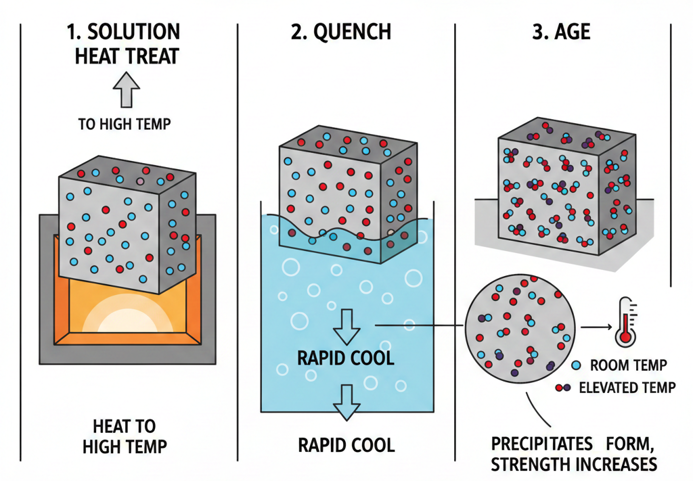
The core idea is: first dissolve the strengthening elements into the base metal, then trap them in place, then let them come back out in a controlled way. You do that in three main steps. (1) Solution heat treat: heat the alloy into a single-phase region so the alloying elements (like Cu, Mg, Si, Ni, Ti, Al, etc.) dissolve into a uniform solid solution. (2) Quench: cool rapidly to “freeze in” that high-temperature chemistry, creating a supersaturated solid solution (more solute dissolved than is stable at room temperature). (3) Age: hold the alloy at room temperature (natural aging) or an elevated temperature (artificial aging) so very fine precipitates form throughout the metal.
What matters is the size, spacing, and coherency of the precipitates. Early in aging, the precipitates are usually very small and closely spaced, often partly “coherent” with the crystal lattice, which makes them extremely effective at blocking dislocations. As aging continues, precipitates grow and coarsen and the spacing increases; at some point they become less effective barriers, so strength can drop. That’s why you hear about under-aged (not enough precipitates yet), peak-aged (maximum strengthening), and over-aged (precipitates coarsened, strength reduced but often with better toughness/stability).
Precipitation hardening is different from other strengthening routes. Work hardening strengthens by piling up dislocations through plastic deformation (rolling/drawing), while quench-and-temper steels strengthen primarily through martensite formation and controlled carbide precipitation during tempering (related physics, but not the classic “supersaturated solution → fine precipitate dispersion” approach used in aluminum and many specialty alloys). Precipitation hardening is especially famous in alloys designed to do it cleanly and predictably.
You see it constantly in industry. Many aluminum alloys get their “T” tempers from precipitation hardening—6061-T6 (Mg–Si precipitates), 7075-T6 (Zn–Mg–Cu precipitates), 2024-T3/T351 (Al–Cu precipitates), and more. Some stainless grades are literally named for it, like 17-4 PH, where strength is tuned by specific aging conditions (you’ll see designations like H900, H1025, etc.). It’s also central in nickel superalloys (turbines) and maraging steels, where very high strength comes from precipitates formed during aging rather than from high carbon.
Practically, precipitation hardening is a balancing act between strength, ductility, toughness, corrosion performance, and dimensional stability. Quenching can introduce residual stresses and distortion; aging schedules are time/temperature-sensitive; and certain alloys can become more susceptible to issues like stress corrosion cracking in specific peak-strength tempers, so manufacturers sometimes choose slightly different aging conditions (or over-aging/dual-aging variants) to trade a little strength for better durability.
AKA: Age Hardening
Precipitation Hardening Stainless Steel
Precipitation hardening stainless steel, often abbreviated as PH stainless steel, is a class of stainless steel that achieves its exceptional high strength, hardness, and corrosion resistance through a specialized heat treatment process known as precipitation hardening (or age hardening). This process involves the controlled formation of very fine particles (precipitates) within the metal’s microstructure, which strengthen the material without significantly reducing its toughness or corrosion resistance.
Chemically, PH stainless steels contain chromium and nickel as their main alloying elements, similar to austenitic grades, but they also include copper, aluminum, titanium, or niobium to enable the precipitation-hardening effect. The chromium provides corrosion resistance, while the nickel stabilizes the austenitic or martensitic structure, and the additional elements form the fine precipitates that dramatically increase strength during heat treatment.
The hardening process occurs in three main stages: solution treatment, quenching, and aging. During solution treatment, the alloying elements are dissolved at high temperature. Quenching rapidly cools the material to lock these elements in a supersaturated solid solution. Finally, during aging, the metal is reheated to a moderate temperature, allowing controlled precipitation of intermetallic compounds that impede dislocation motion — the mechanism that gives the steel its high strength.
Depending on their metallurgical structure, PH stainless steels can be martensitic, semi-austenitic, or austenitic. The most common grade is 17-4 PH (UNS S17400), which contains roughly 17% chromium and 4% nickel, along with copper and niobium for hardening. It offers excellent strength, moderate corrosion resistance (similar to 304), and can be hardened to yield strengths exceeding 1,000 MPa (145 ksi). Other notable grades include 15-5 PH, 17-7 PH, and 13-8 Mo, each designed for specific combinations of toughness, hardness, and corrosion resistance.
Precipitation hardening stainless steels are used extensively in aerospace, nuclear, and petrochemical industries, as well as for valves, shafts, turbine components, fasteners, and high-performance mechanical parts that must maintain strength at both elevated and sub-zero temperatures.
In summary, precipitation hardening stainless steels combine the corrosion resistance of austenitic grades with the strength of martensitic steels, made possible through precise heat treatment. Their ability to achieve very high mechanical performance while maintaining corrosion resistance makes them ideal for critical applications where strength, durability, and reliability are equally important.