
Learning Hub
Glossary
Alloy (Mixture)
An alloy is a metal-based material made by combining two or more chemical elements (at least one of them a metal) to create a material with engineered properties that you usually can’t get from a pure metal alone. Think of it like “recipe metallurgy”: you start with a base metal (iron, aluminum, copper, nickel, titanium, etc.), then add specific elements in controlled amounts to dial in strength, toughness, corrosion resistance, heat resistance, machinability, or wear resistance.
Alloys work because the added elements change the metal’s internal structure. Some atoms dissolve into the base metal’s crystal lattice (solid solution strengthening), some form tiny hard particles (precipitates) that block deformation, and some create distinct phases that change how the metal behaves under load or temperature. Heat treatment often matters as much as chemistry—many alloys are designed so their microstructure can be “set” by quenching/tempering, aging, annealing, or solution treating.
In the fastener world, alloys are the reason we can have a bolt that’s tough and ductile for impact, another that’s high-strength for clamping, and another that laughs at chlorides and high heat. Ferrous alloys (iron-based) include carbon steel, alloy steel, and stainless steel—your everyday bolts, structural fasteners, and corrosion-resistant grades. Non-ferrous alloys include aluminum alloys (lightweight), copper alloys (conductive/corrosion-resistant), nickel alloys (high-temperature/corrosive service), and titanium alloys (high strength-to-weight and excellent corrosion resistance). In short: an alloy is how we turn “a metal” into “the right metal for the job.”
Alloy Steel
Alloy steel is a type of steel that has been intentionally mixed with one or more alloying elements—such as chromium, nickel, molybdenum, vanadium, manganese, or tungsten—to improve its mechanical and physical properties beyond those of plain carbon steel. These added elements enhance characteristics like strength, hardness, toughness, wear resistance, and corrosion resistance, depending on the specific combination and percentage used.
At its core, all steel is primarily iron (Fe) with a small amount of carbon (C)—usually less than 2%. In carbon steel, carbon is the main hardening element, but in alloy steels, other elements are added (typically between 1% and 5%, though sometimes higher) to achieve specialized performance.
Different alloying elements serve specific purposes:
- Chromium (Cr): Improves hardness, corrosion resistance, and wear resistance.
- Nickel (Ni): Increases toughness and impact resistance.
- Molybdenum (Mo): Enhances strength at high temperatures and resists softening.
- Vanadium (V): Refines grain structure and increases toughness and fatigue strength.
- Manganese (Mn): Boosts strength and hardness while aiding deoxidation.
- Tungsten (W): Increases hot hardness and high-temperature strength.
Alloy steels are broadly classified into two groups:
- Low-alloy steels, with total alloying content below about 5%, used for general engineering and structural applications.
- High-alloy steels, with more than 5% total alloying elements, designed for highly specialized uses such as tool steels, heat-resistant steels, and stainless steels.
Common uses of alloy steels include gears, axles, crankshafts, fasteners, tools, high-strength structural components, and pressure vessels. Their ability to combine strength, toughness, and resistance to fatigue and corrosion makes them essential in automotive, aerospace, oil and gas, and heavy machinery industries.
Aluminum Alloy
An aluminum alloy is a metallic material composed primarily of aluminum combined with one or more additional elements to improve its mechanical, chemical, or physical properties. Pure aluminum is relatively soft and has limited strength, so alloying elements are added to increase characteristics such as strength, hardness, corrosion resistance, wear resistance, or high-temperature performance. These alloys allow aluminum to be used in demanding structural applications while retaining the metal’s natural advantages, including low density, good corrosion resistance, and high thermal and electrical conductivity.
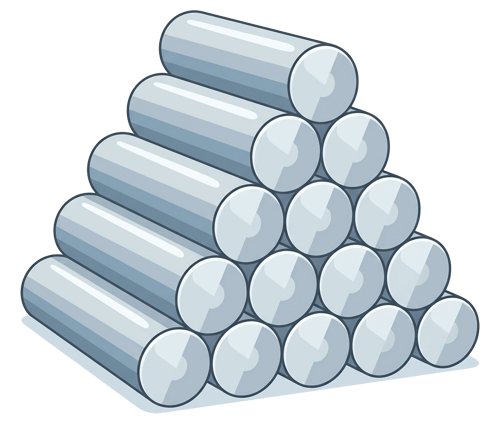
Aluminum alloys are created by adding controlled amounts of elements such as copper, magnesium, silicon, zinc, manganese, or lithium to molten aluminum during the manufacturing process. Each alloying element changes the internal structure of the metal in specific ways. For example, copper can significantly increase strength through heat treatment, magnesium improves strength and corrosion resistance, silicon enhances casting properties and wear resistance, and zinc contributes to the very high strength seen in certain aerospace alloys. These elements form solid solutions or microscopic precipitates within the aluminum’s crystal structure, which impede dislocation movement and increase the material’s strength.
Aluminum alloys are generally grouped into two broad categories: wrought alloys and cast alloys. Wrought aluminum alloys are mechanically worked into shapes through processes such as rolling, extrusion, forging, or drawing. These alloys are commonly used for structural components, sheet, plate, and fasteners. Cast aluminum alloys, on the other hand, are poured into molds while molten to produce complex shapes such as engine blocks, housings, and machine components. The alloy compositions used for casting are optimized to flow well and solidify without defects.
Wrought aluminum alloys are further organized into numbered alloy series, each indicating the primary alloying element. For example, the 1xxx series consists of nearly pure aluminum used for electrical conductivity and corrosion resistance; the 2xxx series contains aluminum-copper alloys used in aerospace structures; the 3xxx series contains aluminum-manganese alloys known for good formability; the 5xxx series includes aluminum-magnesium alloys used in marine environments; the 6xxx series combines magnesium and silicon and is widely used in structural extrusions; and the 7xxx series contains aluminum-zinc alloys that provide extremely high strength for aerospace applications.
Many aluminum alloys can also be heat treated to increase their strength. In heat-treatable alloys, controlled heating and cooling produce fine precipitates within the aluminum matrix that strengthen the material through a mechanism known as precipitation hardening. Other alloys strengthen primarily through strain hardening, where mechanical deformation during rolling or forming increases the metal’s strength.
Because aluminum alloys combine light weight with relatively high strength, they are widely used in industries such as aerospace, transportation, construction, marine engineering, electronics, and industrial manufacturing. Aircraft structures, automotive components, heat exchangers, pressure vessels, and many types of fasteners rely on aluminum alloys for their favorable strength-to-weight ratio and corrosion resistance.
Brass (Metal Alloy)
Brass is a metal alloy made primarily of copper (Cu) and zinc (Zn). It is known for its bright gold-like appearance, excellent corrosion resistance, and workability, making it one of the most widely used and versatile alloys in both industrial and decorative applications.
The exact properties of brass vary depending on the ratio of copper to zinc and the presence of small amounts of other elements such as lead, tin, aluminum, or nickel. Typically, brass contains 55–95% copper and 5–45% zinc.
- Higher copper content produces a softer, more ductile brass with a deeper reddish tone and superior corrosion resistance.
- Higher zinc content yields stronger, harder brass with a lighter yellow color but slightly reduced corrosion resistance.
Brass is valued for several key characteristics. It is malleable and ductile, allowing it to be easily machined, stamped, rolled, or cast into complex shapes. It also has low friction, non-sparking properties, and good thermal and electrical conductivity. These features make it ideal for fasteners, fittings, valves, bearings, gears, electrical connectors, and musical instruments.
Because brass resists tarnishing and corrosion—especially in water and marine environments—it is commonly used in plumbing components, marine hardware, and decorative applications like architectural accents, lamps, and door hardware. Certain types, such as naval brass and admiralty brass, include small additions of tin for enhanced resistance to saltwater corrosion.
The alloy also has favorable acoustic qualities, which is why it’s widely used in musical instruments such as trumpets, trombones, and saxophones—collectively known as “brass instruments.”

Bronze (Metal Alloy)
Bronze is a metal alloy primarily composed of copper (Cu) and tin (Sn), often containing small amounts of other elements such as aluminum, phosphorus, manganese, or silicon to enhance specific properties. It is one of the oldest and most significant alloys in human history, marking the technological leap known as the Bronze Age (around 3300–1200 BCE).
Bronze was the first alloy intentionally created by humans, and it quickly replaced stone and pure copper tools because of its superior hardness, strength, and durability. Adding tin to copper changes the alloy’s crystal structure, making it stronger, less brittle, and more resistant to corrosion.
In appearance, bronze has a reddish-brown to golden color, which can darken or develop a greenish patina (a layer of copper carbonate) over time due to oxidation. This patina actually protects the metal from further corrosion, making bronze extremely durable — a reason why ancient bronze artifacts, statues, and coins often survive for millennia.
Bronze’s properties can vary depending on composition:
- Phosphor bronze (copper + tin + phosphorus) is tough, wear-resistant, and used for springs, bushings, and bearings.
- Aluminum bronze (copper + aluminum) is stronger and highly corrosion-resistant, often used in marine hardware and fasteners.
- Silicon bronze (copper + silicon) has excellent corrosion resistance and weldability, used in architecture, sculptures, and boat fittings.
Because of its low friction and non-sparking characteristics, bronze is commonly used in bearings, gears, bushings, and tools for environments where sparks could ignite gases or vapors. Its acoustic properties also make it ideal for musical instruments such as bells, cymbals, and strings for pianos and guitars.
In art and architecture, bronze has long been valued for its workability and beautiful aging, used in statues, memorials, and decorative fittings. When molten, it fills molds cleanly, capturing fine detail, which is why bronze casting remains the preferred method for sculptures.
Cast Alloy Nut
A cast alloy nut is a fastener created by pouring a molten metal alloy into a mold. Two of the most commonly used types are made from zinc and aluminum, each having distinct properties for specific applications. The general manufacturing process involves melting the metal and then casting it into a mold, such as through die casting or sand casting. Die casting is a high-pressure, high-volume method that produces accurate parts with smooth finishes, while sand casting is a lower-cost, more versatile method often used for complex shapes. Following casting, the nuts may undergo further processes, like threading and machining, to achieve their final specifications.
Zinc alloy nuts, which are often die-cast, offer cost-effectiveness and good corrosion resistance. Their properties prevent them from galling or "freezing" onto mating threads, a significant advantage in many fastening applications. They are frequently used for panel mounting and as thumb or wing nuts in various consumer and hardware products.
Alternatively, aluminum alloy nuts are valued for their exceptional strength-to-weight ratio, making them significantly lighter than their steel counterparts. They naturally form a protective oxide layer that gives them excellent corrosion resistance. Although not as strong as steel, they are highly durable and reliable for many uses. Their applications range from weight-sensitive items like automotive wheel lug nuts and aerospace components to consumer goods and electronics where light weight and corrosion resistance are needed.
The applications for cast alloy nuts are diverse due to their combination of strength, light weight, and corrosion resistance. In the automotive industry, lightweight aluminum wheel lug nuts can improve a vehicle's performance by reducing unsprung weight. The electronics sector benefits from cast aluminum nuts' high thermal conductivity, which helps dissipate heat in connectors and other components. Furthermore, cast alloy barrel nuts are a popular choice in the furniture industry for assembly, while corrosion-resistant zinc alloy nuts are commonly used in appliances and general hardware.
Continuous Cast Alloys
Continuous cast alloys are metal alloys produced by a casting process in which molten metal is poured into a cooled mold and solidified continuously into a long, uniform shape such as bar, rod, tube, billet, slab, strip, or plate. Instead of casting one individual piece at a time, continuous casting creates a steady length of material that can later be cut, machined, forged, rolled, extruded, or otherwise processed into finished components.
In this process, molten alloy flows into a water-cooled mold where the outside surface begins to solidify. As the partially solidified metal is drawn out of the mold, more molten metal is added behind it, creating a continuous strand. The material is then cooled further, straightened if needed, and cut to length. Because the process is controlled and repeatable, continuous cast material can offer consistent chemistry, grain structure, density, and mechanical properties throughout the length of the product.
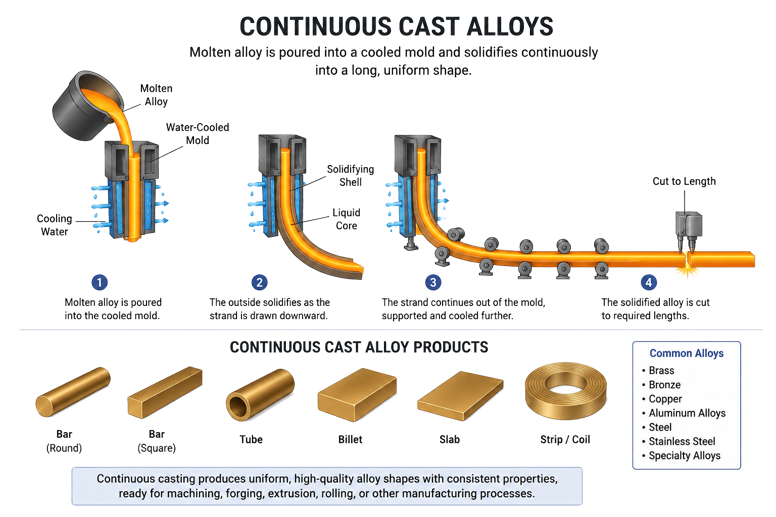
Continuous cast alloys are common in copper alloys, brass, bronze, aluminum alloys, steel, stainless steel, and specialty metals. In copper-based alloys, continuous casting is often used to make bar stock, tube stock, and shaped sections for bushings, bearings, gears, wear plates, electrical components, marine hardware, valve parts, fittings, and machined industrial components.
The advantage of continuous casting is that it can produce sound, uniform material with less waste than some older casting methods. It also reduces the need for repeated remelting or individual mold pouring. Compared with sand casting, for example, continuous cast material generally has better dimensional consistency and a more uniform internal structure. Compared with fully wrought material, it may offer good machinability and availability in larger or specialty shapes.
In fastener and industrial manufacturing, continuous cast alloys may be used as starting stock for machined parts, threaded inserts, bushings, spacers, nuts, washers, wear components, and custom per-print parts. The material is not usually a finished fastener by itself; it is a controlled alloy form that can be cut and machined into finished components.
Copper Alloy
Copper alloy is a metal made by combining copper with one or more additional elements to improve strength, hardness, corrosion resistance, wear resistance, machinability, conductivity, or formability. Pure copper is highly conductive and corrosion resistant, but it is also relatively soft, so alloying it with elements such as zinc, tin, aluminum, nickel, silicon, beryllium, or phosphorus allows the material to perform better in demanding industrial and fastener applications.
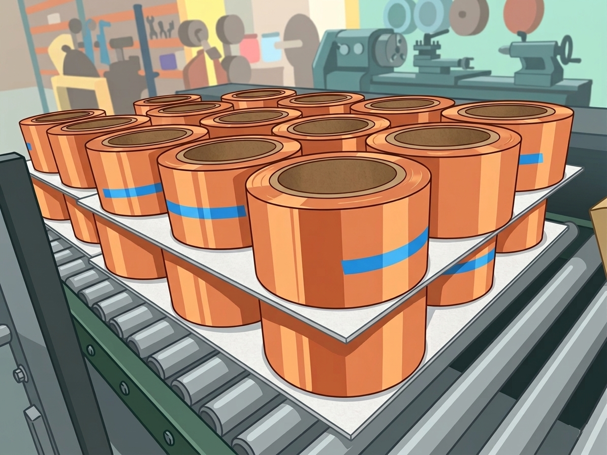
Common copper alloys include brass, which is primarily copper and zinc; bronze, which is traditionally copper and tin but may include other elements; silicon bronze, which offers good corrosion resistance and strength; phosphor bronze, known for fatigue resistance and spring properties; copper-nickel alloys, used in marine and corrosive environments; and beryllium copper, valued for high strength, electrical conductivity, and non-sparking properties.
In fasteners, copper alloys are often selected when corrosion resistance, electrical conductivity, thermal conductivity, appearance, or non-magnetic behavior is important. They may be used for screws, nuts, bolts, washers, electrical connectors, marine hardware, grounding components, spring contacts, and specialty parts exposed to moisture or chemicals. While copper alloys generally do not match the high tensile strength of alloy steel fasteners, they provide a useful balance of conductivity, durability, corrosion resistance, and workability in applications where ordinary carbon steel or stainless steel may not be the best fit.
Ferrovanadium Alloy
Ferrovanadium is an iron–vanadium alloy used primarily as a strengthening additive in steel production. It typically contains 35% to 85% vanadium by weight, with the remainder being iron. The alloy is designed to introduce vanadium efficiently into molten steel, improving its hardness, toughness, tensile strength, and resistance to wear and fatigue.

Ferrovanadium is made by reducing vanadium pentoxide (V₂O₅)—the most common vanadium compound—with iron in the presence of a reducing agent such as silicon, aluminum, or carbon. This process is carried out in an electric arc furnace or aluminothermic reactor, where the vanadium oxide reacts with the reducing metal to form ferrovanadium and slag. The molten alloy is then cast into ingots, crushed, and sized for use in steelmaking.
When added to steel, vanadium forms hard, stable carbides and nitrides within the microstructure. These compounds refine the grain size and prevent dislocation movement, dramatically increasing the steel’s strength and resistance to deformation, even at high temperatures. As a result, ferrovanadium is widely used in high-strength low-alloy (HSLA) steels, tool steels, spring steels, and high-speed steels.
In construction and automotive industries, ferrovanadium helps produce steel that is lighter but stronger, allowing for reduced material usage without sacrificing performance—a key advantage in bridges, pipelines, rebar, and vehicle frames. In aerospace and defense applications, vanadium’s ability to enhance temperature stability and fatigue strength makes ferrovanadium-containing alloys suitable for jet engines, landing gear, and armor plating.
Ferrovanadium typically comes in two standard grades:
- FeV 80 – containing about 78–82% vanadium, commonly used in high-strength steels.
- FeV 50 – containing about 45–55% vanadium, used where lower vanadium content is sufficient.
Aside from steelmaking, small amounts of ferrovanadium are also used in titanium–vanadium–aluminum alloys, which are essential in aerospace engineering.
Nickel Alloy
Nickel alloys are alloys where nickel is the main base metal (the “matrix”), with other elements added to engineer performance you can’t reliably get from carbon steels or even many stainless steels—especially when you have heat + corrosion + stress happening at the same time.
Why nickel is the base metal
Nickel is unusually good at staying stable when things get ugly:
- It keeps useful strength at elevated temperature (good creep resistance compared to many steels).
- It can form protective oxide films (especially when paired with chromium), giving strong oxidation and scaling resistance.
- It supports alloy chemistries that resist aggressive corrosion modes like pitting/crevice corrosion, stress corrosion cracking, and certain acid environments.
So nickel alloys are often the “insurance policy” material: expensive, but cheaper than unplanned shutdowns, leaks, or cracked parts.
The “big levers” in nickel alloy chemistry
A few alloying elements do most of the heavy lifting:
- Chromium (Cr): boosts oxidation resistance and helps passivation in many environments.
- Molybdenum (Mo): boosts resistance to pitting/crevice corrosion (especially in chlorides) and many reducing acids.
- Copper (Cu): often improves performance in certain reducing acids and seawater-related environments (depends on alloy family).
- Aluminum (Al) + Titanium (Ti) + Niobium (Nb): enable precipitation hardening (very high strength, good high-temp capability).
- Iron (Fe): often used to lower cost and tune thermal/strength behavior in certain “Ni-Fe-Cr” families.
Main families (how industry tends to bucket them)
1) Corrosion-resistant nickel alloys (chemical/process service)
These are selected primarily to survive specific chemistries (chlorides, acids, sour environments, etc.). Many are Ni–Cr–Mo types, because Cr helps passivation and Mo helps localized corrosion resistance.
2) High-temperature nickel alloys (heat, creep, oxidation)
These are for furnaces, turbines, hot tooling, and anything that lives where steels start to soften or scale. Many are Ni–Cr types for oxidation resistance, sometimes with additions for creep strength.
3) Precipitation-hardened (age-hardened) nickel alloys (strength monsters)
These are the “clamp-load and don’t blink” alloys—high strength (including at temperature) after heat treatment. They show up in critical fasteners, springs, shafts, and aerospace/power applications.
4) Ni–Cu and other specialty families
Used for particular corrosion niches, seawater exposure patterns, or specific chemical compatibility needs.
Where you see nickel alloys in the real world
- Fasteners & bolting: hot flanges, corrosive services, offshore, chemical plants—where you need preload retention and corrosion resistance (and you worry about galling).
- Piping & pressure equipment: heat exchangers, reactors, acid service, chloride service, sour service.
- High-temperature hardware: furnace fixtures, burner parts, thermocouple protection tubes, high-temp brackets.
- Power & aerospace: hot-section components, high-cycle fatigue + heat environments.
Practical “gotchas” (the stuff that bites)
- Galling: Many nickel alloys (and stainless) are prone to thread galling—lubrication, coatings, and correct nut/bolt pairing matter a lot.
- Galvanic corrosion: Mixing nickel alloys with carbon steel or aluminum in wet environments can create galvanic trouble if not designed/isolated properly.
- Weldability and heat treatment: Some nickel alloys weld beautifully; others need strict procedure control. Precipitation-hardened alloys are especially sensitive to thermal history.
- Cost/lead time: Often the biggest non-technical constraint.
How they’re specified
Nickel alloys are usually called out by a standard/spec + grade + product form + heat treatment condition, commonly under bodies like ASTM International and ASME, and corrosion-service choices are often influenced by industry guidance from groups like AMPP (formerly NACE).
Refractory High-Entropy Alloy (RHEA)
A Refractory High-Entropy Alloy, often abbreviated RHEA, is a type of advanced metal alloy made primarily from refractory elements combined in relatively high proportions. Refractory elements are metals with very high melting points, such as tungsten, molybdenum, tantalum, niobium, hafnium, vanadium, zirconium, and titanium. These elements are valued because they can retain strength and stability at temperatures where many conventional alloys soften, creep, oxidize, or lose mechanical performance.
The “high-entropy alloy” part means the alloy is not built around one dominant base metal the way steel is based on iron or nickel superalloys are based on nickel. Instead, a high-entropy alloy contains several principal elements, often five or more, mixed in significant amounts. For example, an RHEA might contain niobium, molybdenum, tantalum, tungsten, and vanadium in roughly comparable proportions. The idea is that the complex mixture of elements can create unusual crystal structures and properties that are not easily achieved with traditional alloy design.
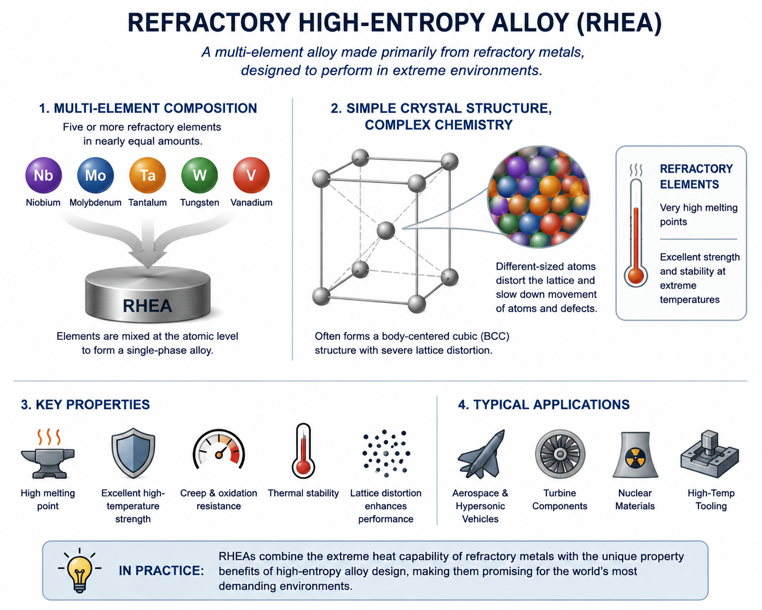
In many RHEAs, the atoms form a simple-looking crystal structure, often body-centered cubic, even though the chemistry is highly complex. Because the different atoms vary in size, weight, and bonding behavior, they distort the crystal lattice and make it harder for atoms and defects to move. This can improve high-temperature strength, creep resistance, hardness, and thermal stability.
RHEAs are being studied for demanding applications such as aerospace components, turbine parts, hypersonic vehicles, nuclear materials, high-temperature tooling, and other environments where metals must survive extreme heat and stress. Some RHEAs are considered potential alternatives or complements to nickel-based superalloys, especially at very high temperatures.
However, RHEAs also have challenges. Many are very dense because they contain heavy elements like tungsten and tantalum. Some can be brittle at room temperature, difficult to manufacture, expensive, or vulnerable to oxidation at high temperatures unless protective alloying elements or coatings are used. Their performance depends heavily on the exact composition, processing method, heat treatment, and service environment.
Superalloy
A superalloy is a high-performance metallic alloy engineered to maintain exceptional strength, toughness, and stability at high temperatures—often above 1000°C (1832°F)—while resisting creep, corrosion, and oxidation. These materials are specifically designed for environments where conventional metals like steel or aluminum would quickly weaken, deform, or oxidize.
Superalloys are typically based on three primary metals: nickel, cobalt, or iron (or combinations of them). Of these, nickel-based superalloys are the most widely used because of their outstanding performance under both mechanical and thermal stress. The alloys achieve their remarkable properties through a combination of precise chemical composition and complex microstructural strengthening mechanisms.
Their key alloying elements include:
- Chromium (Cr) – enhances oxidation and corrosion resistance.
- Cobalt (Co) – stabilizes the microstructure and improves strength at high temperatures.
- Molybdenum (Mo), tungsten (W), and tantalum (Ta) – increase creep resistance.
- Aluminum (Al) and titanium (Ti) – form strengthening precipitates known as γ′ (gamma-prime) phases in nickel-based alloys, which give superalloys their superior heat strength.
- Niobium (Nb) – further improves strength and stability in alloys such as Inconel 718.
Superalloys are produced through advanced metallurgical techniques like vacuum induction melting (VIM), vacuum arc remelting (VAR), and powder metallurgy, which ensure purity and precise control over grain structure. Some are precipitation-hardened, meaning they gain strength from fine, stable particles distributed throughout the metal that block dislocation movement at high temperatures.
These alloys are critical in industries where materials must withstand extreme thermal, chemical, and mechanical conditions. They are used in jet and rocket engines, gas turbines, nuclear reactors, chemical processing plants, and marine and oil drilling equipment. For example, turbine blades in jet engines—arguably one of the most demanding engineering components—are often made of single-crystal nickel-based superalloys to eliminate grain boundaries and prevent creep.
Wrought Alloy
A wrought alloy is a metal alloy designed to be mechanically worked into shape after it is cast into an initial form such as an ingot, billet, slab, rod, or bar. “Wrought” means the material has been worked by processes such as rolling, forging, extrusion, drawing, swaging, or cold forming, rather than being poured directly into a final mold shape like a casting.
The key idea is that a wrought alloy is not defined only by its chemistry, but also by how it is processed. After the alloy is melted and solidified into a basic starting shape, it is plastically deformed into a finished or semi-finished product. That deformation changes the internal grain structure of the metal, often improving strength, toughness, ductility, fatigue resistance, and consistency compared with many cast forms.
Common wrought product forms include sheet, plate, bar, rod, wire, tube, strip, extrusions, forgings, and cold-headed fastener blanks. In fastener manufacturing, many bolts, screws, pins, rivets, washers, and specialty parts begin as wrought wire, rod, or bar stock. The material may then be cold headed, hot forged, roll threaded, machined, heat treated, coated, or otherwise finished.
Wrought alloys are commonly contrasted with cast alloys. A cast alloy is formulated to flow well as molten metal and fill a mold. A wrought alloy is formulated to survive mechanical deformation without cracking. Because of that, wrought alloys generally need good ductility and controlled composition so they can be rolled, drawn, forged, or formed reliably.
For example, in aluminum metallurgy, alloys such as 6061, 7075, 2024, and 5052 are wrought aluminum alloys. They are typically rolled, extruded, or forged into usable shapes. Cast aluminum alloys, by contrast, include materials designed for foundry processes and die casting. Similarly, many steels, stainless steels, titanium alloys, nickel alloys, copper alloys, and aluminum alloys used in industrial components are supplied in wrought form.
Zirconium Alloys
Zirconium alloys are metal alloys made primarily of zirconium and small amounts of other elements added to improve strength, corrosion resistance, temperature performance, and manufacturing characteristics. These alloying elements commonly include tin, niobium, iron, chromium, and nickel, depending on the grade and intended service environment. Zirconium itself is known for its excellent resistance to corrosion and its ability to perform well in aggressive chemical and high-temperature conditions, and alloying helps tailor those properties for specific industrial uses.
One of the most important characteristics of zirconium alloys is their combination of corrosion resistance, heat resistance, and relatively good mechanical strength. They are especially valued in environments where many other metals would corrode, contaminate the process, or lose performance over time. Zirconium alloys are widely associated with chemical processing equipment and nuclear applications. In the nuclear field, they are used because zirconium has a very low neutron absorption cross section, which makes it especially useful for components such as fuel cladding and other reactor-related parts where the material must resist hot water and steam while interfering as little as possible with the nuclear reaction.
In practical terms, zirconium alloys are not a single material but a family of engineered zirconium-based grades developed for demanding service. Some are optimized for corrosive chemical environments, while others are designed for reactor service, pressure, heat, and long-term dimensional stability. Well-known examples include the Zircaloy family and zirconium-niobium alloys used in nuclear systems. Overall, zirconium alloys are best understood as high-performance, corrosion-resistant zirconium-based materials used where purity, durability, temperature resistance, and chemical stability are critical.