Learning Hub
Glossary
Lap Joint Flange
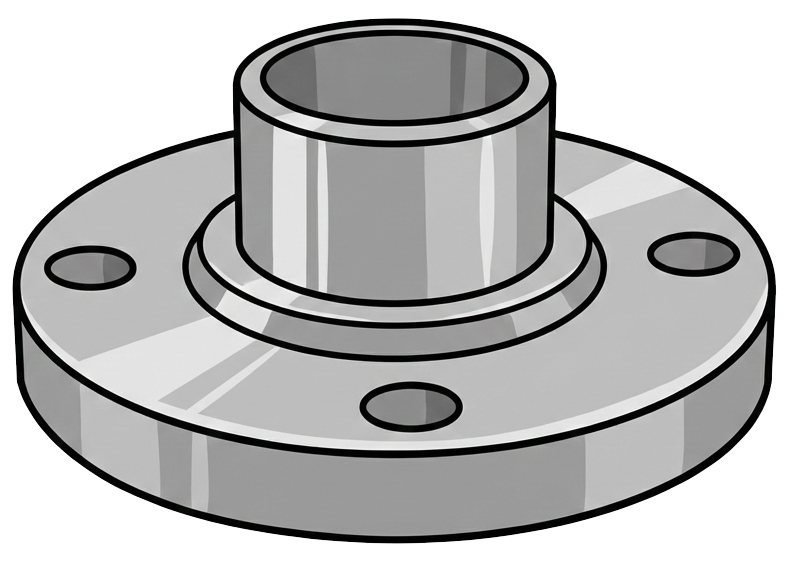
A lap joint flange is a two-piece flanged connection used in piping where the flange itself is not welded to the pipe. Instead, a stub end (a short fitting with a flared “lap” face) is butt-welded to the pipe, and then a loose backing flange (the lap joint flange) slides over the pipe and rotates freely around the stub end. That free rotation is the whole party trick: it makes bolt-hole alignment much easier during installation and maintenance.
Functionally, the stub end provides the sealing surface, not the backing flange. When you tighten the bolts, the lap joint flange pushes against the back of the stub end’s “lap,” transmitting clamp load so the gasketed seal occurs at the stub end face against the mating flange.
You’ll see lap joint flanges used where systems need frequent dismantling, where alignment is a headache, or where you want flexibility in materials. A classic example is corrosion-resistant (wetted) pipe and stub end (like stainless) paired with a less expensive backing flange (like carbon steel), because the backing flange typically doesn’t contact the process fluid—it’s mainly providing bolt-up strength and clamping force.
The tradeoffs: lap joint assemblies are generally favored for low-to-moderate pressure/temperature service and are not the first pick for high cyclic bending/fatigue-prone situations compared to something like a weld neck. They also introduce extra parts (stub end + backing flange), which can add cost and create crevice/cleanability considerations depending on the service.
From a standards standpoint, lap joint flange dimensions are commonly governed by ASME B16.5 (typical sizes/classes) and B16.47 (large diameter), while the stub end is treated as a fitting and commonly falls under ASME B16.9.