
Learning Hub
Glossary
Gangue
Gangue is the unwanted rock, mineral, or earthy material that occurs naturally with valuable ore minerals. When ore is mined, it usually contains both the useful mineral that holds the metal and surrounding nonvaluable material. The valuable portion is processed to recover the metal, while the gangue must be separated and discarded or reused.
For example, a copper ore may contain copper-bearing minerals such as chalcopyrite along with quartz, clay, calcite, feldspar, or other minerals that do not contain enough copper to be worth recovering. Those unwanted materials are considered gangue in that particular mining operation.
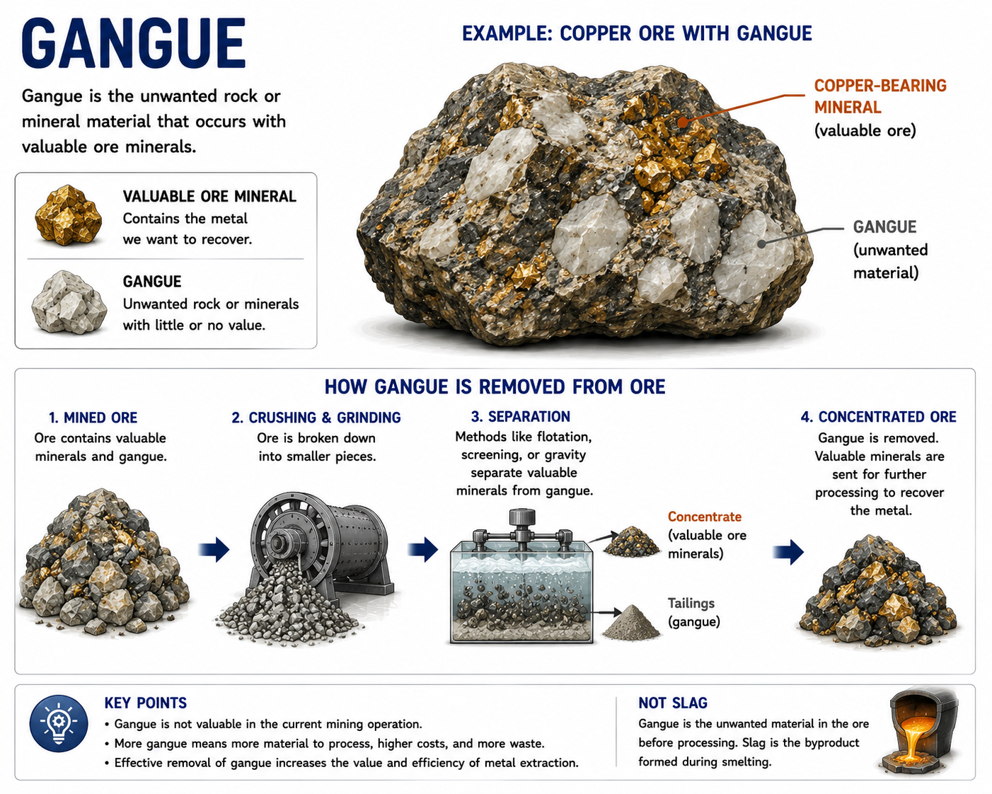
Gangue is important because it affects how difficult and expensive an ore is to process. If an ore contains a large amount of gangue, more material must be crushed, ground, moved, heated, leached, or separated to recover the same amount of metal. This can increase energy use, chemical consumption, processing time, waste volume, and overall cost.
During ore processing, gangue may be removed by methods such as crushing, grinding, washing, screening, gravity separation, flotation, magnetic separation, or chemical treatment. The goal is to concentrate the valuable mineral and reject as much gangue as possible before the material goes to smelting, leaching, or refining.
In smelting, some gangue can react with a flux, such as limestone, to form slag. The slag collects many of the unwanted impurities and separates from the molten metal. In this way, gangue is not the same thing as slag. Gangue is the unwanted material present in the ore before processing, while slag is the molten byproduct formed during high-temperature processing.
A material can be gangue in one operation but valuable in another, depending on what is being recovered. For example, quartz may be unwanted gangue in a metal ore, but high-purity quartz can be valuable in other applications.