
Learning Hub
Glossary
Black Oxide
Black oxide is a chemical conversion coating that creates a thin, dark black surface layer on metal, most commonly steel. Instead of adding a thick layer of another metal like zinc or nickel plating, black oxide changes the outer surface of the base metal through a controlled chemical reaction. On steel, the process forms a black iron oxide layer, usually magnetite, which is chemically known as Fe₃O₄.
Black oxide is valued for its dark appearance, low dimensional change, mild corrosion resistance, reduced light reflection, and ability to hold oil or wax. Because the coating is very thin, it is useful when a part needs a black finish but cannot tolerate much buildup on threads, bearing surfaces, holes, or precision dimensions. This makes it common on fasteners, tools, shafts, gears, machine components, firearms parts, and decorative hardware.
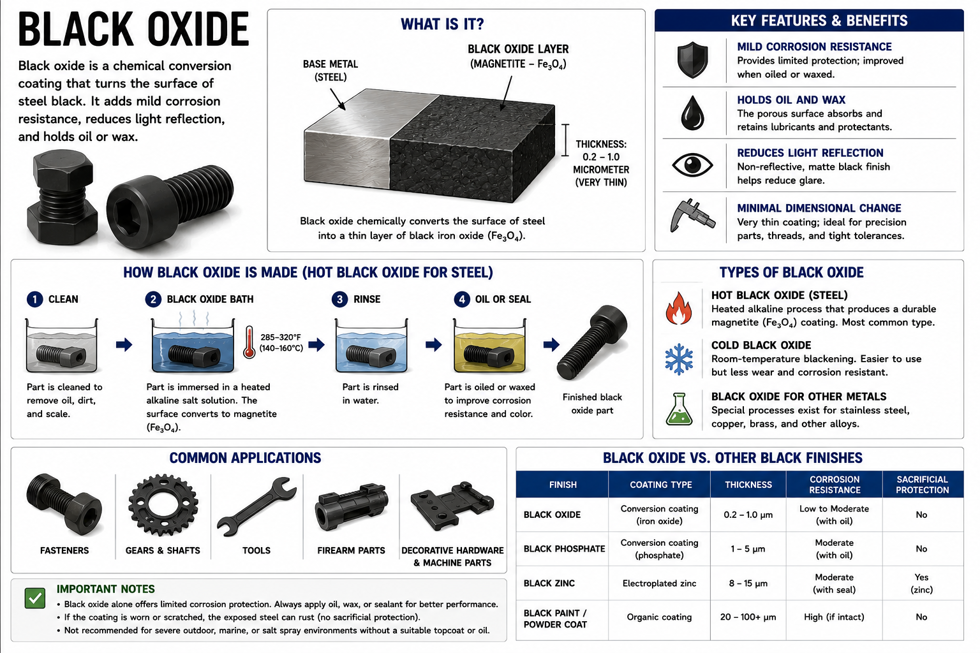
The coating itself does not provide strong corrosion protection by itself. Its corrosion resistance usually comes from the oil, wax, or sealant applied after the black oxide treatment. The black oxide layer is somewhat porous, so it can absorb and hold these protective materials. Without an after-seal, black oxide on steel offers only limited rust protection, especially in wet, salty, or outdoor environments.
There are several types of black oxide processes. Hot black oxide for steel is performed in a heated alkaline salt bath and produces a durable black magnetite finish. Cold black oxide is often used as a room-temperature blackening treatment, but it is usually less wear-resistant and less chemically integrated with the surface than a true hot black oxide. There are also black oxide processes for stainless steel, copper, brass, and other alloys, although the chemistry differs from standard steel black oxide.
In fastener applications, black oxide is often chosen for appearance, minimal dimensional change, mild lubricity when oiled, and reduced glare. However, it is not usually the best choice for severe corrosion environments unless paired with an appropriate oil, wax, or other protective topcoat. It also does not provide sacrificial protection like zinc. If black oxide is scratched or worn away, the exposed steel does not have a more active coating nearby to corrode in its place.
Black oxide should not be confused with black zinc, black phosphate, black paint, or black powder coating. Those finishes may look similar from a distance, but they are different coating systems with different thicknesses, corrosion resistance, friction behavior, and performance characteristics. In practical terms, black oxide is a thin black conversion finish that improves appearance and oil retention while adding only modest corrosion protection unless it is properly sealed.