
Learning Hub
Glossary
Bend Radius
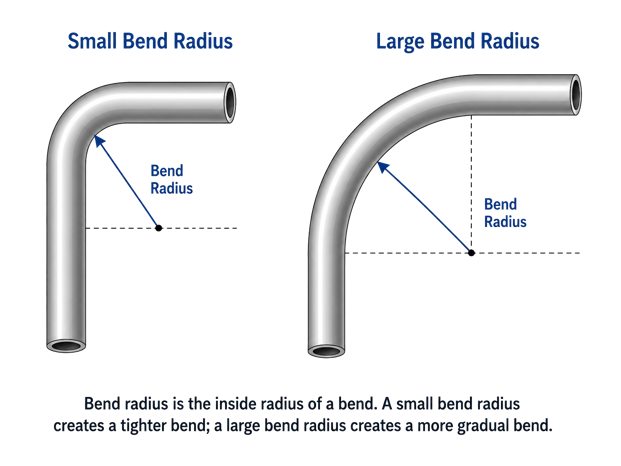
Bend radius is the inside radius of a bend formed in metal, wire, tubing, sheet, strip, or another material. It describes how tightly the material is bent and is usually measured from the center of the bend curve to the inside surface of the material. A small bend radius means the part is bent sharply, while a large bend radius means the bend is more gradual.
In metalworking, bend radius is important because bending does not simply “fold” the material without consequences. When a part is bent, the outside of the bend stretches and the inside of the bend compresses. If the bend radius is too tight for the material, thickness, hardness, grain direction, or temper, the outside surface can crack, split, thin excessively, or weaken. If the radius is too large, the part may not fit the required design envelope or may fail to provide the intended spring action, clearance, or geometry.
Bend radius is commonly used in sheet metal forming, wire forming, fourslide stamping, roll forming, tubing, brackets, clips, clamps, springs, and custom fastener-related components. For example, a stamped spring clip may need a controlled bend radius so it can flex without cracking. A formed wire retainer may need a consistent radius so it seats properly and maintains spring tension. A bent bracket may require a specific inside radius so the part matches the print and does not develop stress concentrations at the bend.
Material selection has a major effect on the required bend radius. Softer, more ductile materials can usually tolerate tighter bends. Harder, stronger, or spring-temper materials often require a larger bend radius to prevent cracking. Stainless steel, spring steel, hardened alloys, and some copper alloys may need more generous radii than softer low-carbon steel or annealed aluminum. Material thickness also matters: as thickness increases, the minimum safe bend radius usually increases as well.
Bend radius is closely related to minimum bend radius, which is the smallest radius a material can be bent to without unacceptable cracking, weakening, or distortion. It is also related to springback, because after bending force is removed, many materials partially rebound toward their original shape. Tooling often has to overbend the material slightly to achieve the final required angle and radius.
In manufacturing drawings, bend radius may be specified to control fit, strength, repeatability, and appearance. A note such as “R .125” or “inside bend radius .125 in.” tells the manufacturer the required radius at the inside of the bend. When no radius is specified, the bend may be formed according to standard tooling, shop practice, or material limitations, but critical parts usually define the radius clearly to avoid cracking, poor fit, or inconsistent performance.