
Learning Hub
Glossary
Springback
Springback is the elastic recovery that occurs after a metal has been bent, formed, stamped, drawn, or otherwise plastically deformed. In simple terms, it is the tendency of a formed part to “bounce back” slightly toward its original shape after the forming force is removed.
When a metal is bent, not all of the deformation is permanent. Part of the deformation is plastic, meaning the metal’s shape has been permanently changed. Another part is elastic, meaning the metal was temporarily stretched or compressed and tries to recover once the tool, punch, die, press brake, or forming load is released. That elastic recovery is springback.
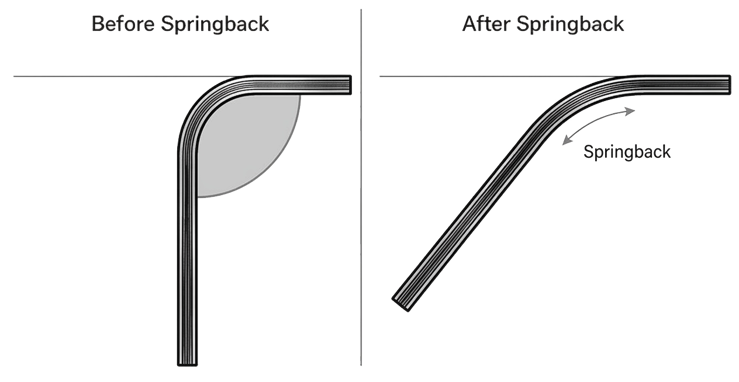
In bending, the outside of the bend is placed in tension and the inside of the bend is placed in compression. After the forming tool is removed, those internal stresses try to rebalance. The result is that the bend angle opens up slightly, the bend radius may increase, and the final part shape may differ from the shape of the tooling. For example, a sheet metal part bent to exactly 90 degrees in the die may relax to 91, 92, or more degrees after release unless the process compensates for it.
Springback is affected by several factors, including material type, yield strength, modulus of elasticity, thickness, bend radius, grain direction, amount of cold work, tooling geometry, friction, and forming method. High-strength steels, stainless steels, aluminum alloys, titanium alloys, and spring-temper materials generally show more springback than softer, lower-strength materials. A larger bend radius also tends to increase springback because the deformation is less severe and more of the strain remains elastic.
Manufacturers compensate for springback by overbending, using tighter tooling radii, coining, bottoming, restrike operations, controlled die design, simulation, or trial adjustments. In precision forming, springback is one of the main reasons tooling may not match the final desired part shape exactly. The tool may intentionally form the part “too far” so that it relaxes into the correct geometry.
In fastener and industrial manufacturing, springback matters in parts such as clips, clamps, retaining rings, spring washers, lock washers, brackets, formed sheet metal hardware, stamped components, and wire forms. In some products, springback is a problem to be controlled; in others, it is part of the design. A spring clip, for example, depends on elastic recovery to grip and hold parts together.