
Learning Hub
Glossary
Fourslide Stamping
Fourslide stamping, also called four-slide stamping or multi-slide stamping, is a metal forming process that uses multiple moving tool slides to cut, bend, pierce, notch, coin, and form small metal parts from strip stock or wire. Unlike a traditional stamping press, which usually drives tooling mostly up and down in a vertical motion, a fourslide machine uses slides that move horizontally toward the workpiece from several directions, commonly from the front, back, left, and right. This allows the machine to form complex bends, offsets, hooks, tabs, loops, and spring features in one continuous operation.
The process usually starts with a coil of flat metal strip or wire. The material is fed into the machine, where it may be pierced, blanked, notched, embossed, or partially cut. Then the slides move in sequence to bend or shape the part from different angles. After the forming steps are complete, the finished component is cut off from the strip or wire. Because several forming actions can happen in a compact machine cycle, fourslide stamping is especially useful for parts that would otherwise require multiple press operations, secondary forming steps, or complicated progressive dies.
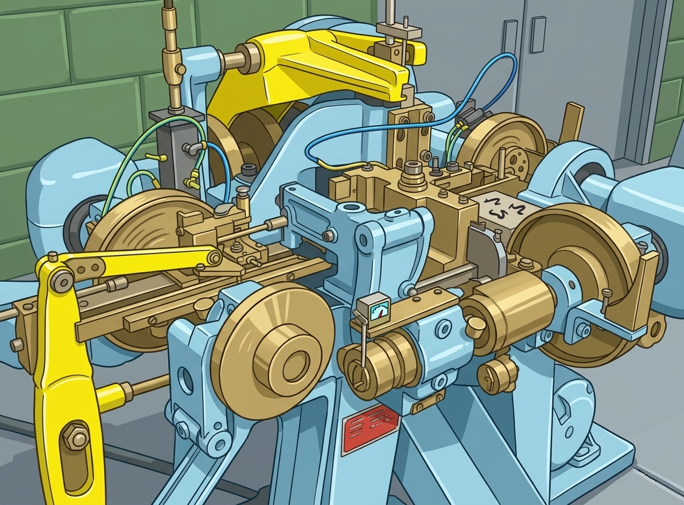
In fastener, hardware, and industrial component manufacturing, fourslide stamping is often used to produce small precision parts such as spring clips, retaining clips, electrical contacts, terminals, brackets, latches, wire forms, clamps, hooks, shields, specialty washers, and custom fastening components. It is especially valuable for parts with multiple bends or features that wrap around, snap into place, apply spring pressure, retain another part, or act as a small mechanical connector.
A major advantage of fourslide stamping is its ability to make complex parts efficiently from coil-fed material with relatively low scrap. Because the tooling can approach the part from multiple directions, the process can form shapes that may be awkward or expensive to make with a conventional straight-down stamping press. For high-volume production, it can be very cost-effective, especially for small metal parts that require repeatability, tight dimensional control, and fast cycle times.
Materials commonly used in fourslide stamping include carbon steel, stainless steel, spring steel, brass, phosphor bronze, beryllium copper, aluminum, and other formable metal alloys. Material selection depends on the required strength, spring properties, corrosion resistance, conductivity, hardness, and finish. After forming, parts may be heat treated, plated, passivated, deburred, cleaned, or coated depending on the application.
Fourslide stamping is best understood as a hybrid between stamping and precision forming. It does not simply punch a flat shape out of metal; it can create a finished three-dimensional component with bends and functional features built into the part. In fastener-related applications, it is commonly used when the part needs to grip, retain, spring, latch, ground, shield, or hold another component in position.
AKA: Four-Slide Stamping or Multi-Slide Stamping