
Learning Hub
Glossary
Stress Concentrations
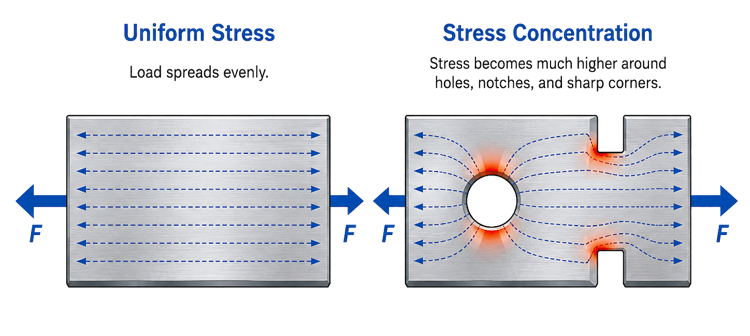
Stress concentrations are localized areas in a part where mechanical stress becomes much higher than the average stress in the surrounding material. They occur when the shape, surface condition, or geometry of a component interrupts the smooth flow of load through the material. Instead of the force spreading evenly, it “crowds” into a smaller region, creating a high-stress zone that is more likely to crack, deform, fatigue, or fail.
In metal parts and fasteners, stress concentrations commonly occur at sharp corners, notches, holes, grooves, thread roots, keyways, stamped edges, scratches, cracks, abrupt diameter changes, undercuts, weld toes, and tight bend radii. A smooth round bar under tension may carry load fairly evenly, but if a groove or sharp inside corner is added, the stress increases around that feature. The sharper the transition, the more severe the concentration.
A simple example is a bolt thread. The root of the thread is a natural stress concentration because the thread shape creates a small-radius valley. When the bolt is loaded in tension, stress is higher at the thread root than it is in the smoother shank area. This is one reason thread design, rolled threads, proper root radius, material quality, and fatigue strength matter in critical bolted joints.
Stress concentrations are especially important in fatigue applications, where a part is exposed to repeated loading and unloading. Even if the load is below the material’s static tensile strength, a high-stress area can become the starting point for a fatigue crack. Once a crack begins, it acts like an even sharper stress concentration, causing the crack to grow over time until the part eventually fails.
In formed metal parts, stress concentrations can also occur at tight bends. If the bend radius is too small for the material thickness, hardness, or temper, the outside of the bend may stretch too much and develop microcracks. A larger bend radius spreads the deformation over a wider area, reducing the concentration of stress and improving durability.
Manufacturers reduce stress concentrations by using generous radii, smooth transitions, proper fillets, deburring, polishing, shot peening, rolling instead of cutting threads, avoiding sharp corners, controlling surface finish, and designing gradual changes in section thickness. The goal is to help the load flow through the part more evenly instead of forcing it through a sharp or weakened location.
In fastener and industrial design, a stress concentration is not automatically a defect; many normal features, including threads and holes, create them. The concern is whether the concentration is severe enough to reduce strength, fatigue life, or reliability for the application.