
Learning Hub
Glossary
Diffusion Bonding
Diffusion bonding is a solid-state joining process that permanently fuses two materials without melting them. You bring the mating surfaces into intimate contact, apply heat (typically a high fraction of the material’s melting temperature, but still below melting) and pressure for a controlled time, usually in vacuum or an inert atmosphere, and atoms literally diffuse across the interface until the boundary disappears into a joint that can approach parent-material properties.
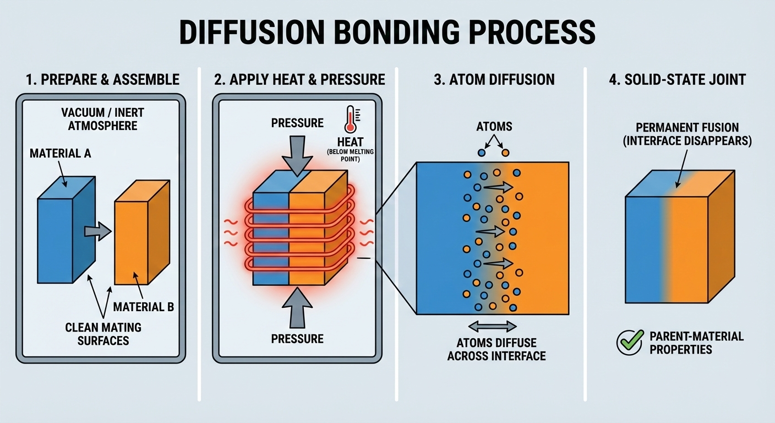
What makes diffusion bonding work is a mix of surface contact and atomic mobility. The applied pressure collapses microscopic high spots (asperities), improves real contact area, and helps eliminate interfacial voids. The elevated temperature accelerates diffusion and allows local creep/plastic flow so remaining gaps shrink. If the surfaces are clean and well-prepped (flatness, finish, cleanliness), the interface gradually transforms from “two parts touching” into a continuous microstructure.
In industry, diffusion bonding is used when you want high integrity and no melt-related defects (no solidification shrinkage, no weld HAZ issues in the usual sense, no filler metal dilution). Common applications include aerospace structures, titanium and nickel alloy assemblies, heat exchangers (including microchannel/plate-type constructions), honeycomb/sandwich panels, and parts that need leak-tight joints or very clean metallurgy. It’s also used to join dissimilar materials in some cases—carefully—because you can avoid some of the cracking and brittle structures that happen when you melt dissimilar metals, though diffusion can still form brittle intermetallics if the pairing is risky.
The tradeoffs are that diffusion bonding is process-sensitive and equipment-intensive. You usually need precise surface prep, controlled atmosphere (often vacuum), tight control of temperature/pressure/time, and fixturing that maintains alignment while the parts are hot and under load. Cycle times can be long, and part geometry matters (large, flat interfaces are “easier” than complex contact surfaces). Inspection often relies on NDT and/or proof testing depending on criticality.
Hot Isostatic Pressing (HIP) can be thought of as diffusion bonding applied through isostatic gas pressure. In HIP, the pressure comes from high-pressure inert gas acting uniformly in all directions, which is excellent for closing internal porosity and bonding powder/canned assemblies; diffusion bonding is more typically a press/fixture-driven contact process focused on a specific interface.