
Learning Hub
Glossary
Asperities
Asperities are the microscopic peaks and valleys that make up a surface’s real topography. Even a surface that looks “smooth” to the eye is a landscape of uneven high spots (summits) and low spots at the micrometer or nanometer scale. When two parts touch, they don’t mate over the whole apparent area—load is carried at a sparse population of these asperity summits.
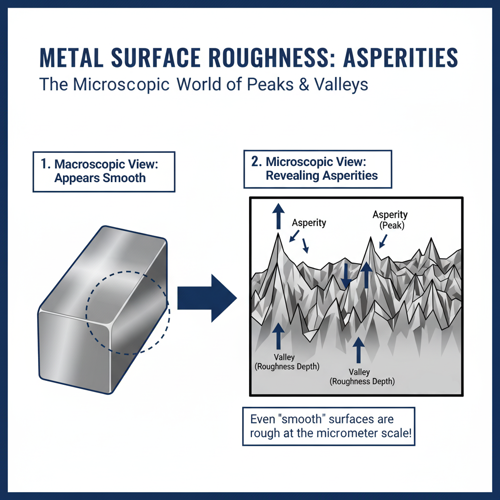
In contact, asperities concentrate pressure to very high local levels. Some summits elastically flatten, others plastically deform, and clean metal-to-metal junctions can briefly micro-weld, then shear. This behavior governs real contact area, friction, wear, heat generation, and noise. In bolted joints it also causes embedment relaxation: as asperities crush under clamp load—under the nut face, washer, and in the thread flanks—preload drops slightly after tightening.
Industrial implications are wide. For fasteners, asperities drive torque-to-tension scatter through their effect on the friction coefficient at threads and bearing surfaces; they contribute to galling in stainless/aluminum where micro-junctions weld and tear; and they influence sealing because leak paths run through unflattened valleys until compressive load “closes” them. In electrical/mechanical interfaces they set contact resistance and thermal conductance, since current/heat flows only through the real (asperity) contact spots. Asperity ridges are also common fatigue-crack initiators and corrosion nucleation sites because peaks see the highest stress and often the least protective film.
Asperities are specified and checked via surface roughness parameters measured with stylus or optical profilometers. Common 2D metrics include Ra (average roughness), Rq (RMS), Rz (mean peak-to-valley height), and bearing-area/Abbott–Firestone curve descriptors like Rpk/Rk/Rvk (peak/core/valley). For full-field control, 3D areal measures (Sa, Sq, Sz, Ssk, Sku) describe the surface over an area instead of a single trace.
You control asperities by changing topography, coatings, and lubrication. Finishing processes (grinding, honing, lapping, superfinishing, electropolishing, bead/shot blasting) tune peak height and valley volume. Platings and coatings (e.g., zinc, phosphate + oil, MoS₂, PTFE, DLC) modify asperity shape and chemistry, stabilizing friction and mitigating galling. Lubricants fill valleys and prevent metal-to-metal junctions. In bolted joints, hardened washers, proper surface finishes under the head/nut, and tightening practices that account for embedment (e.g., snug-pause-final) reduce preload loss and improve consistency.