
Learning Hub
Glossary
Noble Metal
A noble metal is a metal that strongly resists chemical reaction, oxidation, and corrosion, especially in normal air, moisture, and many common chemical environments. Noble metals do not readily give up electrons, which makes them less likely to tarnish, rust, dissolve, or form surface oxides compared with more reactive metals such as iron, zinc, aluminum, or magnesium.
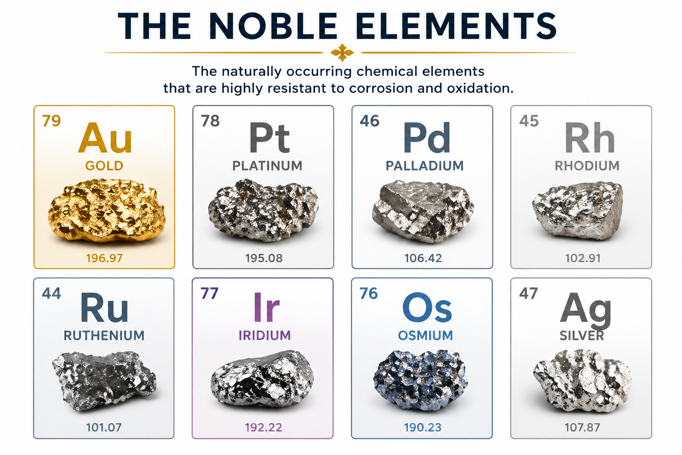
Common noble metals include gold, platinum, palladium, rhodium, ruthenium, iridium, osmium, and silver, although silver is sometimes treated as “less noble” because it tarnishes in sulfur-containing environments. Copper is also relatively noble compared with steel or zinc, but it is not usually grouped with the classic precious noble metals.
In corrosion science, “noble” often refers to a metal’s position in the galvanic series. When two different metals are electrically connected in the presence of an electrolyte, such as water, saltwater, or condensation, the less noble metal becomes the anode and corrodes faster, while the more noble metal becomes the cathode and is protected. For example, zinc is less noble than steel, which is why zinc coatings sacrificially corrode to protect fasteners. Stainless steel is generally more noble than zinc-plated steel, so mixing stainless components with zinc-coated parts in wet service can accelerate corrosion of the zinc.
In fastener and industrial applications, the idea of nobility matters because it helps predict galvanic corrosion risk when dissimilar metals are used together. A noble metal may resist corrosion very well by itself, but pairing it with a much less noble metal can create a corrosion cell if moisture or another electrolyte is present.