Learning Hub
Glossary
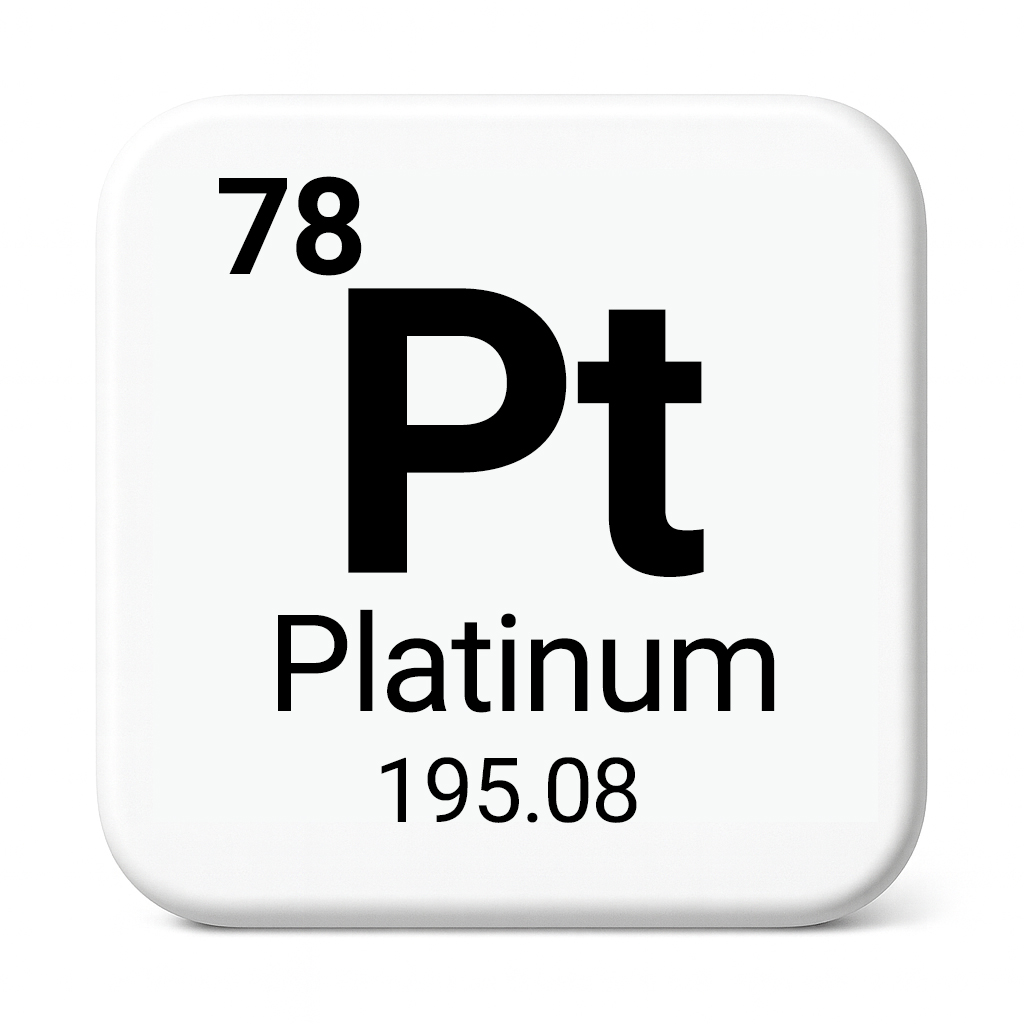
Platinum (Pt)
Platinum is a chemical element with the symbol Pt and atomic number 78. It is a dense, silvery-white precious metal and one of the platinum-group metals, a family that also includes palladium, rhodium, ruthenium, iridium, and osmium. Platinum is especially known for its high melting point, strong resistance to corrosion and oxidation, and excellent chemical stability, which is why it has long been valued both as a luxury metal and as an important engineering material.
From an industrial standpoint, platinum is important because it is not just decorative; it is also a highly effective catalytic metal. Its catalytic behavior, along with its heat resistance and chemical inertness, makes it useful in applications such as catalytic converters, chemical processing, laboratory equipment, electronics, and certain medical and dental uses. Platinum-group metals as a class are widely recognized for their high melting points, corrosion resistance, and catalytic qualities, and platinum is one of the best-known members of that group.
In materials and manufacturing terms, platinum is best understood as a specialty noble metal used where corrosion resistance, high-temperature stability, conductivity, or catalytic performance justify its cost. It is far less common than structural metals such as steel or aluminum, but it is highly important in critical applications where ordinary metals would corrode, react, or fail to perform as reliably.