
Learning Hub
Glossary
Anchor Eye Bolt
An anchor eye bolt is a type of fastener designed with a threaded shank on one end and a closed loop, or "eye," on the other, specifically intended for securing, lifting, or anchoring loads. Unlike standard eye bolts, which may simply be screwed into wood or metal, an anchor eye bolt is designed to provide stronger, more permanent anchoring, especially in masonry, concrete, or other heavy-duty applications.
The construction of an anchor eye bolt typically includes a forged steel or stainless steel body for strength and durability. The threaded portion is often paired with an expansion anchor, shield, or sleeve that grips into concrete or masonry when tightened. The closed eye creates a secure point for attaching ropes, cables, chains, or rigging hardware, making it versatile for load-bearing uses. Many are galvanized or coated to resist corrosion, especially in outdoor, marine, or industrial environments.
The main function of an anchor eye bolt is to provide a reliable anchor point. When properly installed, it distributes load evenly through its expansion mechanism, minimizing the risk of pullout. This makes it suitable for lifting operations, structural anchoring, and safety tie-downs. In construction, they’re often embedded into concrete floors or walls to serve as secure attachment points, while in marine applications they anchor rigging or mooring lines.
Common applications include construction and infrastructure, where they secure scaffolding, support beams, or lifting equipment; industrial machinery, where they serve as hoisting or tie-down points; and safety systems, such as fall arrest anchors or securing heavy loads. They’re also used in marine environments to anchor ropes and chains, benefiting from corrosion-resistant coatings.
The advantages of anchor eye bolts are their high load capacity, versatility, and ability to provide permanent, reliable anchoring in hard materials. They also resist pullout better than standard eye bolts when properly installed. However, limitations include the need for precise installation, as improper placement or insufficient embedment depth can compromise strength. They also generally require drilling into masonry or concrete, which adds complexity compared to simple screw-in eye bolts. Additionally, they are not always reusable, as the anchoring mechanism may deform during installation.
Eye Bolt
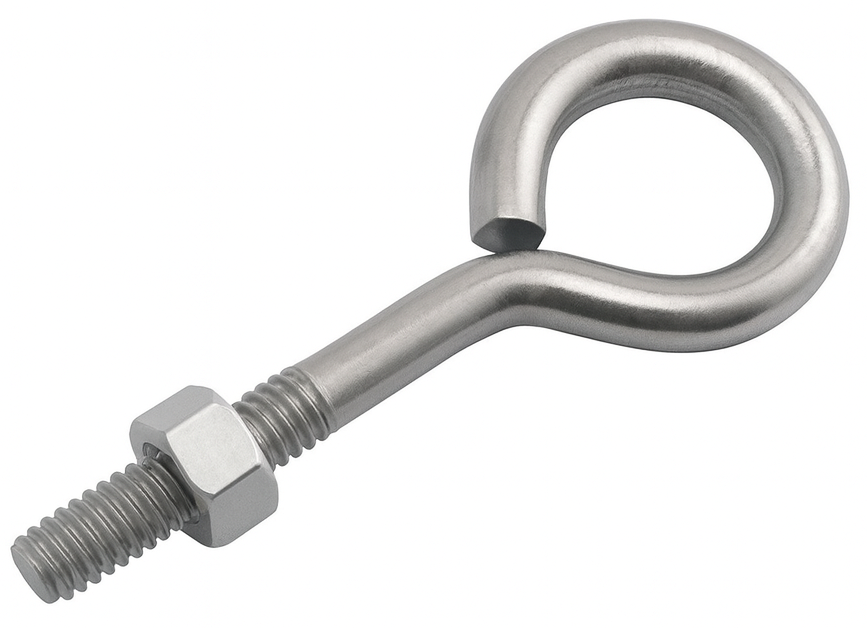
An eye bolt is a type of fastener that features a loop (or "eye") at one end and a threaded shaft on the other. It’s used primarily as a point for attaching ropes, cables, chains, or hooks to lift, secure, or support loads.
Flexible Roller Eye Bolt
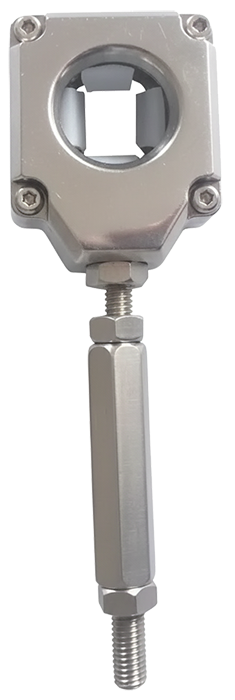
A Flexible Roller Eye Bolt is a specialized type of lifting or anchoring bolt designed to handle loads that may shift or move during operation. Unlike a standard eye bolt, which has a rigid, fixed loop, a flexible roller eye bolt incorporates a rotating or pivoting eye that can move slightly to accommodate angular loads, vibration, or directional changes in tension. This flexibility helps prevent bending stresses on the shank and reduces the risk of fatigue failure, especially in dynamic or off-angle lifting applications.
The “roller” aspect typically refers to an internal bearing or bushing mechanism that allows the eye portion to rotate smoothly under load. This feature helps maintain alignment of the attached cable, chain, or hook, distributing force evenly and reducing wear on both the bolt and the attached lifting hardware. Flexible roller eye bolts are commonly used in material handling systems, marine rigging, cranes, conveyors, and heavy machinery where movement or vibration occurs during operation.
In essence, a flexible roller eye bolt combines the strength of a traditional lifting bolt with the adaptability of a swivel or pivoting head, offering a safer and more durable solution for multi-directional load conditions.
Pigtail Eye Bolt
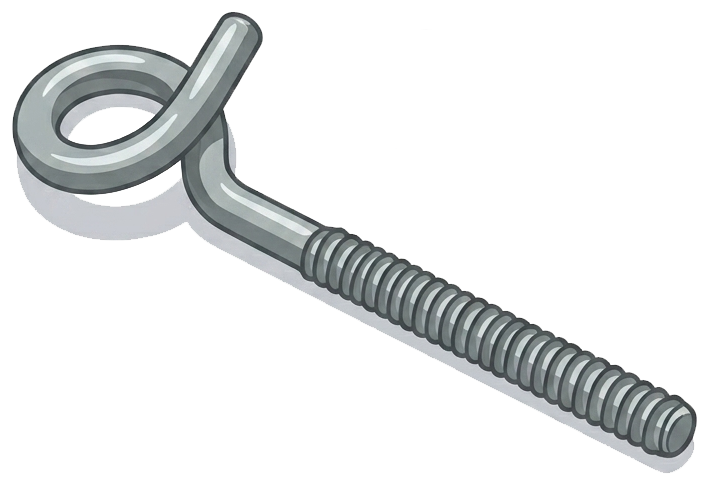
A pigtail eye bolt is a specialty eye-bolt-style fastener with a threaded shank on one end and an open spiral or helical “eye” on the other end, the loop resembling a pig’s tail. That spiral end is what gives the part its name. In industry literature it is also called a pigtail bolt, pigtail hook, or pigtail hook bolt.
In practical use, a pigtail eye bolt is most commonly associated with utility and pole-line hardware rather than general household hardware. It is used on wood, concrete, and utility poles to support or connect hardware such as suspension clamps, dead-end clamps, drop-wire clamps, messenger wire attachments, and overhead service cable connections.
The key feature of a pigtail eye bolt is that it provides a partially open attachment point rather than a fully closed forged eye. That makes it convenient where an installer needs to hook in or capture a bail, wire, or cable-support component without feeding the entire line through a closed ring. These parts are commonly supplied in galvanized steel or other corrosion-resistant finishes because they are often used outdoors in power, telecom, and aerial-line environments.
AKA: Pigtail Bolt, Pigtail Hook, Pigtail Hook Bolt
Ring Eye Bolt
A ring eye bolt is a type of lifting or anchoring fastener that features a round, closed loop (ring) at one end and a threaded shank at the other. It is used to attach ropes, cables, or chains and can serve as a lifting point, tie-down, or suspension anchor.
Screw Eye Bolt
A screw eye bolt is a fastener with a looped head and a threaded shaft, commonly used to anchor cables, ropes, or chains into wood. It's often used in light-duty applications like hanging items or guiding wires.
Thimble Eye Bolt
A thimble eye bolt is a type of lifting or anchoring bolt designed with an integrated thimble-shaped eye that provides a smooth, rounded surface for attaching wire rope, cable, or chain. The thimble eye is formed to mimic the shape of a thimble used in wire rope terminations, which helps protect the rope or cable from abrasion, kinking, and wear when tension is applied.
Structurally, a thimble eye bolt consists of a threaded shank (for mounting into a tapped hole, nut, or structure) and a forged eye at the head with a reinforced, curved interior surface. The curved “thimble” shape evenly distributes load stress across the rope or cable loop, reducing bending fatigue and extending the life of the connection.
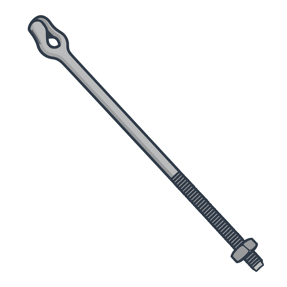
Thimble eye bolts are commonly used in lifting, rigging, and guying applications—for example, on utility poles, structural supports, marine hardware, and industrial lifting assemblies—where wire rope or strand must remain aligned with the direction of load.
They are typically made from forged carbon steel or stainless steel and often hot-dip galvanized or zinc-plated for corrosion resistance, especially in outdoor or marine environments.