
Learning Hub
Glossary
Drop-Wire Clamp
A drop-wire clamp is a hardware fitting used to secure, support, and strain-relieve an aerial drop wire or drop cable where it attaches to a pole, building, hook, span clamp, messenger wire, or other support point. It is most commonly used in telecommunications, fiber-to-the-home, CATV, broadband, and service-drop installations, where a cable runs from an overhead line to a house, building, terminal, or other service location.
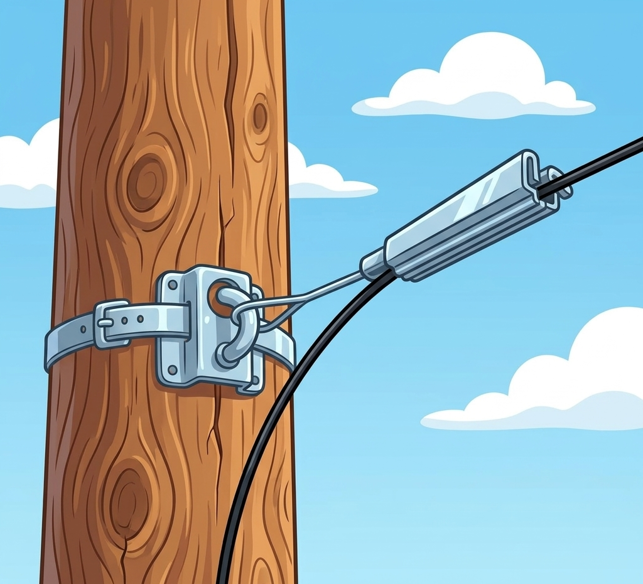
The main purpose of a drop wire clamp is to hold the cable securely without damaging it. Aerial drop cables are exposed to tension from sag, wind, ice, movement, and the weight of the cable itself. The clamp helps transfer that mechanical load into the pole, building, or attachment hardware so the cable jacket, messenger strand, conductor, fiber, or connector is not overstressed. Some designs use a wedge, shell, shim, bail, trough, or clamp body to grip the cable while controlling pressure so the signal-carrying portion is not crushed.
Drop wire clamps are often used with drive hooks, house hooks, span clamps, pole brackets, and other aerial drop hardware. In older telephone service, they were commonly associated with one-pair or two-pair telephone drop wire. In modern systems, similar clamp designs are used for fiber optic drop cable, flat FTTH cable, coaxial cable, network cable, and other communications service drops. The exact clamp style depends on the cable shape, cable diameter, messenger configuration, required tension, and whether the installation is at a building, pole, mid-span support, or aerial terminal.
A drop wire clamp is different from a dead end clamp in scale and typical application. Both can anchor a line, but a dead end clamp is usually discussed in broader utility-line tensioning and termination work, while a drop wire clamp is usually a smaller service-drop fitting used to support the final run of cable to a customer location or terminal point.