
Learning Hub
Glossary
Suspension Clamp
A suspension clamp is a pole-line or overhead-line hardware fitting used to support and suspend a conductor, cable, messenger wire, or fiber-optic line from a pole, tower, crossarm, bracket, or insulator assembly. Its job is to hold the line at an intermediate support point while allowing enough controlled movement to reduce stress from wind, vibration, temperature changes, and line movement. In this sense, a suspension clamp supports the line rather than terminating it.
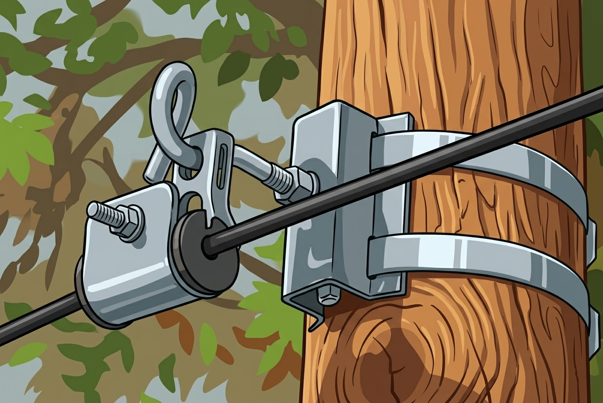
Suspension clamps are commonly used in overhead power distribution, transmission lines, telecom lines, ADSS fiber-optic cable, OPGW cable, service drops, and messenger-supported cable systems. They help maintain line position, sag, clearance, and mechanical support without fully locking the conductor the way a dead-end clamp or strain clamp would. A dead-end clamp anchors and tensions a line at an end point or angle; a suspension clamp is usually used along the run where the line continues past the support.
The design can vary by application. Some suspension clamps use a U-bolt, clamp body, and pressure plate to grip the conductor, while others use preformed rods, elastomer inserts, armor rods, cushions, or shaped saddles to distribute load and reduce localized damage. The clamp must hold the conductor securely enough to prevent slipping or excessive sag, but it also has to avoid crushing, nicking, or creating a severe bend point that could lead to fatigue failure.
Selection depends on the conductor or cable diameter, line type, span length, mechanical load, suspension angle, vibration exposure, corrosion environment, and required hardware connection. In utility work, the right suspension clamp is not just a “fits the wire” choice; it has to match the mechanical and environmental demands of the line.