
Learning Hub
Glossary
Dead-End Clamp
A dead-end clamp is an overhead-line hardware fitting used to terminate, anchor, and hold tension on a conductor, cable, messenger wire, or fiber-optic line at the end of a span, at a pole or tower, or at a major change in direction. Unlike a suspension clamp, which mainly supports a line as it continues past a support point, a dead end clamp is designed to grip the line and transfer its pulling load into the supporting structure. The U.S. Patent and Trademark Office classification language describes dead-end clamps as hardware for fastening cable ends to poles.
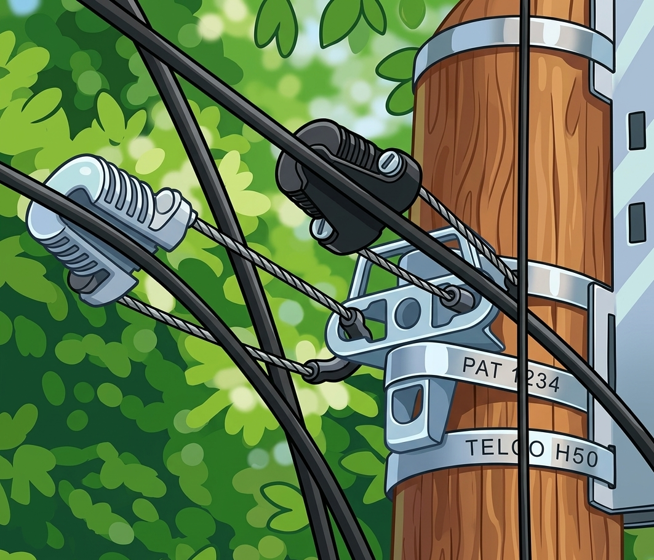
Dead end clamps are used in electric distribution, transmission, telecom, ADSS fiber-optic cable, OPGW cable, messenger wire, and service-drop applications. Their job is to prevent the line from slipping while maintaining the required tension and sag in the span. They may be used at terminal poles, angle poles, tap points, strain points, and locations where the cable or conductor cannot simply pass through a suspension support.
The design can vary depending on the line type. Some dead end clamps are bolted wedge-style or quadrant-style clamps, while others are preformed helical grips that wrap around the conductor or cable. Preformed Line Products describes one dead-end product as being specifically designed to terminate primary, secondary, and neutral conductors, with each size covering a range of conductor diameters.
Selection depends on conductor or cable diameter, material, tension load, span length, installation angle, corrosion environment, and compatibility with poles, towers, insulators, brackets, or other line hardware.