
Learning Hub
Glossary
Deep Drawing
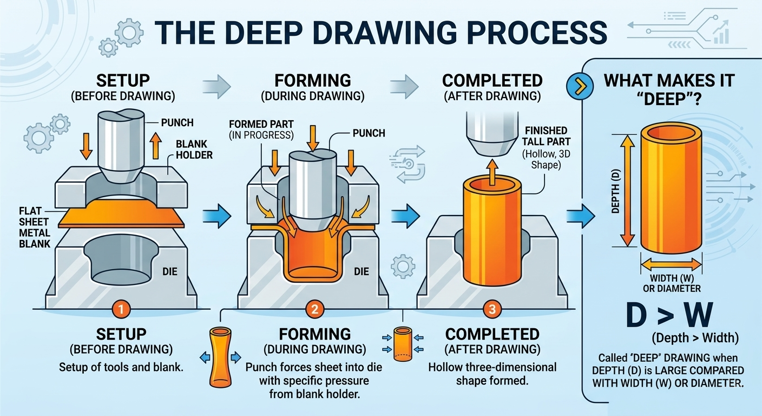
Deep drawing is a metal forming process used to turn flat sheet metal into a deeper, hollow, three-dimensional shape by forcing the sheet into a die with a punch. It is called “deep” drawing when the depth of the formed part is large compared with its diameter or width. Common deep-drawn parts include cups, cans, shells, housings, battery cases, cartridge cases, kitchen sinks, automotive components, electrical enclosures, and some specialty industrial parts.
The process starts with a flat metal blank, usually cut from sheet or coil. The blank is placed over a die opening and held in place by a blank holder or pressure pad. A punch then pushes the metal into the die cavity. Instead of simply stretching like rubber, the sheet metal flows inward from the outer flange area while being bent, pulled, and formed into the desired shape. The goal is to control that metal flow so the part forms cleanly without tearing, wrinkling, or excessive thinning.
Deep drawing depends heavily on ductility, which is the material’s ability to deform plastically without cracking. Low-carbon steel, stainless steel, aluminum, brass, copper, and some nickel alloys can be deep drawn when properly selected and processed. Materials with good elongation, uniform grain structure, and controlled surface finish generally draw better than hard, brittle, or heavily work-hardened materials.
Several forces are at work during deep drawing. The punch applies downward force, the die shapes the part, and the blank holder controls how much material is allowed to flow into the die. If the blank holder pressure is too low, the flange can wrinkle. If the pressure is too high, the metal may not flow freely enough and can tear. Lubrication is also critical because friction affects draw force, surface finish, thinning, and tool wear.
Deep drawing is different from simple stamping or bending because it involves substantial plastic flow of sheet metal into a cup-like or shell-like form. A shallow pan or slight formed feature may be stamped, but a tall cup, can, or cylindrical shell is typically deep drawn. Some parts require multiple drawing operations, called redraws, where the part is progressively drawn deeper and narrower in stages.
In manufacturing terms, deep drawing is valuable because it can produce strong, seamless parts with efficient material use and high repeatability. Since the part is formed from one continuous piece of metal, it can avoid welded seams, reduce leak paths, and improve structural integrity. This is why deep drawing is commonly used for containers, pressure-sensitive housings, fuel system parts, aerospace and automotive shells, and other components where shape, strength, and consistency matter.
For fastener and industrial hardware context, deep drawing is not the usual process for making standard bolts, nuts, or screws, which are more commonly cold headed, forged, machined, or roll threaded. However, deep drawing may be used to make related metal components such as sleeves, caps, ferrules, cups, retainers, shields, enclosures, and specialty formed hardware.