
Learning Hub
Glossary
Grain Boundaries
Grain boundaries are the thin interfaces where two metal “grains” meet in a polycrystalline material. A “grain” is a tiny crystal with atoms lined up in a repeating pattern, but neighboring grains are usually rotated differently (different crystallographic orientation). Where those differently oriented crystals collide, the atomic arrangement can’t stay perfectly continuous—so you get a boundary region that’s more disordered than the grain interiors.
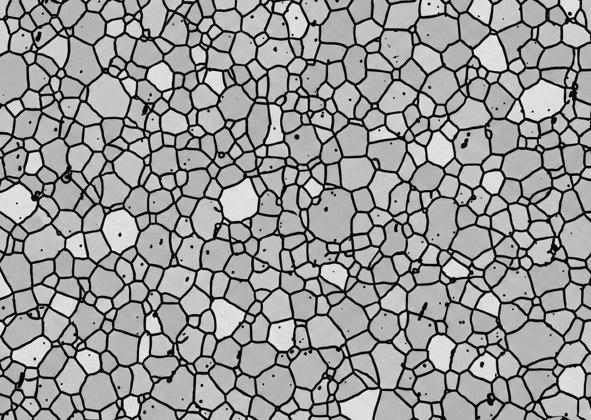
Even though grain boundaries are extremely thin (think: on the order of just a few atomic layers), they matter a lot because they behave like built-in internal surfaces. They tend to have higher energy than the inside of a grain, which makes them favored sites for things like segregation of impurities, precipitation of new phases, and in some environments the start of corrosion. They also commonly influence how cracks initiate and grow (many “intergranular” failures are literally “the crack ran along the grain boundaries”).
Mechanically, grain boundaries are famous for one big job: they impede dislocation motion. Dislocations are how metals plastically deform; when a dislocation glides and hits a grain boundary, it often can’t continue on the same slip plane into the next grain because the orientation changes. That “speed bump” effect is a major reason smaller grain size usually means higher strength (more boundaries per unit distance = more barriers).
Grain boundaries also act like fast highways for diffusion compared with the regular crystal lattice, because the atomic packing is less perfect and there are more “easy” pathways. That’s helpful in some processes (certain sintering and creep mechanisms), but it can also be a problem—because diffusion-driven changes and damage can localize along boundaries.
Not all grain boundaries are the same. Engineers often talk about low-angle boundaries (small misorientation) versus high-angle boundaries (large misorientation). A useful mental model is that a low-angle boundary can be approximated as a periodic array of dislocations accommodating the small mismatch, while high-angle boundaries are more structurally complex and tend to behave more like “general” interfaces.
In corrosion and heat-affected-zone behavior, grain boundaries show up in very practical ways. For example, in austenitic stainless steels, chromium carbides can precipitate at grain boundaries in a sensitizing temperature range, which can deplete chromium next to the boundary and set the stage for intergranular corrosion if the environment is right.