
Learning Hub
Glossary
Chromate Conversion Coating
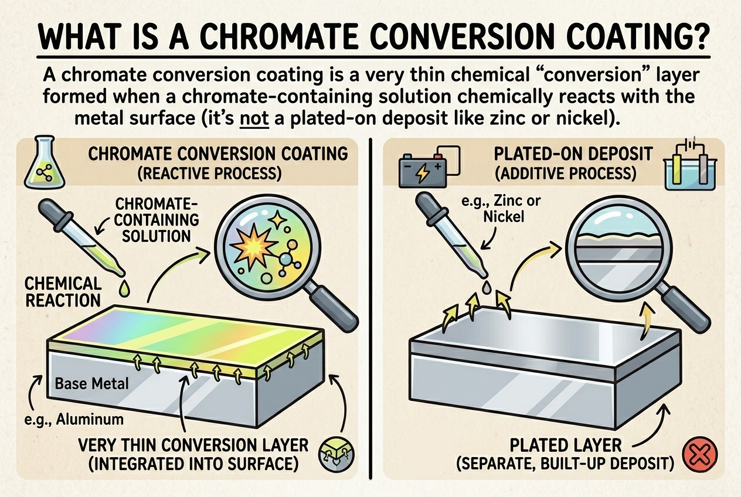
A chromate conversion coating is a very thin chemical “conversion” layer formed when a chromate-containing solution chemically reacts with the metal surface (it’s not a plated-on deposit like zinc or nickel). The purpose is typically corrosion resistance, improved paint/primer/adhesive adhesion, and—on some substrates/grades—maintaining low electrical contact resistance. On aluminum, this is exactly how ASTM B449 frames the intent: protection against corrosion, a base for other coatings, and low electrical contact impedance.
On aluminum and aluminum alloys, the common “spec language” comes from MIL-DTL-5541 and related documents. MIL-DTL-5541 defines two types: Type I (contains hexavalent chromium) and Type II (contains no hexavalent chromium). It also defines classes such as Class 1A (maximum corrosion protection; painted or unpainted) and Class 3 (intended where lower electrical resistance is required, generally at some corrosion-resistance tradeoff). NASA’s PRC-5005 (a process spec used at JSC) notes the real-world performance nuance: because of environmental concerns there’s effort to move to Type II, but Type I often outperforms Type II in certain corrosion tests, and it describes a key reason—hexavalent chromium can migrate to deep scratches and provide added protection (a “self-healing” style effect).
How it’s applied depends on the process and the part, but the basics are consistent: the surface must be clean and deoxidized, then the conversion solution is applied (often immersion, but also spray/wipe methods are used), followed by rinsing/drying as required by the process. ASTM B449 notes chromate solutions are typically acidic and may contain hexavalent chromium salts, and that coating appearance/performance are influenced by factors like pH, temperature, and treatment time.
On zinc-plated steel (very relevant in fasteners), a “chromate” is typically a supplementary conversion coating applied over the zinc to boost corrosion performance and change appearance. ASTM B633 classifies supplementary finishes including Type II (colored chromate) and Type III (colorless chromate conversion), and it also distinguishes passivates: for B633 purposes, a “passivate” on zinc shall not contain hexavalent chromium, and the standard was revised to address RoHS-driven reductions in toxic metals—adding non-hex chrome options (Types V and VI). B633 also flags that while it may be used for fasteners, ASTM F1941/F1941M are often more applicable for threaded fasteners.
AKA: Chem Film, Alodine
Hexavalent Chromate
A chemical treatment applied to zinc or cadmium-plated fasteners to improve corrosion resistance. This finish forms a protective layer that helps prevent white rust and slows corrosion near small scratches or around areas of minor damage. Hexavalent chromate coatings are effective but have environmental and health concerns, which is why alternatives like trivalent chromate are becoming more common.
Zinc Dichromate
Zinc dichromate is a type of plating finish applied to steel fasteners to provide corrosion resistance and a distinctive yellow-gold appearance. It is created by first electroplating the steel with a layer of zinc, then applying a dichromate conversion coating (a type of chromate passivation). This dual layer protects the base metal by slowing oxidation and offering sacrificial protection—meaning the zinc corrodes before the steel does.
Zinc dichromate is widely used because it provides better corrosion protection than plain zinc plating, while also giving fasteners a recognizable yellow or iridescent finish. However, because traditional dichromates contain hexavalent chromium (Cr6+), which is hazardous to health and the environment, many industries are phasing it out in favor of safer alternatives like trivalent chromates or zinc flake coatings.