
Learning Hub
Glossary
Fishplate
A fishplate—also called a rail joint bar—is a heavy steel bar used in railway track construction to mechanically join two sections of rail end-to-end. It is mounted on the sides of the rail web and bolted through matching holes in the rail ends, creating a structural joint that holds the rails in alignment while allowing the track to carry the extreme loads generated by passing trains.
A typical rail joint uses two fishplates, one on each side of the rail. The plates are clamped to the rail using high-strength rail bolts (such as track bolts or camrail bolts) and heavy hex nuts. When tightened, the bolts clamp the fishplates firmly against the rail web, forming a rigid assembly that maintains the horizontal alignment, vertical alignment, and load transfer between the two rail sections.
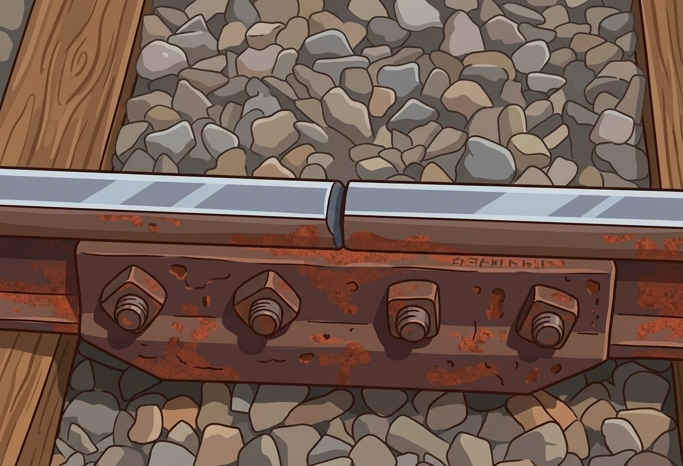
The name “fishplate” originates from the plate’s slightly curved or tapered profile, which historically resembled the shape of a fish. Early railway engineers also borrowed the term from mechanical engineering, where a “fish joint” described a reinforcing plate used to strengthen a connection between structural members.
From an engineering standpoint, the fishplate serves several important functions:
First, it transfers bending and shear forces across the rail joint. When a train wheel passes over a rail joint, the load must move smoothly from one rail to the next. The fishplates act as reinforcing members that help distribute these forces.
Second, it maintains precise rail alignment. Rails must stay accurately positioned to prevent derailment, so the fishplates hold the rail ends tightly in both the vertical and lateral directions.
Third, it allows for controlled movement due to thermal expansion. Unlike continuously welded rail (CWR), traditional jointed track systems include small gaps between rail ends to accommodate temperature changes. The fishplate joint keeps the rails aligned while allowing slight movement as the rails expand or contract.
Fishplates are typically manufactured from rolled high-strength carbon steel, often heat treated for durability and fatigue resistance. They are designed to match the specific rail profile being used (such as AREMA rail sections in North America), and the bolt holes are precisely spaced to align with the rail drilling pattern.
Although modern rail systems increasingly use continuously welded rail, fishplates remain widely used in yard track, industrial sidings, temporary track installations, and maintenance repairs. They are also essential during rail installation before welding operations are completed.
In essence, a fishplate is a structural rail connector that bridges the joint between two rail sections, ensuring load transfer, alignment, and mechanical stability in railway track systems.
AKA: Joint Bar, Spilce Bar